
Comment on the Bases of Power.
How the answer moves
The flow snapshot — the routes in, the body, the counter-view and the routes out.
Route 1 Bases = what power-holders control to shape behaviour → power is more than force
Route 2 Bases run visible → near-invisible → power rests on a widening set of supports
Three basic bases: force / influence / authority → forms: coercive, reward, legitimate, expert, referent → individual base: Dahl (“A over B”) + Weber (will despite resistance) = power over → structural bases: Marx (economic class controls state) → feminist (patriarchy, exclusion of women) → Foucault (institutions, knowledge, surveillance, normalisation → ideology/discourse = least visible base)
Arendt: “acting in concert” → collective, enabling base from civic participation, against power-as-domination
Route 1 Power rests on structure, knowledge and consent, not force alone
Route 2 Bases widen from coercion (visible) to ideology (invisible) → power is far broader than force
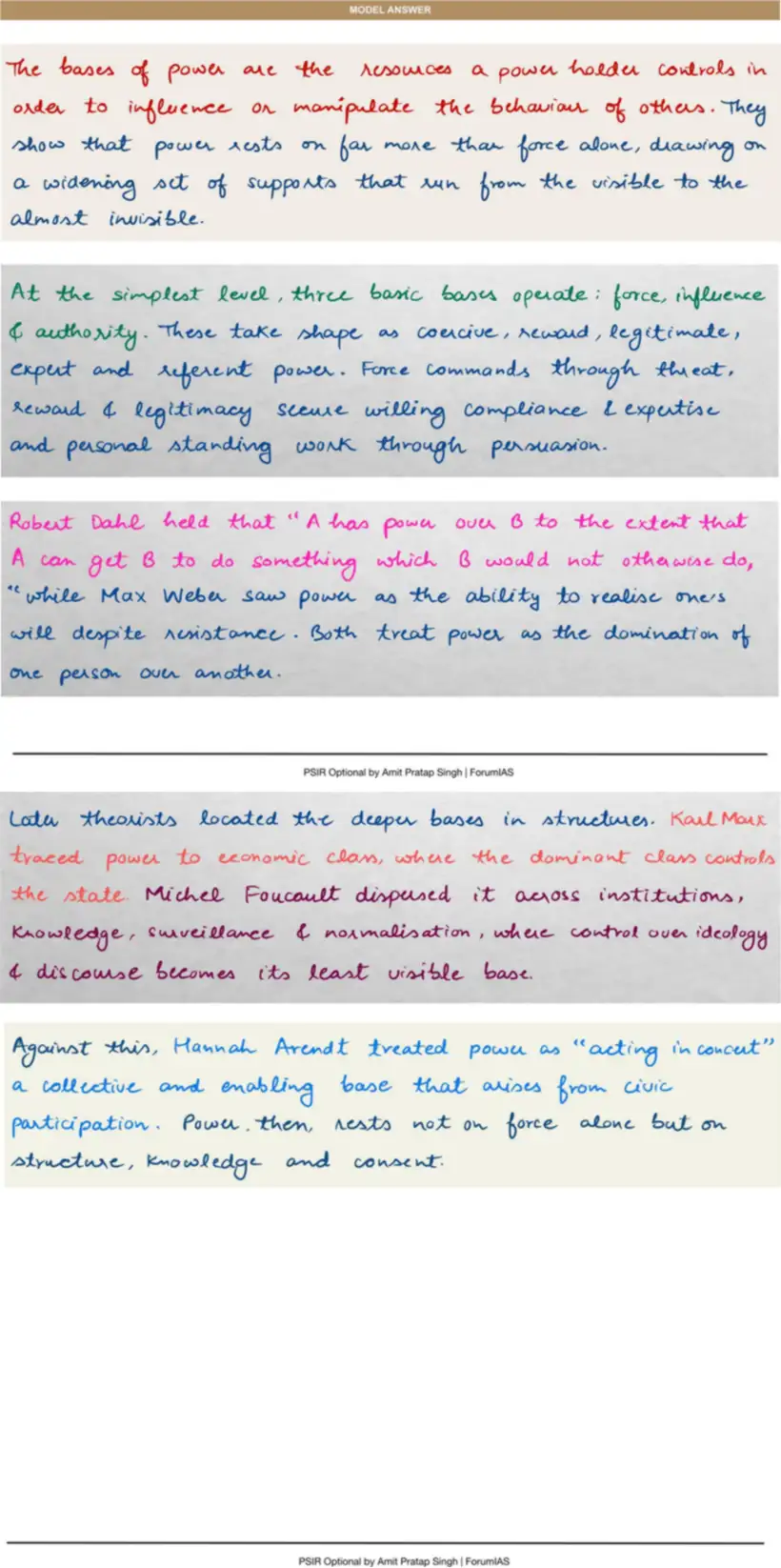
Model answer
Handwritten, in the form it would be written in the examination hall.
Also asked on this head
Power, Authority & Legitimacy — 10 questions in the Vault.
- Legitimacy is always a ‘social construct’. (150 words)
- Do you think that legitimacy acquired by consent or manufactured by indoctrination is an essential element in maintenance of political rule? Justify your answer with relevant...
- Explain Macpherson’s view on power.
How this is taught
The same flow snapshot, built for every head of the syllabus, with the answer written in class.
The first session of Foundation 2027 is published in full.
Six programmes across three levels.