
Examine the nature and meaning of power.
How the answer moves
The flow snapshot — the routes in, the body, the counter-view and the routes out.
Route 1 Power = central concept of politics (“money of economics”) → meaning settled, nature contested
Route 2 Lasswell: shaping & sharing of power → politics = acquisition / exercise / resistance → meaning vs nature
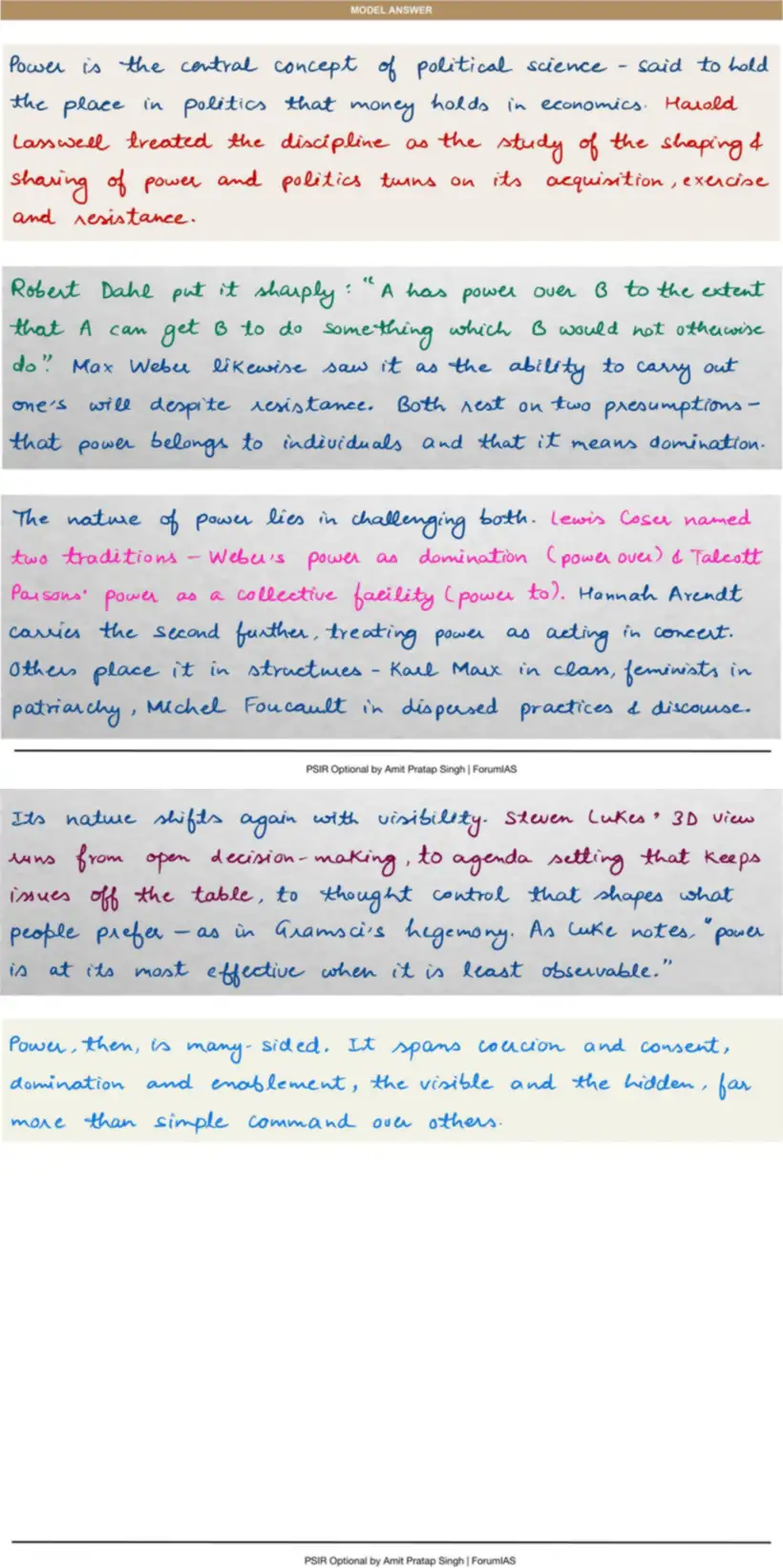
Meaning = capacity to produce intended effects → Dahl + Weber (“power over”) → two presumptions: individual + domination → nature challenges both → Coser’s two traditions (Weber domination / Parsons facility) → Arendt: acting in concert, enabling → structural loci: Marx (class) / feminists (patriarchy) / Foucault (discourse) → Lukes’ three dimensions: decision-making → agenda-setting → thought-control (Gramsci hegemony) → least observable
Against the Dahl-Weber individual-and-domination reading: power as collective and enabling (Arendt), as structural (Marx, feminist, Foucault), and as hidden/ideological (Lukes, Gramsci)
Route 1 Power is many-sided: “over” and “to”, visible and hidden — more than command
Route 2 Meaning stable (capacity for effects); nature plural and contested across agent, locus and visibility
Model answer
Handwritten, in the form it would be written in the examination hall.
Also asked on this head
Power, Authority & Legitimacy — 10 questions in the Vault.
- Legitimacy is always a ‘social construct’. (150 words)
- Do you think that legitimacy acquired by consent or manufactured by indoctrination is an essential element in maintenance of political rule? Justify your answer with relevant...
- Explain Macpherson’s view on power.
How this is taught
The same flow snapshot, built for every head of the syllabus, with the answer written in class.
The first session of Foundation 2027 is published in full.
Six programmes across three levels.