
Explain the relationship between power, authority and legitimacy.
How the answer moves
The flow snapshot — the routes in, the body, the counter-view and the routes out.
Route 1 Three not separate but one continuum → Authority = Power + Legitimacy
Route 2 Power = the fact of acting → authority = that fact accepted → legitimacy = the reason for acceptance
Power is broadest (MacIver: command of compliance / Weber: will despite resistance) → may rest on force, coercion, reward, manipulation → force alone produces fear, not authority → legitimacy = rightfulness, belief of the governed → converts naked power into rightful authority (Rousseau: strength into right, obedience into duty) → authority = power + willing obedience from duty → Weber’s three types (traditional / charismatic / legal-rational) ground rightful rule → analytically distinct but practically intertwined → legitimacy lowers the cost of rule
Habermas: the process of legitimation matters → consent can be manufactured in capitalist democracies through party systems and welfare reforms
Route 1 All three indispensable → where legitimacy fails, authority decays back into naked force
Route 2 Power becomes stable authority only when clothed in legitimacy → a continuum, not separate compartments
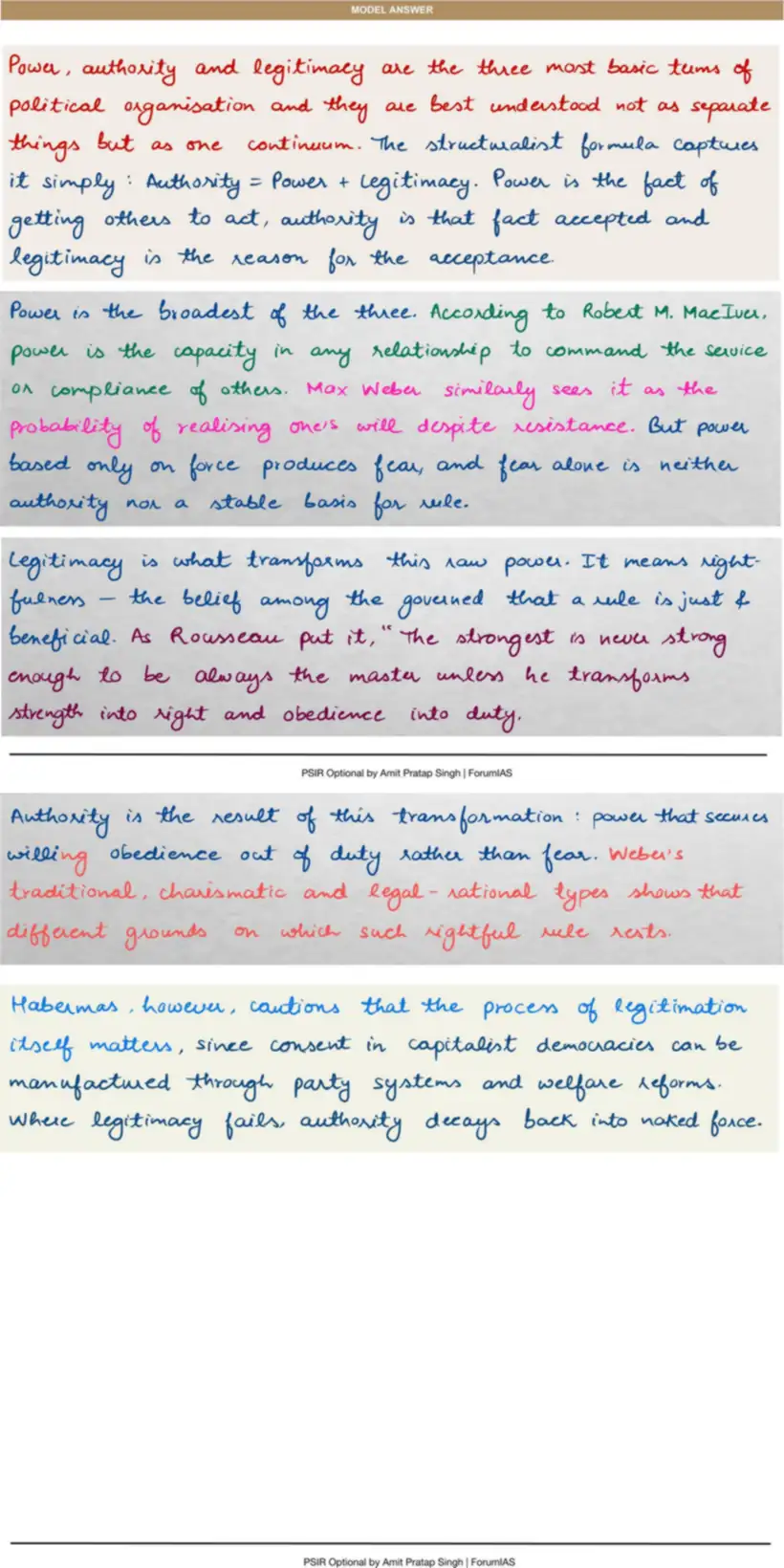
Model answer
Handwritten, in the form it would be written in the examination hall.
Also asked on this head
Power, Authority & Legitimacy — 10 questions in the Vault.
- Legitimacy is always a ‘social construct’. (150 words)
- Do you think that legitimacy acquired by consent or manufactured by indoctrination is an essential element in maintenance of political rule? Justify your answer with relevant...
- Explain Macpherson’s view on power.
How this is taught
The same flow snapshot, built for every head of the syllabus, with the answer written in class.
The first session of Foundation 2027 is published in full.
Six programmes across three levels.