
Explain Macpherson’s view on power.
How the answer moves
The flow snapshot — the routes in, the body, the counter-view and the routes out.
Route 1 Power located in liberalism’s own foundations, not command over others → possessive individualism as starting point
Route 2 Individual as self-owner → freedom tied to property → limited liberal freedom, sets up the argument
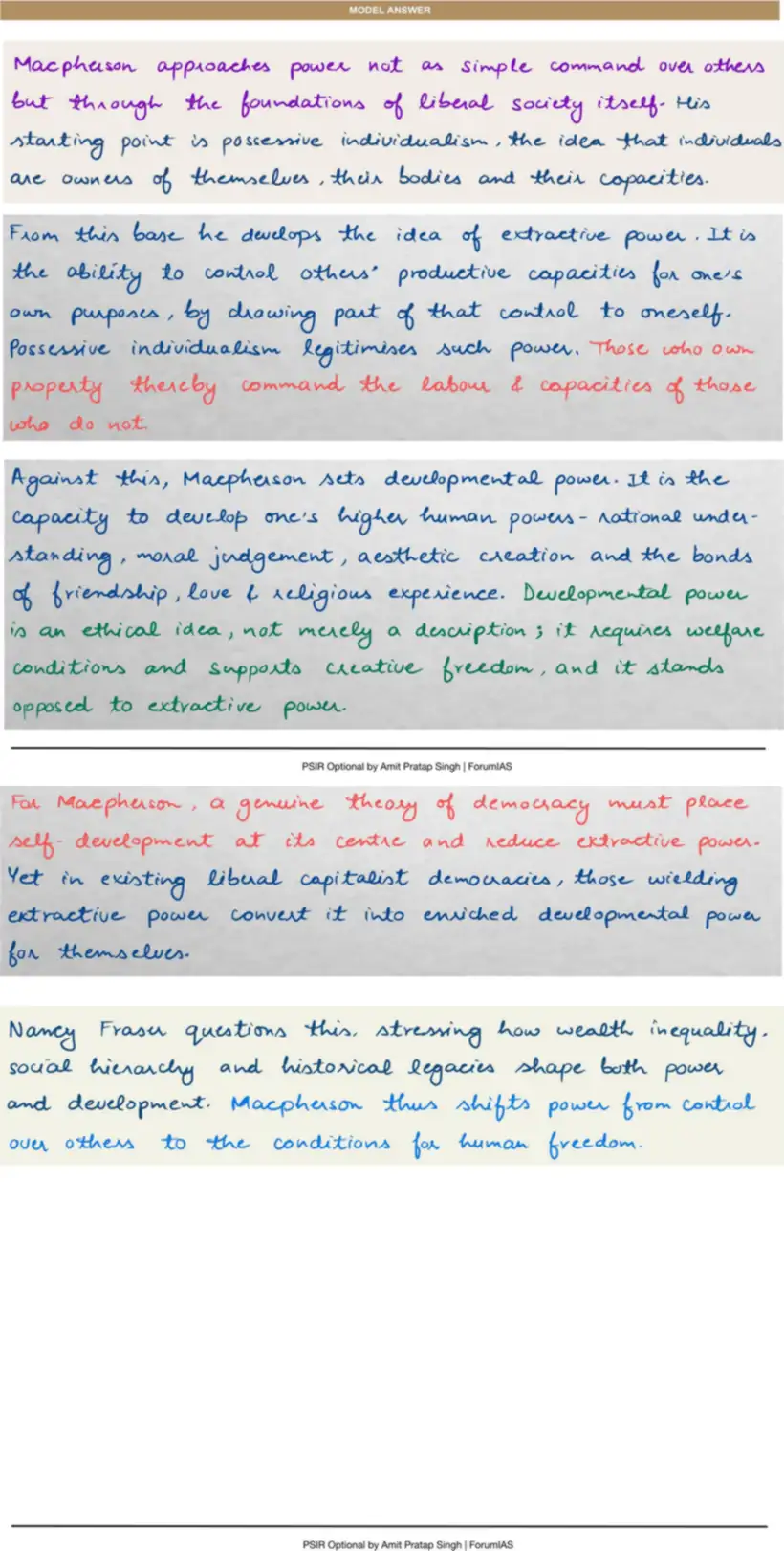
Possessive individualism (self-ownership, freedom = property, state guards property/market) → extractive power (control of others’ productive capacities; legitimised by possessive individualism; capitalist-market inequality; owners command non-owners) → developmental power (higher human capacities; ethical, not descriptive; needs welfare; opposes extractive) → real democracy must centre self-development + cut extractive power → but liberal capitalist democracies let the powerful convert extractive into their own developmental power
Nancy Fraser → wealth inequality + social hierarchy + historical legacies shape power and development (checks Macpherson’s optimism)
Route 1 Power redefined: from control over others → conditions for human self-development
Route 2 Genuine democracy = maximising developmental power, minimising extractive power
Model answer
Handwritten, in the form it would be written in the examination hall.
Also asked on this head
Power, Authority & Legitimacy — 10 questions in the Vault.
- Legitimacy is always a ‘social construct’. (150 words)
- Do you think that legitimacy acquired by consent or manufactured by indoctrination is an essential element in maintenance of political rule? Justify your answer with relevant...
- Legitimacy adds positive value to political authority and obligation. Discuss.
How this is taught
The same flow snapshot, built for every head of the syllabus, with the answer written in class.
The first session of Foundation 2027 is published in full.
Six programmes across three levels.