
Legitimacy adds positive value to political authority and obligation. Discuss.
How the answer moves
The flow snapshot — the routes in, the body, the counter-view and the routes out.
Route 1 Legitimacy = rightfulness → transforms naked power into rightful authority → this transformation is the positive value (to authority + obligation)
Route 2 Power merely obeyed vs power accepted as right → legitimacy turns the first into the second → strengthens both ruler’s authority and citizens’ obligation
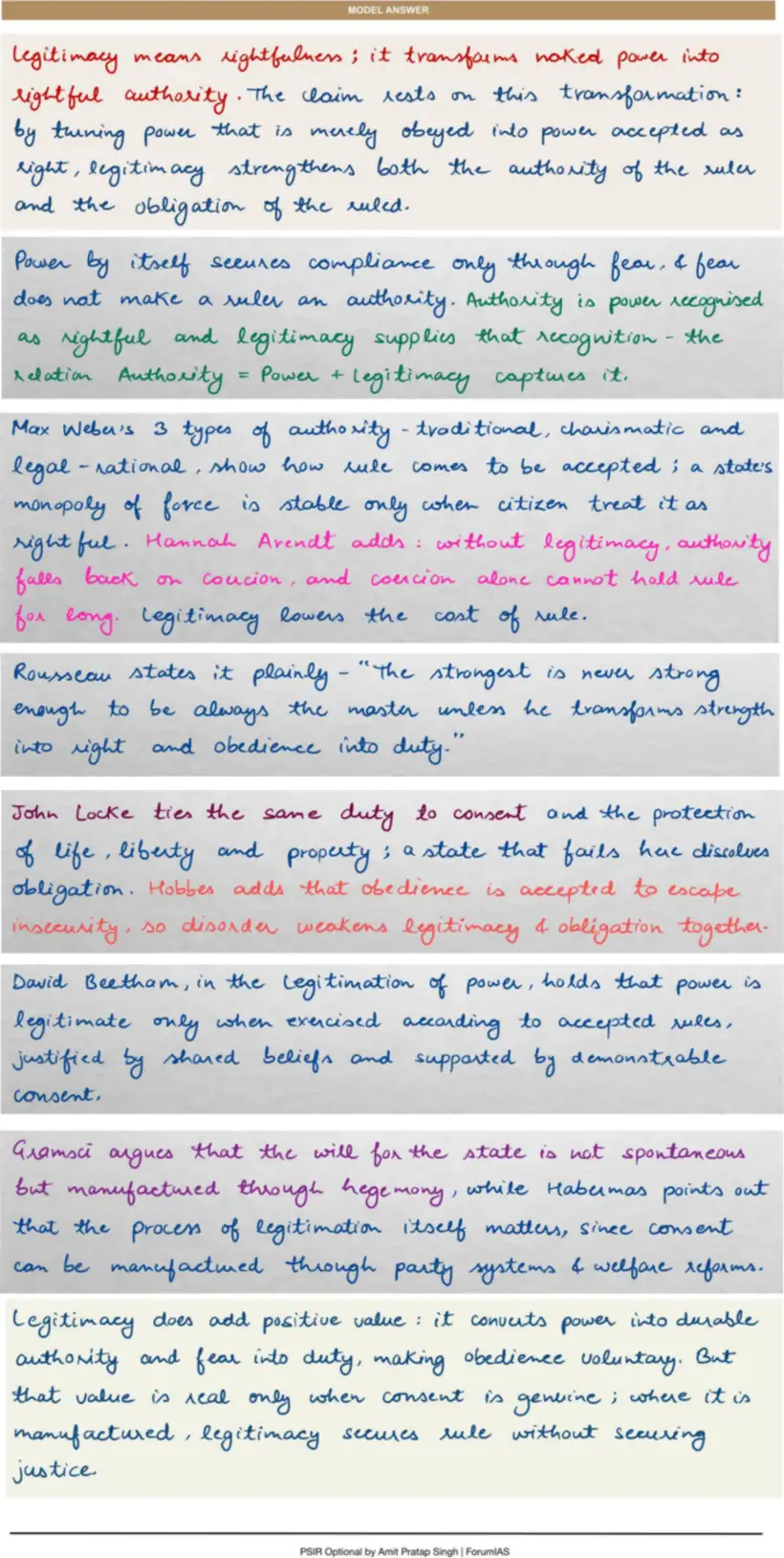
Value to authority: fear-based power ≠ authority → Authority = Power + Legitimacy → Weber’s three types (rule becomes accepted) → state’s monopoly stable only if treated as rightful → Arendt (no legitimacy → coercion → cannot last) → legitimacy lowers cost of rule → value to obligation: duty to obey → ground shifts from fear/punishment to “just & fair” → Rousseau (strength → right, obedience → duty) → Locke (consent + life/liberty/property; failure dissolves obligation) → Hobbes (obey to escape insecurity; disorder weakens both) → condition: Beetham (rules + shared beliefs + consent)
Radical tradition: is the value truly positive? → Gramsci (will for state manufactured via hegemony, not spontaneous) → Habermas (process of legitimation matters; consent manufactured via party systems, welfare) → legitimacy may stabilise without justifying
Route 1 Yes, positive value: power → durable authority, fear → duty, obedience voluntary
Route 2 Value genuine only with real consent → manufactured legitimacy secures rule without securing justice
Model answer
Handwritten, in the form it would be written in the examination hall.
Also asked on this head
Power, Authority & Legitimacy — 10 questions in the Vault.
- Legitimacy is always a ‘social construct’. (150 words)
- Do you think that legitimacy acquired by consent or manufactured by indoctrination is an essential element in maintenance of political rule? Justify your answer with relevant...
- Explain Macpherson’s view on power.
How this is taught
The same flow snapshot, built for every head of the syllabus, with the answer written in class.
The first session of Foundation 2027 is published in full.
Six programmes across three levels.