
Describe the changing nature of the State in the developing societies in the context of inclusive growth in the 21st century.
How the answer moves
The flow snapshot — the routes in, the body, the counter-view and the routes out.
Route 1 developing State = apparatus inherited from colonial rule → early form concentrated growth, ill-suited to inclusion
Route 2 nature has since shifted → from a structure that monopolised development → to one built for inclusive growth
Myrdal’s soft state: no social discipline, spares the rich → non-inclusive → Riggs’s prismatic society / bazaar-canteen favours the wealthy, family-community monopolise development → Alavi’s overdeveloped state atop a transitional socio-economic base → shift from state-led development → market reforms (India’s mixed-market model; China’s capitalist economy under a socialist polity) → globalization aggravates inequality (99% vs 1%, social unrest) → 21st-century inclusion turn: participative culture, ICT / JAM-Jan Dhan; RTI strengthens the political arena; welfare + affirmative action → structural change → developmental-state debate: inclusive growth rests on state capacity to penetrate society (East Asia)
market-led globalization deepened inequality; the soft / overdeveloped state’s incapacity to discipline elites limits how far the inclusion turn can reach
Route 1 nature moved from a soft, elite-shielding apparatus → an active enabler of inclusion
Route 2 the inclusion turn is real but conditional → holds only where the State can discipline the powerful / build developmental capacity
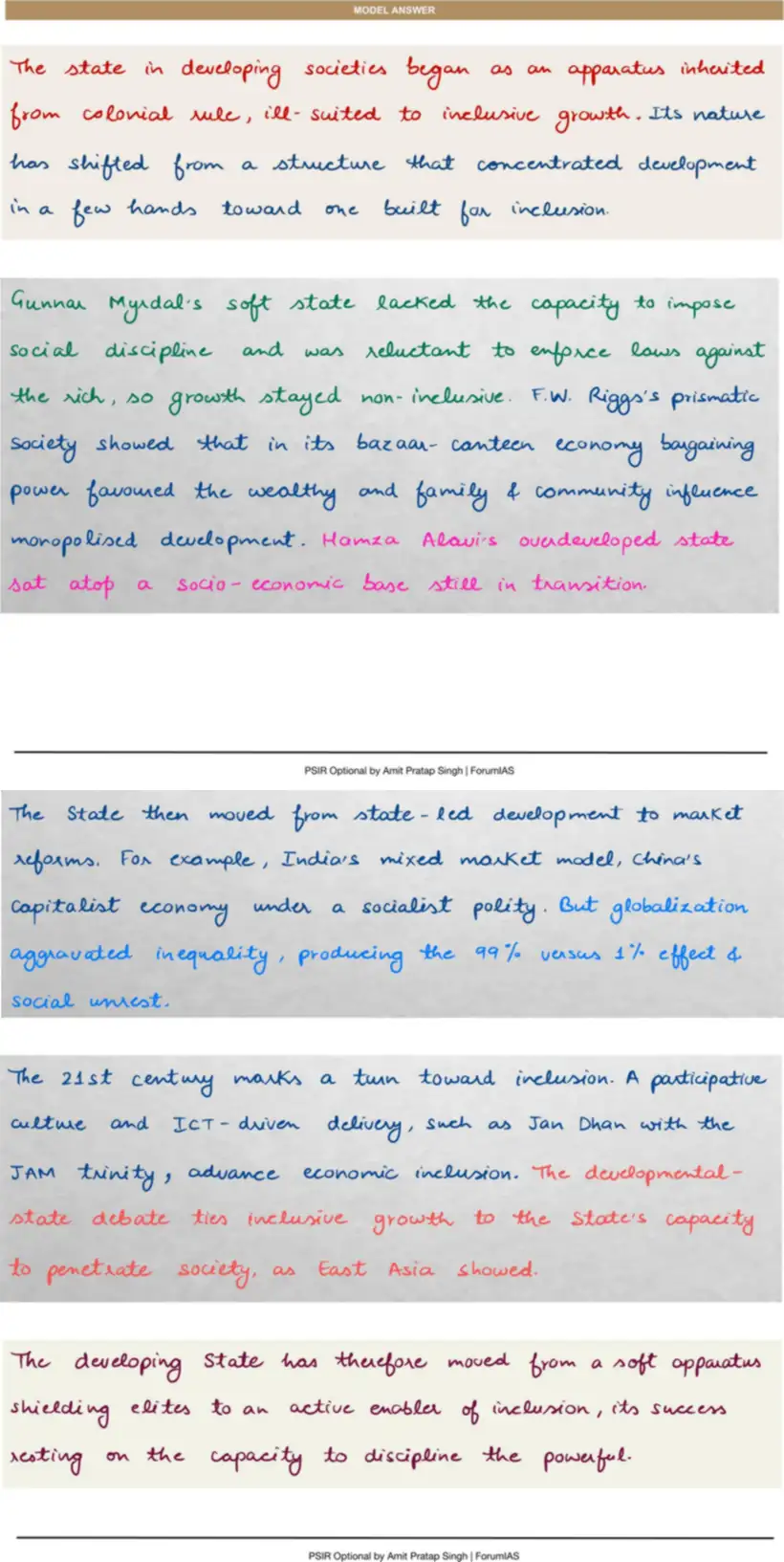
Model answer
Handwritten, in the form it would be written in the examination hall.
Also asked on this head
State in Comparative Perspective — 6 questions in the Vault.
- Discuss the factors responsible for the changing nature of states in contemporary industrial societies and explain its impact.
- What are the distinctive features of the post-modern state in the advanced capitalist economies? Analyse.
- What are the difficulties faced by a political theorist in comparing the States?
How this is taught
The same flow snapshot, built for every head of the syllabus, with the answer written in class.
The first session of Foundation 2027 is published in full.
Six programmes across three levels.