
Do you subscribe to the view that the modern constructs of the state and politics are pre-eminently Euro-Centric and not indigenous and appropriate for the analysis of non-western societies?
How the answer moves
The flow snapshot — the routes in, the body, the counter-view and the routes out.
Route 1 qualified yes → modern state a European, Westphalian creation → imported onto a pre-modern base
Route 2 state and politics as Western categories → misfire outside the West → but reworked, not junked
European state: sovereignty, monopoly of violence, Westphalia → imported institution / Alavi’s overdeveloped state, no indigenous bourgeoisie → modernization theory charged with Eurocentrism → borrowed categories fail locally / Riggs’s prismatic society: form vs practice → West on rule of law, developing societies on identity → Pye’s communal, loyalty-based process → Kothari: caste as the axis of mobilisation
the same scholarship reworks the categories rather than discarding them → Chandhoke against universal models, for the specificity of colonial history → vocabulary can travel once adjusted
Route 1 Euro-centric in origin, misleading if applied mechanically
Route 2 serviceable once indigenised, not to be abandoned
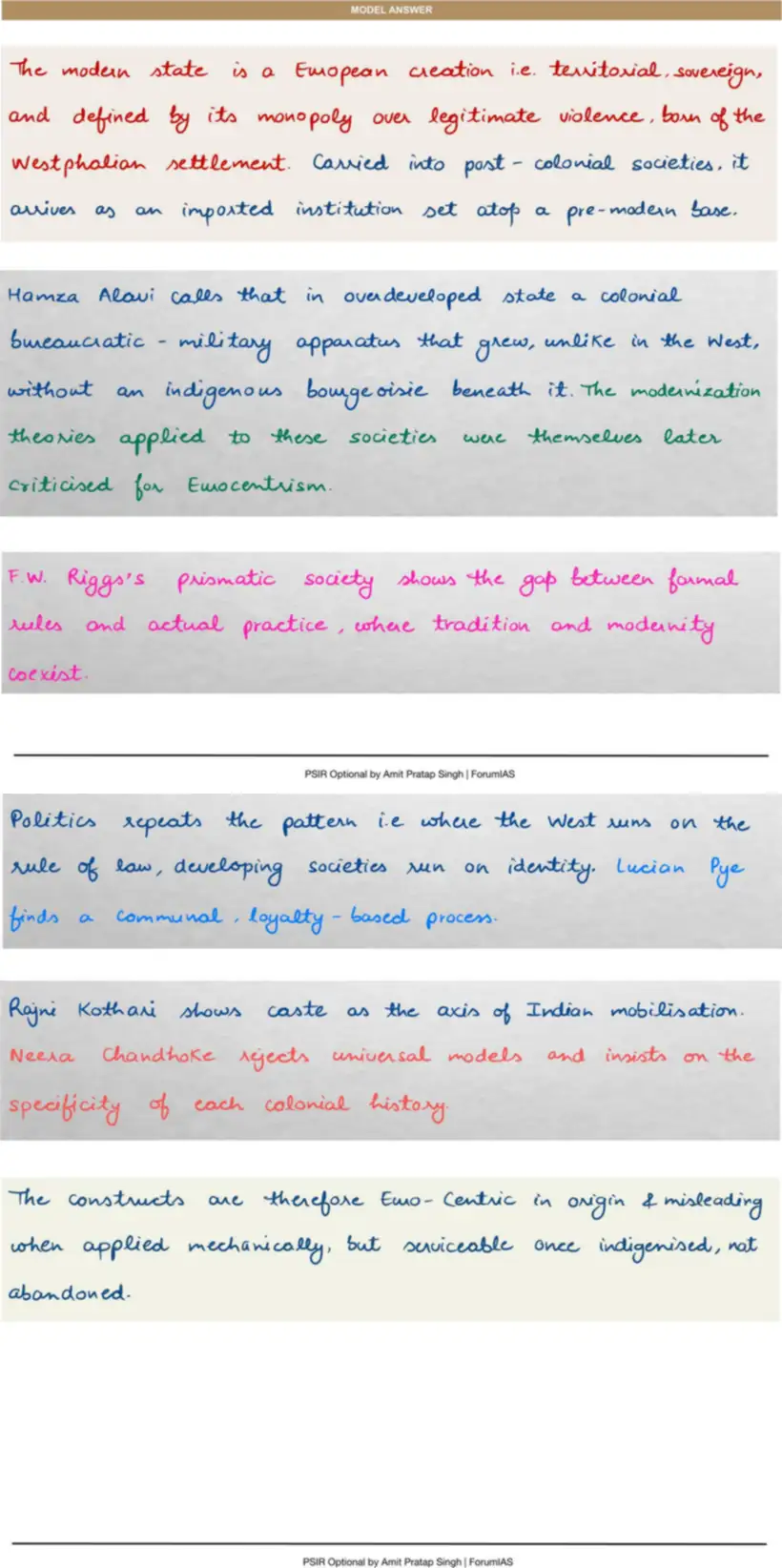
Model answer
Handwritten, in the form it would be written in the examination hall.
Also asked on this head
State in Comparative Perspective — 6 questions in the Vault.
- Discuss the factors responsible for the changing nature of states in contemporary industrial societies and explain its impact.
- What are the distinctive features of the post-modern state in the advanced capitalist economies? Analyse.
- What are the difficulties faced by a political theorist in comparing the States?
How this is taught
The same flow snapshot, built for every head of the syllabus, with the answer written in class.
The first session of Foundation 2027 is published in full.
Six programmes across three levels.