
“The post-colonial state was thought of an entity that stood outside and above society as an autonomous agency. Explain.
How the answer moves
The flow snapshot — the routes in, the body, the counter-view and the routes out.
Route 1 state an imported institution, not organic growth → read as standing outside / above society, self-directing → but appearance only; autonomy relative
Route 2 received view: post-colonial state autonomous, above society → claim to be tested → thesis: real as appearance, relative in fact
weak civil society → state as transformation engine, looms above → Alavi’s overdeveloped state: colonial-built over-powerful apparatus, developed machinery on a transitional base → imported on pre-modern society = “outside” → mediates among indigenous bourgeoisie, landed classes, metropolitan capital → captured by none = relative autonomy = “above” → Poulantzas: class equilibrium, long-term dominant-class interests
autonomy never absolute → Shivji & Saul: bureaucracy itself a dominant class → state a class instrument within society, not above → external limit: neo-colonialism + Wallerstein’s world-systems → complete autonomy denied
Route 1 image = appearance, not full reality → autonomy real but relative (colonial inheritance + class balance)
Route 2 genuine autonomy needs self-reliant development → India the exception: democracy with development
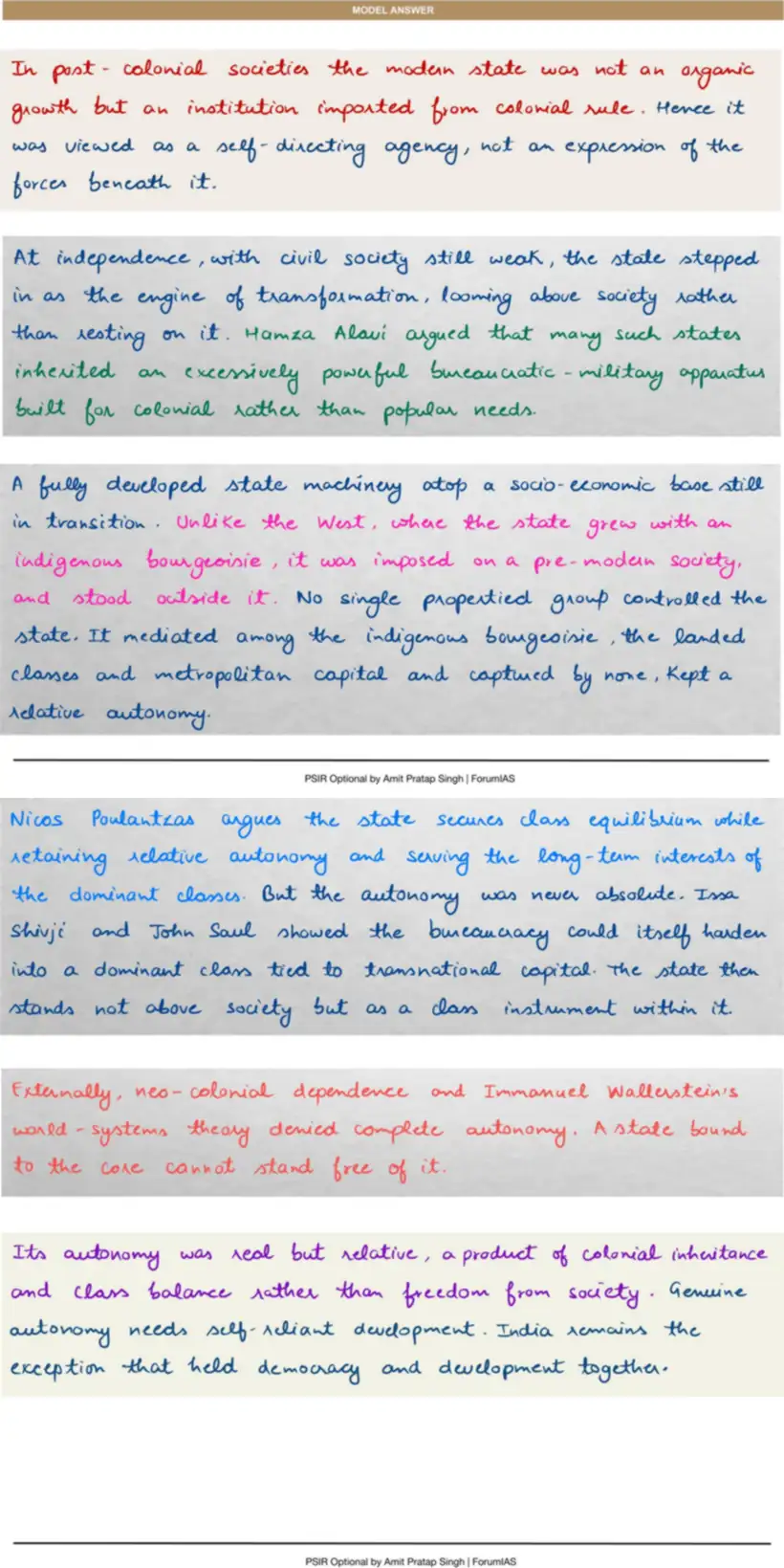
Model answer
Handwritten, in the form it would be written in the examination hall.
Also asked on this head
State in Comparative Perspective — 6 questions in the Vault.
- Discuss the factors responsible for the changing nature of states in contemporary industrial societies and explain its impact.
- What are the distinctive features of the post-modern state in the advanced capitalist economies? Analyse.
- What are the difficulties faced by a political theorist in comparing the States?
How this is taught
The same flow snapshot, built for every head of the syllabus, with the answer written in class.
The first session of Foundation 2027 is published in full.
Six programmes across three levels.