
What are the difficulties faced by a political theorist in comparing the States?
How the answer moves
The flow snapshot — the routes in, the body, the counter-view and the routes out.
Route 1 comparison assumes like units on a common scale → States are not like units → theorist meets variety, context, bias
Route 2 States differ in kind, not just degree → any yardstick carries the theorist’s own assumptions
wide variation, democracies to authoritarian → Lijphart, Patterns of Democracy → universal criterion elusive → unique cultural / historical context → developed grew organically vs developing inherited imposed colonial institutions + patronage → developmental gap (US vs India) breaks like-for-like → indicator choice (GDP, human-rights) drives result → researcher bias, tilt toward Western models → dynamism, analyses date fast → endogeneity + uneven data
interpretation itself contested → Fukuyama “End of History” vs Huntington “Clash of Civilizations” → same world, opposite readings
Route 1 comparison possible but never neutral → chosen measure shapes the verdict
Route 2 theorist must stay self-aware → name the yardstick and its bias rather than claim neutrality
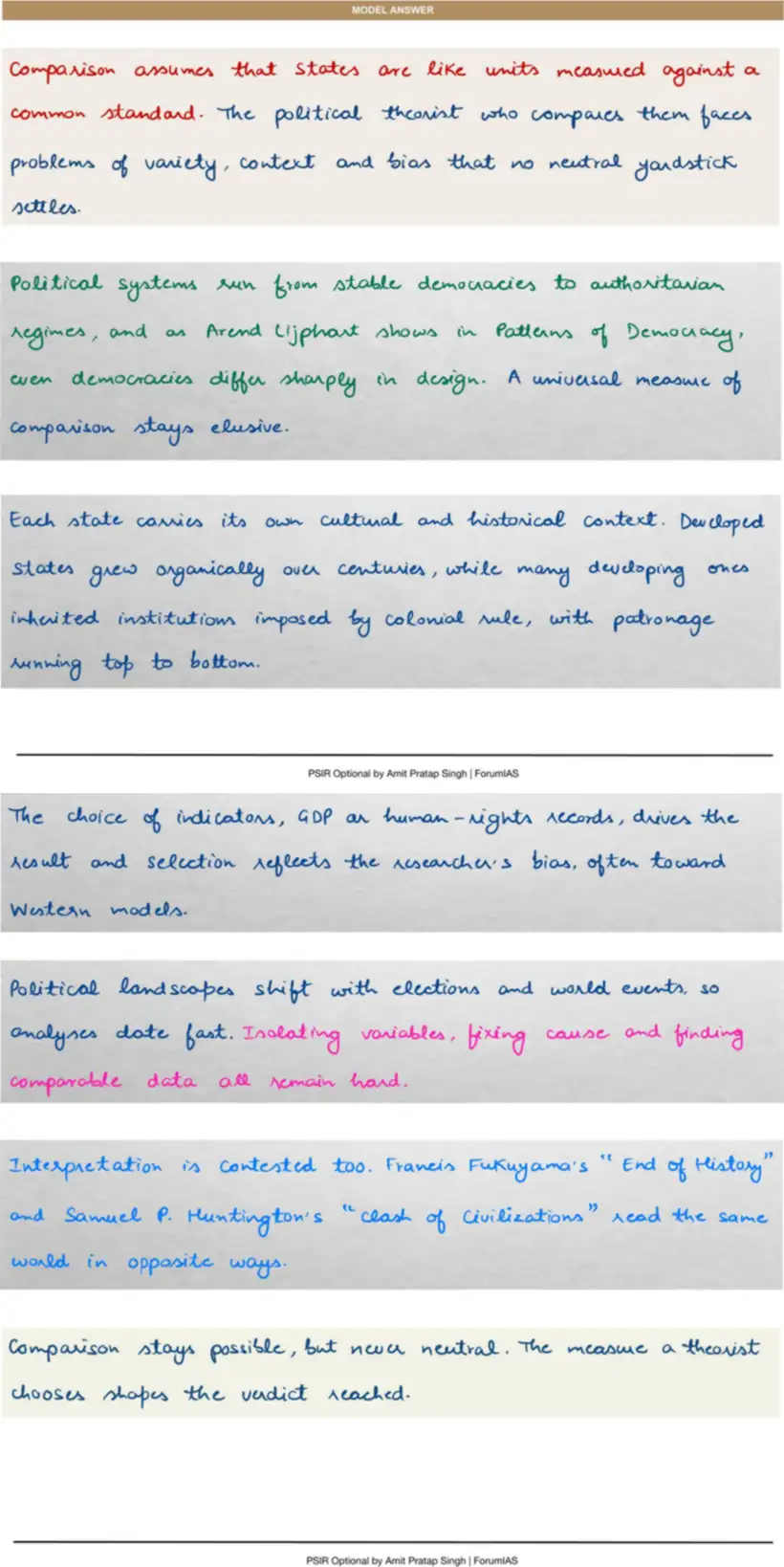
Model answer
Handwritten, in the form it would be written in the examination hall.
Also asked on this head
State in Comparative Perspective — 6 questions in the Vault.
- Discuss the factors responsible for the changing nature of states in contemporary industrial societies and explain its impact.
- What are the distinctive features of the post-modern state in the advanced capitalist economies? Analyse.
- “The post-colonial state was thought of an entity that stood outside and above society as an autonomous agency. Explain.
How this is taught
The same flow snapshot, built for every head of the syllabus, with the answer written in class.
The first session of Foundation 2027 is published in full.
Six programmes across three levels.