
What are the distinctive features of the post-modern state in the advanced capitalist economies? Analyse.
How the answer moves
The flow snapshot — the routes in, the body, the counter-view and the routes out.
Route 1 centralised modern state → decentralised, flexible, fragmented order → authority dispersed + reshaped, not removed
Route 2 drivers: globalization + technology + cultural pluralism → state commands less, coordinates more
sovereignty erodes (EU, WTO, MNC networks) → Held: cosmopolitan democracy + multilevel governance (authority moves up / out) → Jessop: hollowed-out state, functions outsourced to firms / NGOs / local govt via privatisation-deregulation-PPP (authority moves down) → identity fragments: Foucault + Butler (race, gender, sexuality) → Fraser: redistribution balanced with recognition → power changes form: Deleuze society of control (surveillance + data as rule) → governance provisional: Bauman liquid modernity (crisis management over long-term planning)
“state retreats / loses relevance under globalization” reading → state persists, reshaped as coordinator
Route 1 state = less a central authority, more a mediator among globalization, identity, technology
Route 2 its power survives only by managing actors it can no longer command alone
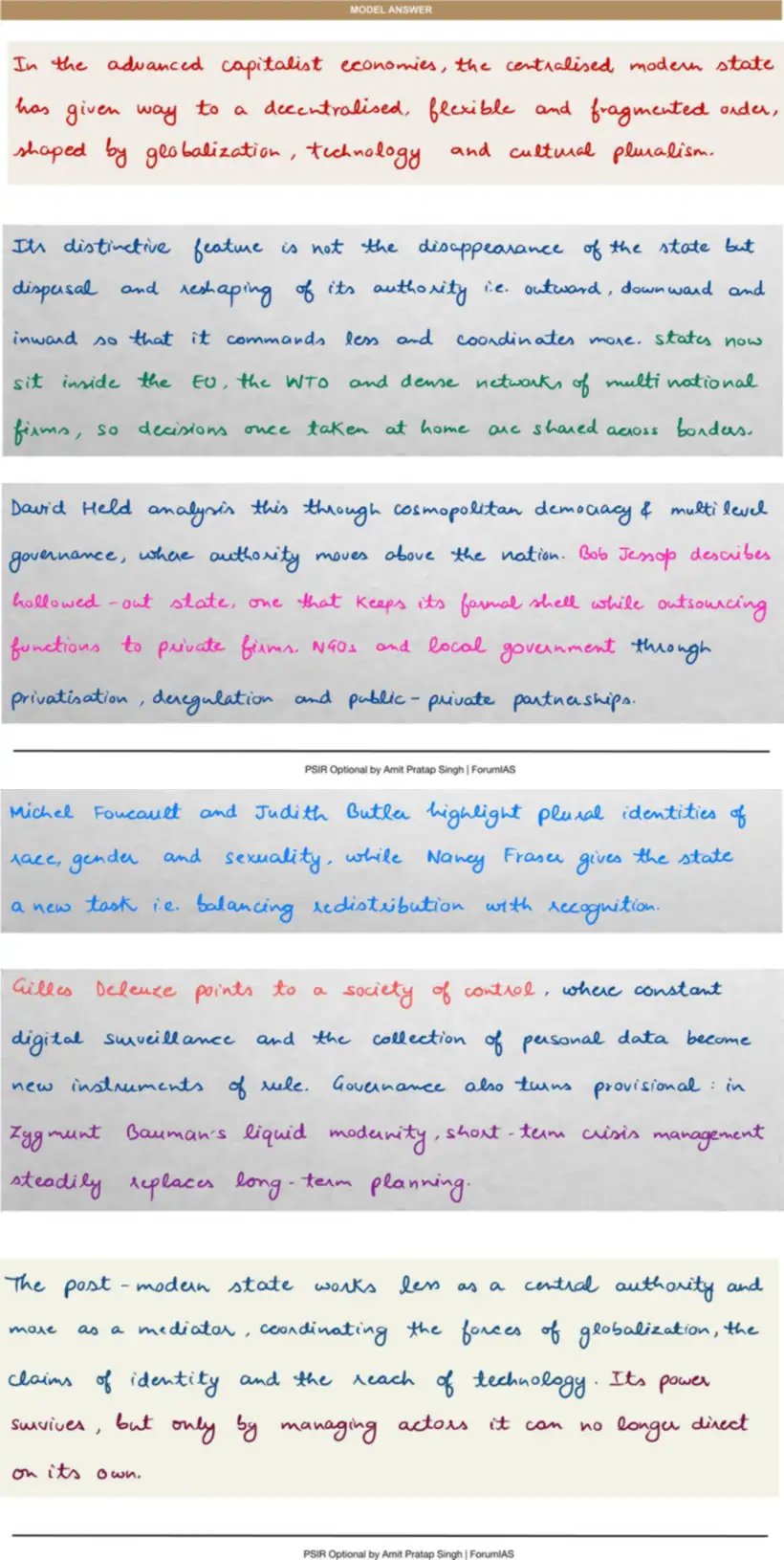
Model answer
Handwritten, in the form it would be written in the examination hall.
Also asked on this head
State in Comparative Perspective — 6 questions in the Vault.
- Discuss the factors responsible for the changing nature of states in contemporary industrial societies and explain its impact.
- What are the difficulties faced by a political theorist in comparing the States?
- “The post-colonial state was thought of an entity that stood outside and above society as an autonomous agency. Explain.
How this is taught
The same flow snapshot, built for every head of the syllabus, with the answer written in class.
The first session of Foundation 2027 is published in full.
Six programmes across three levels.