
Describe the composition of the International Court of Justice (ICJ). Discuss its voluntary jurisdiction.
How the answer moves
The flow snapshot — the routes in, the body, the counter-view and the routes out.
Route 1 principal judicial organ, 1945, The Hague → bench built to represent the world → jurisdiction reaches only as far as states allow
Route 2 composition is universal, jurisdiction is consensual → the Court’s reach is fixed by states, not by its bench
fifteen judges / no two from same state / nine years / elected by General Assembly + Security Council voting separately / five seats every three years → bench must represent principal legal systems + main forms of civilization → hence the claim to speak for international society → but no compulsory jurisdiction → consent routes: party to the Statute / acceptance under conditions / referral → two heads: contentious (states) + advisory (UN organs, specialised agencies) → within consent the grip is firm: final, binding, no appeal → Kulbhushan Jadhav order to Pakistan
the same consent is the weakness → states may refuse jurisdiction → enforcement runs through the UNSC, permanent member can veto → US and Israel non-compliance → Prabhash Ranjan: over Ukraine, Russia can veto enforcement against itself
Route 1 consent loosens the grip exactly where the stakes are highest → still the archetype of international adjudication
Route 2 representative bench + consensual jurisdiction → the most far-reaching attempt yet to apply the rule of law between states
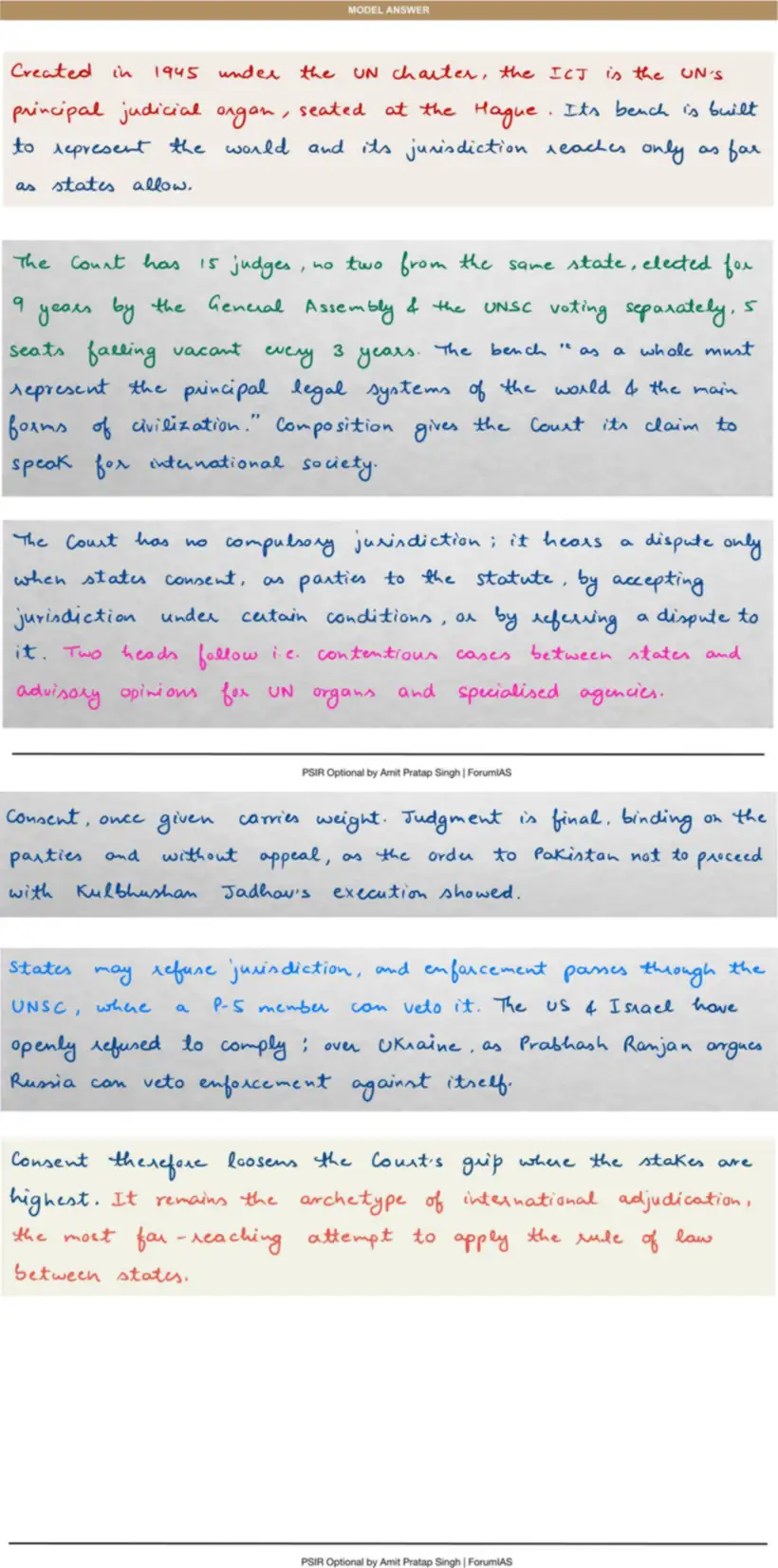
Model answer
Handwritten, in the form it would be written in the examination hall.
Also asked on this head
United Nations — 12 questions in the Vault.
- What is UNCLOS? Explain its salient features.
- What is the structure and functions of International Court of Justice? (150 words)
- Discuss the structure and functions of UN Security Council.
How this is taught
The same flow snapshot, built for every head of the syllabus, with the answer written in class.
The first session of Foundation 2027 is published in full.
Six programmes across three levels.