
Discuss the relevance of UN Security Council Resolution 1325 on the security of women in conflict zones.
How the answer moves
The flow snapshot — the routes in, the body, the counter-view and the routes out.
Route 1 31 Oct 2000, adopted unanimously → first time women’s safety in war treated as international peace and security, not welfare → line: relevance = the standard it set, not the protection delivered
Route 2 security once written around states and soldiers → 1325 shifted the referent to women in conflict → same line: it is a norm, not an enforcement instrument
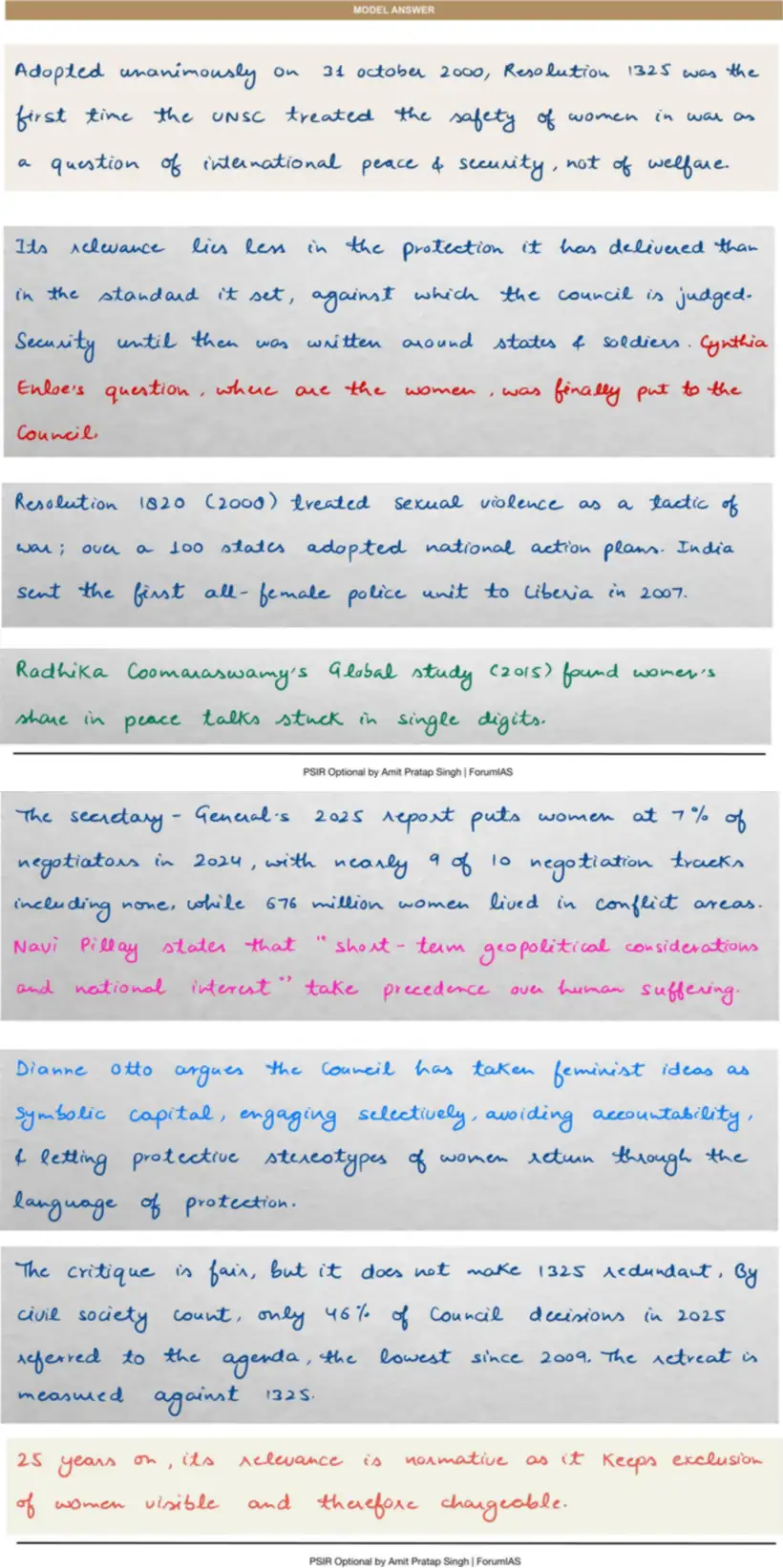
Enloe’s “where are the women?” finally put to the Council → four pillars: participation, protection, prevention, relief and recovery → women as peacemakers, not only victims → architecture built: 1820 (2008) sexual violence as tactic of war; 100+ national action plans; India’s all-female FPU, Liberia 2007 → ground record thin: Coomaraswamy’s Global Study — single digits in peace talks → SG’s 2025 report: 7% negotiators, nine of ten tracks with none; 676 million women in conflict areas → Afghanistan, Sudan, Gaza → no enforcement → Pillay: geopolitics beats suffering
Otto: feminist ideas absorbed as the Council’s symbolic capital → selective engagement, no accountability, protective stereotypes returning through the language of protection
Route 1 critique holds, but 1325 not redundant → 46% of Council decisions (2025), lowest since 2009 → that retreat is itself measured against 1325 → relevance is normative, and rises as compliance falls
Route 2 25 years on, 1325’s power lies in naming, not enforcing → it made women’s exclusion visible, and so chargeable → the resolution outlives its own weak record
Model answer
Handwritten, in the form it would be written in the examination hall.
Also asked on this head
United Nations — 12 questions in the Vault.
- What is UNCLOS? Explain its salient features.
- What is the structure and functions of International Court of Justice? (150 words)
- Discuss the structure and functions of UN Security Council.
How this is taught
The same flow snapshot, built for every head of the syllabus, with the answer written in class.
The first session of Foundation 2027 is published in full.
Six programmes across three levels.