
Discuss the structure and functions of UN Security Council.
How the answer moves
The flow snapshot — the routes in, the body, the counter-view and the routes out.
Route 1 Charter’s primary responsibility for peace and security → only organ whose decisions bind → but structure decides when those powers can be used
Route 2 composition settled in 1945, veto sitting inside it → structure and functions are not two lists but one relation
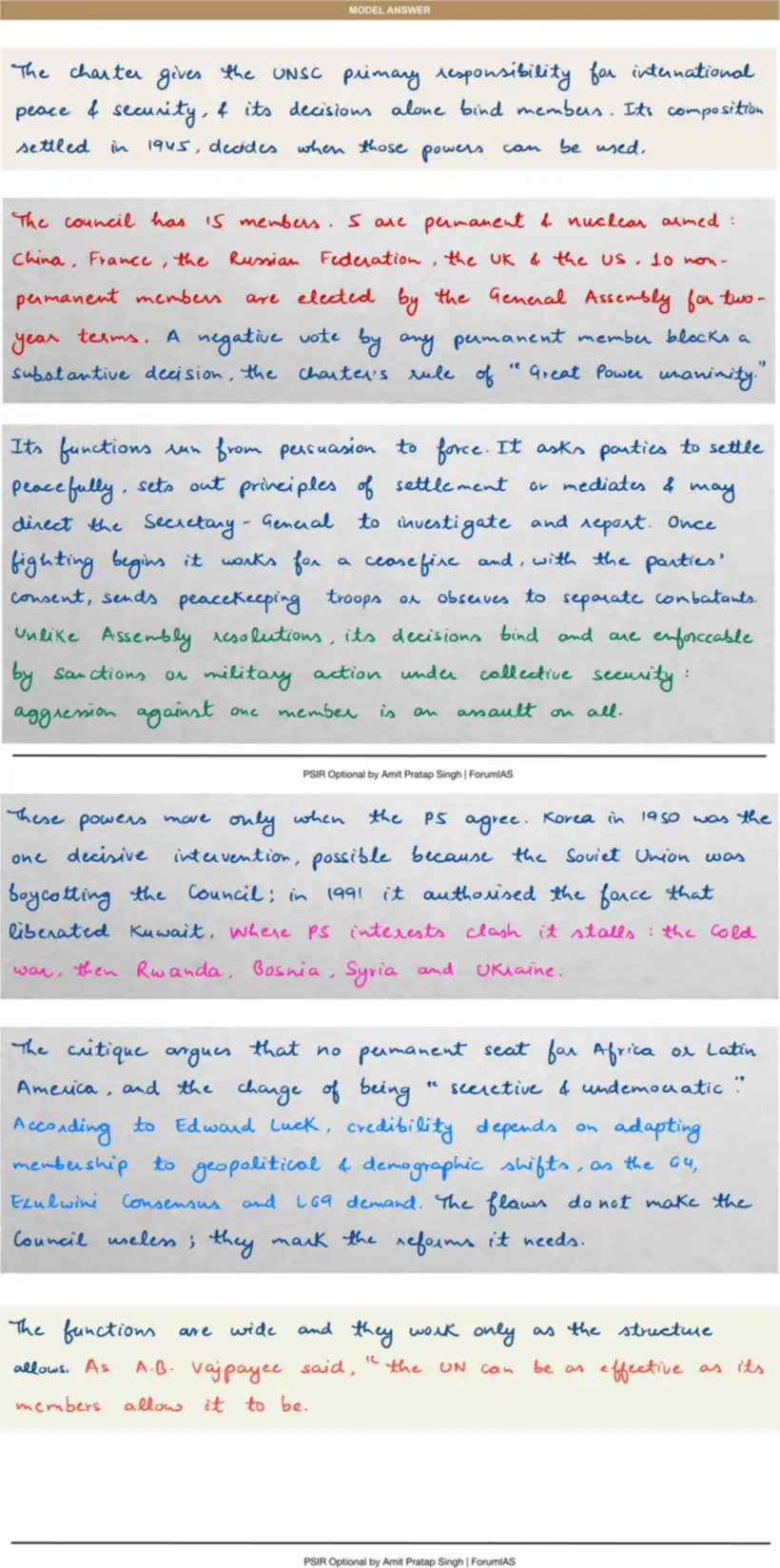
15 members: 5 permanent + nuclear-armed / 10 non-permanent, GA-elected, two-year terms → veto blocks substantive decision = “Great Power unanimity” → functions from persuasion to force: settle peacefully / principles of settlement / mediation / SG investigation → ceasefire → peacekeeping troops or observers with consent → decisions bind, enforceable by sanctions or force under collective security (aggression against one = assault on all) → but powers move only on P5 agreement: Korea 1950 (only because USSR was boycotting), Kuwait 1991 → paralysis when interests clash: Cold War, Rwanda, Bosnia, Syria, Ukraine → same structure breeds the critique: no permanent seat for Africa or Latin America, “secretive and undemocratic” → Edward Luck: credibility ← membership tracking geopolitical and demographic shifts → G4 / Ezulwini / L69
the flaws are not a case against the Council → they mark the reforms it needs, not its uselessness
Route 1 functions are wide, but work only as the structure allows → Vajpayee: the UN is as effective as members allow
Route 2 composition and veto are the precondition for function → until they change, the Council acts only where the great powers already agree
Model answer
Handwritten, in the form it would be written in the examination hall.
Also asked on this head
United Nations — 12 questions in the Vault.
- What is UNCLOS? Explain its salient features.
- What is the structure and functions of International Court of Justice? (150 words)
- Describe the composition of the International Court of Justice (ICJ). Discuss its voluntary jurisdiction.
How this is taught
The same flow snapshot, built for every head of the syllabus, with the answer written in class.
The first session of Foundation 2027 is published in full.
Six programmes across three levels.