
Evaluate the role of the International Court of Justice in inter-State disputes.
How the answer moves
The flow snapshot — the routes in, the body, the counter-view and the routes out.
Route 1 1945, principal judicial organ → only forum where one state can sue another → writ bounded at both ends: consent at entry, veto at exit
Route 2 judicial settlement as the alternative to force → but the Court decides only what states allow, and enforces nothing itself
inside consent, the record is solid: impartial hearing (Jadhav) → territorial disputes settled (El Salvador–Honduras; Cameroon–Nigeria) → law-building (territorial waters, continental shelf) → then the structural limits: consent, not compulsion → judgment final and binding, but enforcement through the UNSC, veto available even to a state that consented → open non-compliance (US, Israel) + Global South charge of Western tilt → Prabhash Ranjan: Russia’s veto shield, yet indifference does not lessen the law’s importance → docket still filling (Myanmar merits, Jan 2026; Guyana–Venezuela, May 2026) → McIntyre & Simpson: standing widened under the Genocide Convention
“UN’s least effective body,” enforcement gap real → against this: the most far-reaching attempt at rule of law between states; at eighty, still the archetype of international adjudication
Route 1 the Court fixes the legal terms on which states contest; it does not police power
Route 2 authority real but conditional — the binding constraint is the veto, not the bench
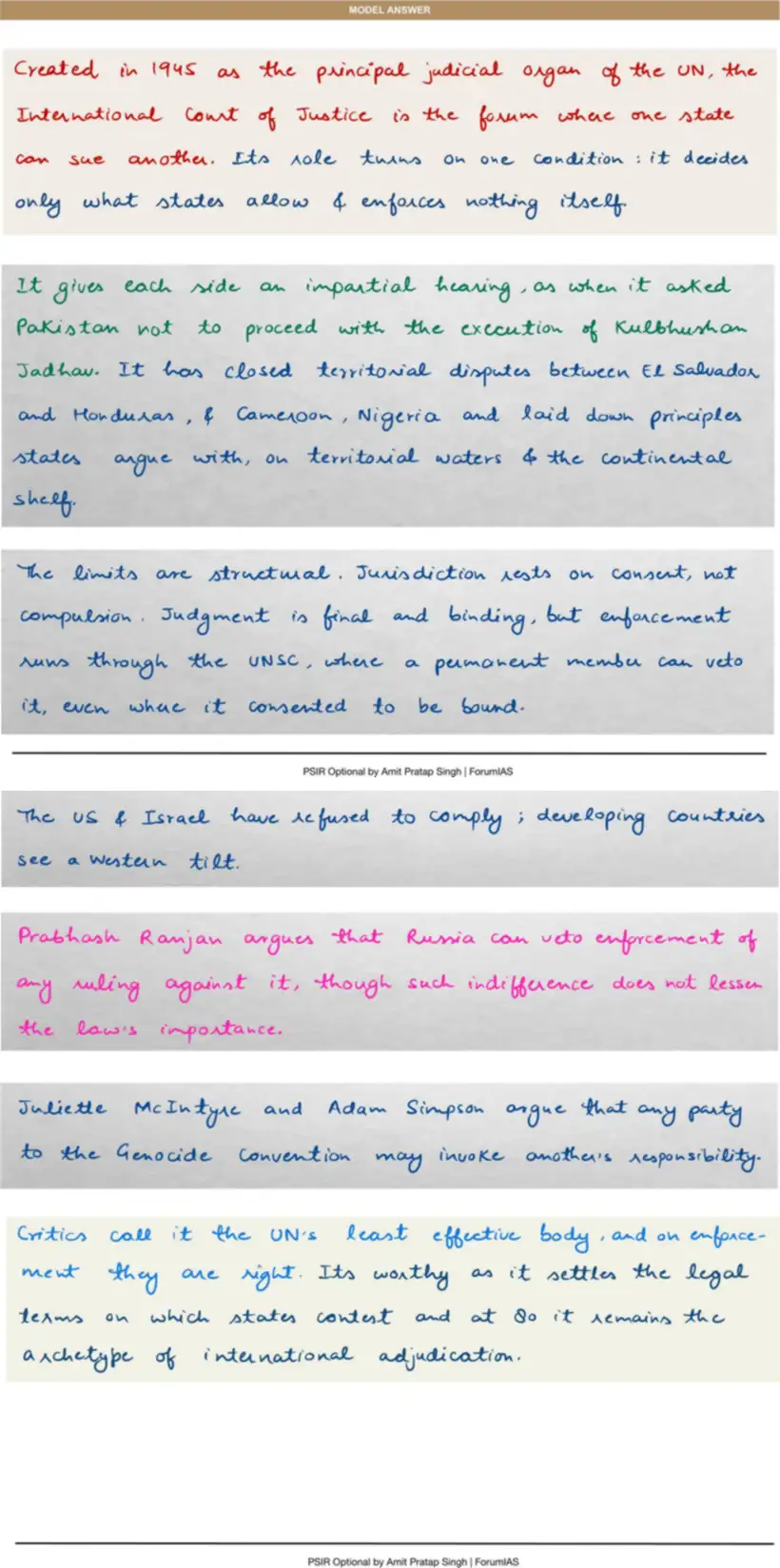
Model answer
Handwritten, in the form it would be written in the examination hall.
Also asked on this head
United Nations — 12 questions in the Vault.
- What is UNCLOS? Explain its salient features.
- What is the structure and functions of International Court of Justice? (150 words)
- Discuss the structure and functions of UN Security Council.
How this is taught
The same flow snapshot, built for every head of the syllabus, with the answer written in class.
The first session of Foundation 2027 is published in full.
Six programmes across three levels.