
In what way does the predominance of the USA in the UN funding affect its decision-making?
How the answer moves
The flow snapshot — the routes in, the body, the counter-view and the routes out.
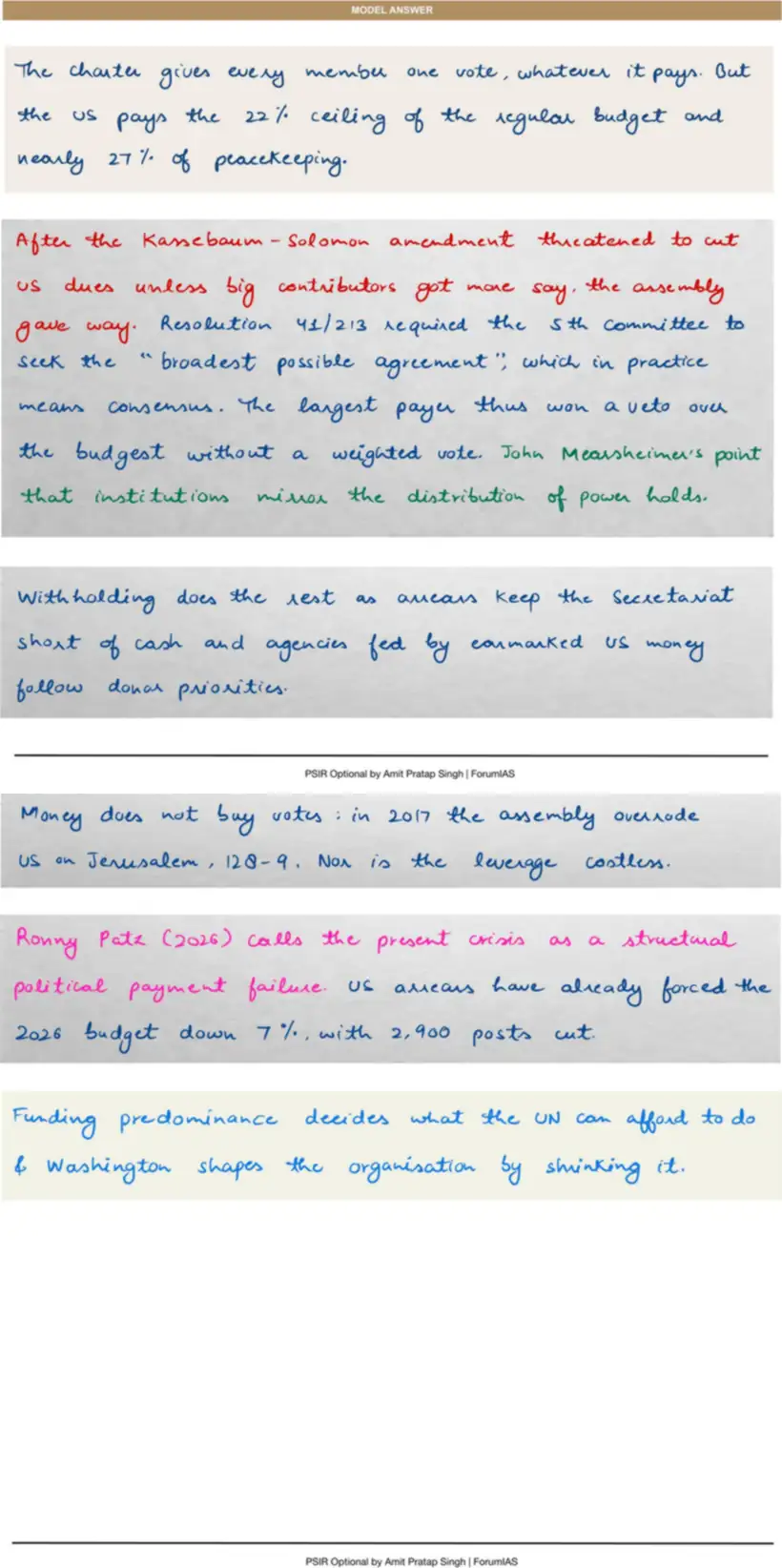
Route 1 one member, one vote whatever it pays → US at the 22% ceiling + nearly 27% of peacekeeping → influence travels through the budget, not the ballot
Route 2 Charter gives no weighted vote → so leverage is built outside the rules → through assessments, arrears, earmarked funds
1986 Kassebaum-Solomon threat → Assembly gives way → Res. 41/213 → Fifth Committee to seek “broadest possible agreement” = consensus in practice → informal budget veto without any weighted vote → Mearsheimer: institutions mirror the distribution of power → withholding/arrears → Secretariat kept short of cash → earmarked money → agencies follow donor priorities
votes stay outside the purse: Jerusalem, 128–9 (2017) → and the leverage is not costless to Washington itself
Route 1 the purse settles what the UN can afford to decide, not what it votes
Route 2 Patz (2026): structural political payment failure → 2026 budget down 7%, 2,900 posts cut → Washington now shapes the UN by shrinking it
Model answer
Handwritten, in the form it would be written in the examination hall.
Also asked on this head
United Nations — 12 questions in the Vault.
- What is UNCLOS? Explain its salient features.
- What is the structure and functions of International Court of Justice? (150 words)
- Discuss the structure and functions of UN Security Council.
How this is taught
The same flow snapshot, built for every head of the syllabus, with the answer written in class.
The first session of Foundation 2027 is published in full.
Six programmes across three levels.