
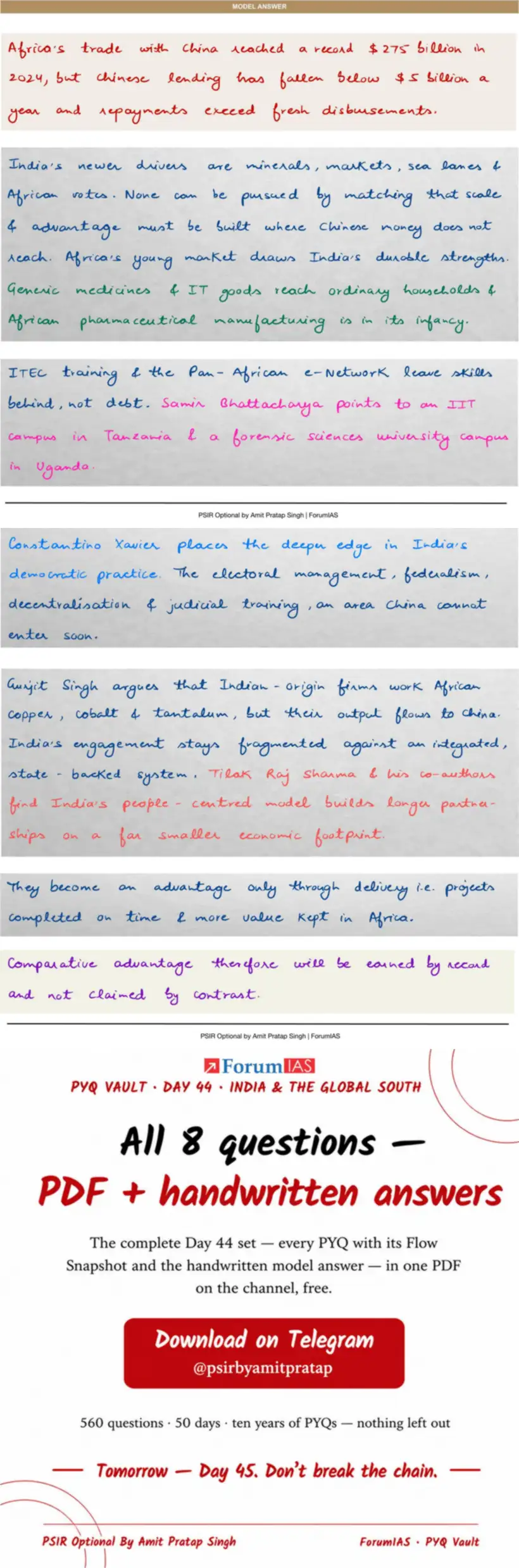
Discuss some of the key drivers of India’s new interests in Africa which might help in developing long-term comparative advantage over China.
How the answer moves
The flow snapshot — the routes in, the body, the counter-view and the routes out.
Route 1 China-Africa trade at a record $275bn in 2024 → yet lending under $5bn a year, repayments now exceed disbursements → drivers named: minerals, markets, sea lanes, African votes → scale cannot be matched → build where Chinese money does not reach
Route 2 engagement once carried by solidarity, now by material need → but the stem asks for edge, not interest → edge must rest on assets money cannot buy quickly
young African market → generics + IT goods to ordinary households → African pharma still in its infancy → ITEC + Pan-African e-Network leave skills, not debt → Bhattacharya: IIT campus Tanzania, forensic sciences campus Uganda → DPI extends the same logic → identity/payments/records as public goods → over twenty countries, six African → no debt, no supplier lock-in → Xavier: electoral management, federalism, decentralisation, judicial training → area China cannot enter
nothing converted into position → Singh’s paradox: Indian-origin firms in African copper, cobalt, tantalum, output flows to China → fragmented engagement vs integrated state-backed system → Sharma and co-authors: longer partnerships, far smaller footprint
Route 1 drivers correct → advantage only through delivery: projects on time, value retained in Africa → earned by record, not claimed by contrast
Route 2 China’s trade at a record while its money recedes → the basis of influence is shifting, not collapsing → India’s edge is slow-appreciating and conditional
Model answer
Handwritten, in the form it would be written in the examination hall.
Also asked on this head
India and the Global South — 20 questions in the Vault.
- Examine India and South-Africa co-operation through bilateral and multi-lateral forums.
- Analyse the relevance of India-Brazil economic co-operation in strengthening the bilateral relations between the two countries. (150 words)
- Describe India’s objections to agricultural negotiations at the World Trade Organisation. (150 words)
How this is taught
The same flow snapshot, built for every head of the syllabus, with the answer written in class.
The first session of Foundation 2027 is published in full.
Six programmes across three levels.