
Discuss the relevance of the demand for New
How the answer moves
The flow snapshot — the routes in, the body, the counter-view and the routes out.
Route 1 1974 Declaration → one claim: rules framed before Southern independence → form changed, grievance unchanged
Route 2 the five asks (sovereign equality, decision-making, policy space, TNC regulation, technology) → globalisation as the new setting → relevance is about the ground, not the wording
finance first: IMF 16th Review (Dec 2023), quotas +50%, shares untouched, realignment deferred → Engel & Mabefam: voice + resource flows recur from NAM → G20 → Bridgetown; response slow, aims unmet → trade: unfinished Doha (agriculture, SDT, public stockholding) = policy space today → technology: TRIPS waiver = sharpest North-South line → corporate power: Raja Mohan (states cannot regulate MNCs) → Mikler (value-chain control; free trade ≠ free markets) → NIEO’s regulation demand still missing
Bhagwati: trading system delivers markets, investment, technology → Happymon Jacob: integration diluted the collective agenda; NAM’s decline removed the vehicle
Route 1 demand survives in narrower form → rule-reform + new instruments (AIIB, NDB, DPI)
Route 2 inter-country gaps widened → equity case stronger, not weaker
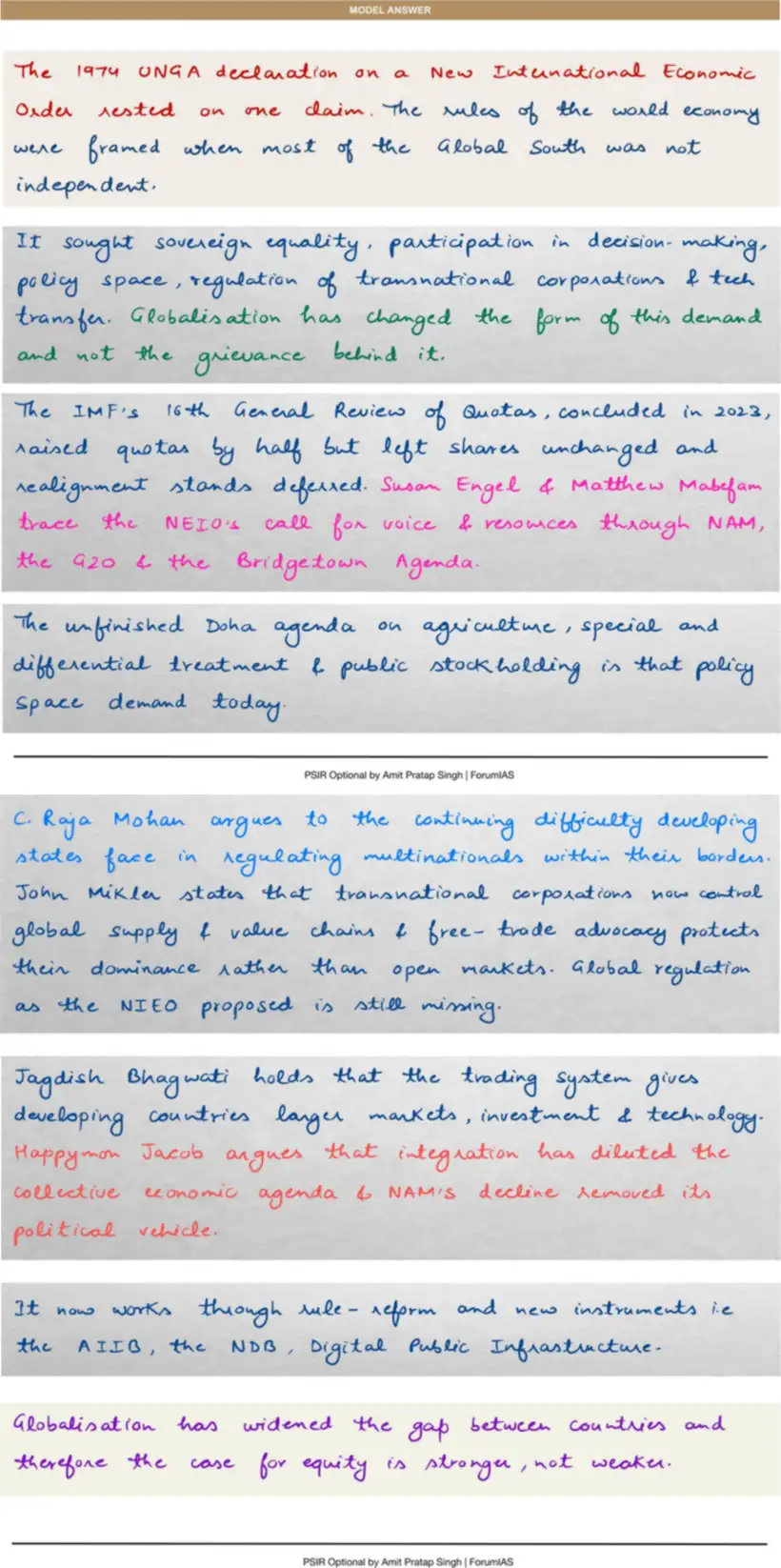
Model answer
Handwritten, in the form it would be written in the examination hall.
Also asked on this head
India and the Global South — 20 questions in the Vault.
- Examine India and South-Africa co-operation through bilateral and multi-lateral forums.
- Analyse the relevance of India-Brazil economic co-operation in strengthening the bilateral relations between the two countries. (150 words)
- Describe India’s objections to agricultural negotiations at the World Trade Organisation. (150 words)
How this is taught
The same flow snapshot, built for every head of the syllabus, with the answer written in class.
The first session of Foundation 2027 is published in full.
Six programmes across three levels.