
“Nothing is going to move within the WTO negotiations unless India is on board.’ Discuss the main reasons behind India’s increased clout in the WTO.
How the answer moves
The flow snapshot — the routes in, the body, the counter-view and the routes out.
Route 1 consensus rule + seat in the inner circle → the rule is old, the seat is recent
Route 2 any member can block → only India’s block halts the organisation → what changed is position, not procedure
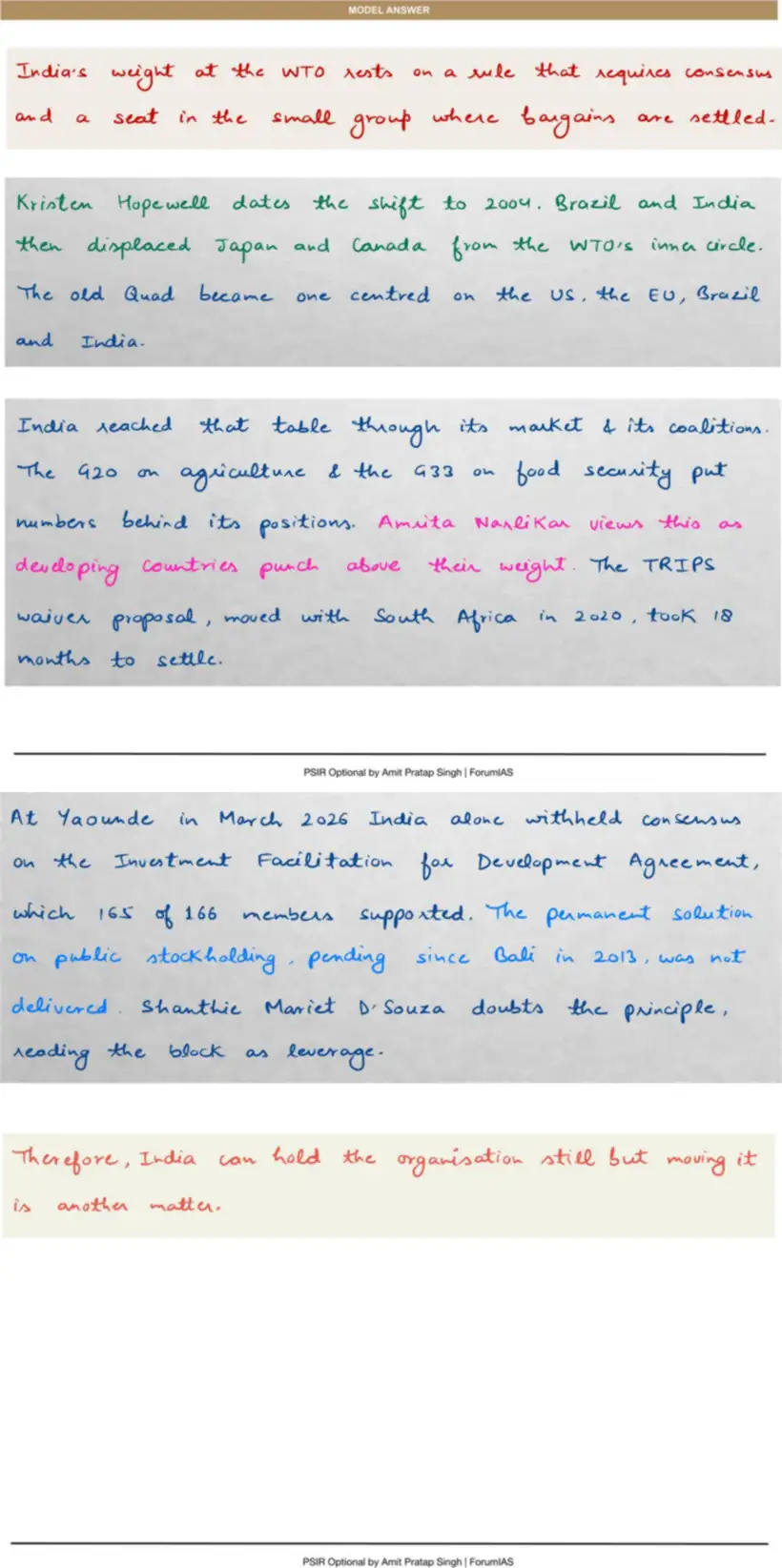
Hopewell, 2004 → Brazil and India displace Japan and Canada → old Quad becomes US / EU / Brazil / India → market + coalitions → G20 agriculture, G33 food security → Narlikar: punching above weight → TRIPS waiver with South Africa, 2020, eighteen months
the strength is the strength to refuse → Yaoundé, March 2026, India alone against 165 of 166 on investment facilitation → public stockholding still undelivered since Bali 2013 → D’Souza: leverage, not principle
Route 1 can hold the organisation still → moving it is another matter
Route 2 veto secured, rule-making not yet → the clout is real but one-directional
Model answer
Handwritten, in the form it would be written in the examination hall.
Also asked on this head
India and the Global South — 20 questions in the Vault.
- Examine India and South-Africa co-operation through bilateral and multi-lateral forums.
- Analyse the relevance of India-Brazil economic co-operation in strengthening the bilateral relations between the two countries. (150 words)
- Describe India’s objections to agricultural negotiations at the World Trade Organisation. (150 words)
How this is taught
The same flow snapshot, built for every head of the syllabus, with the answer written in class.
The first session of Foundation 2027 is published in full.
Six programmes across three levels.