
Discuss the potential role that India could play as the leader of the Global South in realising the goal of
How the answer moves
The flow snapshot — the routes in, the body, the counter-view and the routes out.
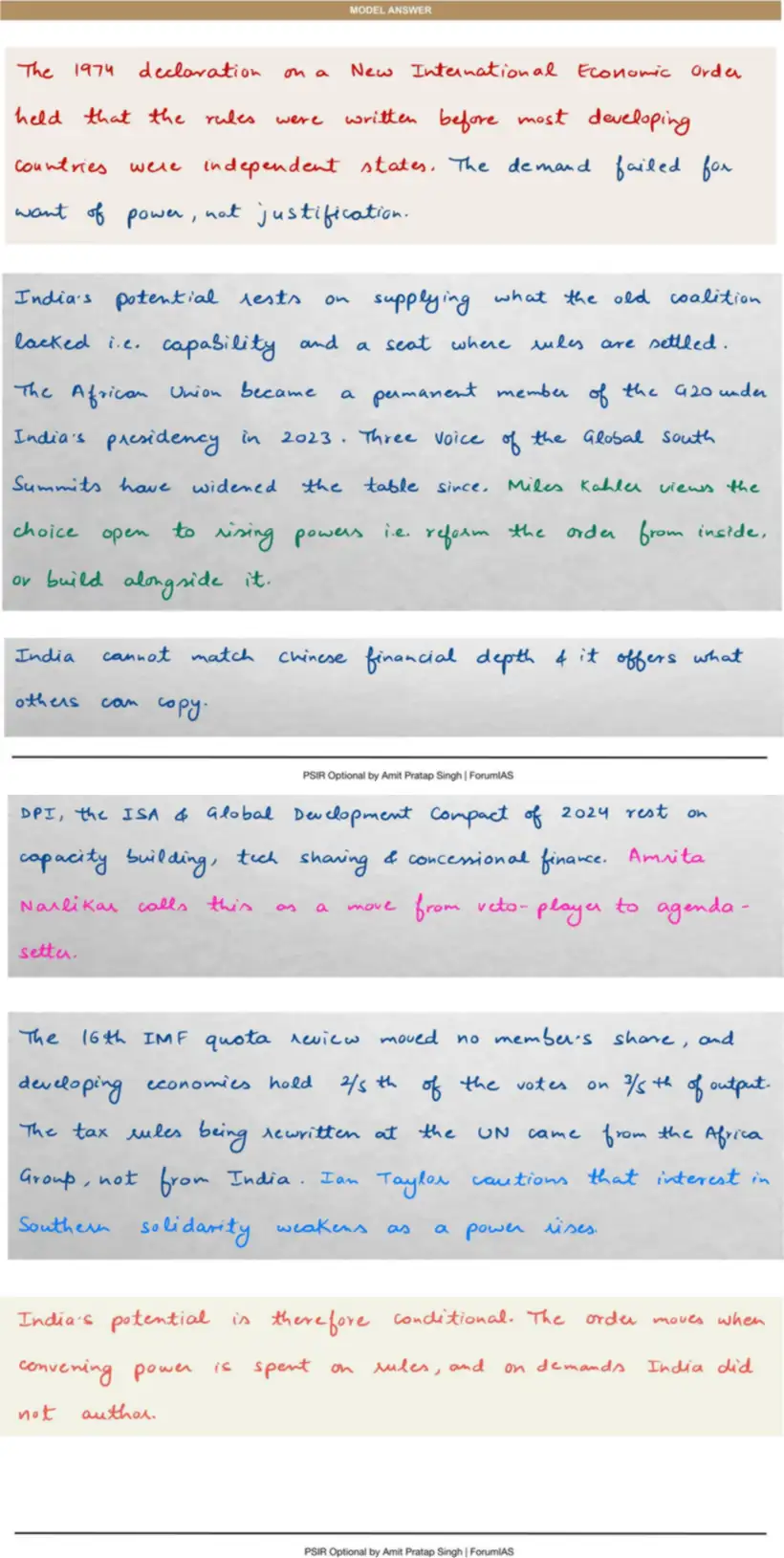
Route 1 1974 Declaration → rules written before most of the South existed as states → demand failed for want of power, not justification
Route 2 what the old coalition lacked → capability + a seat where rules are settled → India’s potential = supplying both
presence first → AU into G20, 2023 → three VOGSS widen the table → BRICS chair 2026 → Kahler’s fork: reform inside / build alongside → India in both tracks → second lever, capability → cannot match Chinese depth → offers what can be copied: DPI, ISA, Global Development Compact 2024 → Narlikar: veto-player → agenda-setter
agenda-setting ≠ rule-making → 16th IMF review moves no share → two-fifths of votes on three-fifths of output → Yaoundé 2026: public stockholding refused again, pending since Bali 2013 → UN tax rules authored by the Africa Group, not India → Taylor: solidarity weakens as a power rises
Route 1 potential is conditional → order moves when convening is spent on rules
Route 2 leadership proved by demands India did not author
Model answer
Handwritten, in the form it would be written in the examination hall.
Also asked on this head
India and the Global South — 20 questions in the Vault.
- Examine India and South-Africa co-operation through bilateral and multi-lateral forums.
- Analyse the relevance of India-Brazil economic co-operation in strengthening the bilateral relations between the two countries. (150 words)
- Describe India’s objections to agricultural negotiations at the World Trade Organisation. (150 words)
How this is taught
The same flow snapshot, built for every head of the syllabus, with the answer written in class.
The first session of Foundation 2027 is published in full.
Six programmes across three levels.