
Discuss the efficacy of India’s ‘no first use’ policy (nuclear weapons) in the context of the evolving strategic challenges from its neighbours.
How the answer moves
The flow snapshot — the routes in, the body, the counter-view and the routes out.
Route 1 NFU’s efficacy ≠ the pledge itself → rests on a survivable, assured second strike → 1998 → 1999 draft → 2003 doctrine (CBW caveat)
Route 2 retaliation-only pledge (shared with China) → real question = does it still deter evolving neighbour threats?
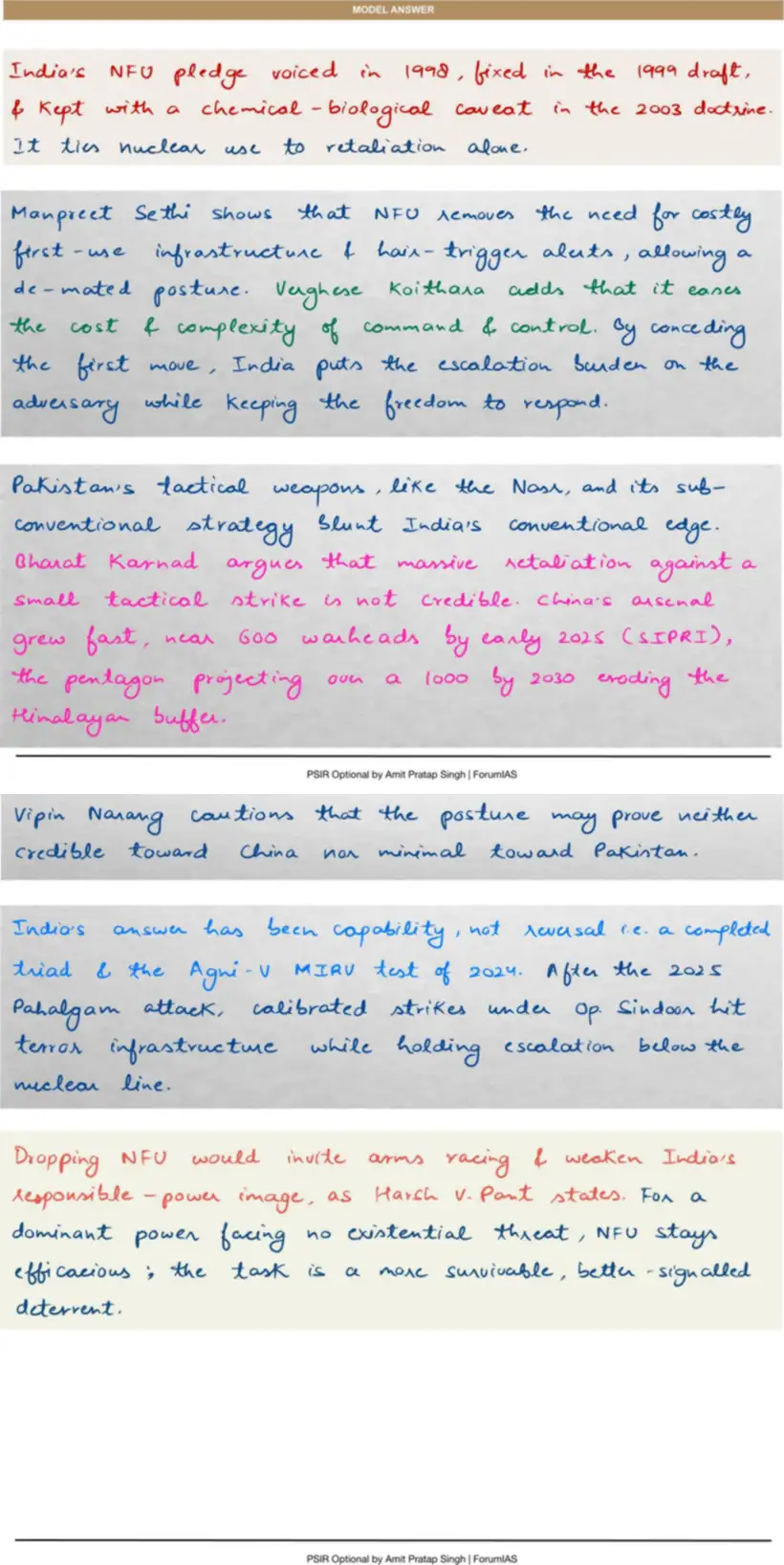
case for NFU (Sethi: no costly first-use infra / hair-trigger → de-mated posture; Koithara: eases command-and-control) → escalation burden shifted to the adversary → evolving threats test it → Pakistan TNW/Nasr + sub-conventional blunt the conventional edge → Karnad: massive retaliation vs a small tactical strike not credible → China’s fast growth (~600 warheads/SIPRI; Pentagon >1,000 by 2030) → eroded Himalayan buffer → Narang: neither credible toward China nor minimal toward Pakistan → India’s reply = capability, not reversal (triad, Agni-V MIRV 2024, Operation Sindoor calibrated strikes; ORF urges flexibility)
expansionist strain: NFU forces India to absorb the first strike, “massive” threat empty against tactical use, counterforce temptation → vs moderate case: economy, de-mated stability, no decapitation capability, first use invites an arms race
Route 1 NFU still efficacious for a dominant power facing no existential threat → task = survivability + clearer signalling, not abandonment
Route 2 discarding NFU changes little in deployment but costs the responsible-power image → strengthen triad / early warning / second strike, retain the pledge
Model answer
Handwritten, in the form it would be written in the examination hall.
Also asked on this head
India and the Nuclear Question — 8 questions in the Vault.
- Critically examine India’s persistent refusal to sign the nuclear non-proliferation treaty (NPT) despite being recognized as a de facto nuclear power.
- “India’s Nuclear policy is deeply influenced by its cultural beliefs and the pragmatic approach of its foreign policy.’ Discuss.
- Discuss the reasons behind India’s refusal to sign the nuclear non-proliferation treaty (NPT).
How this is taught
The same flow snapshot, built for every head of the syllabus, with the answer written in class.
The first session of Foundation 2027 is published in full.
Six programmes across three levels.