
Critically examine India’s persistent refusal to sign the nuclear non-proliferation treaty (NPT) despite being recognized as a de facto nuclear power.
How the answer moves
The flow snapshot — the routes in, the body, the counter-view and the routes out.
Route 1 de facto power (2008 deal + NSG waiver + MTCR/Wassenaar/AG) → still outside NPT → refusal principled, not obstinate
Route 2 recognition without accession → objection is to the treaty’s design, not to disarmament
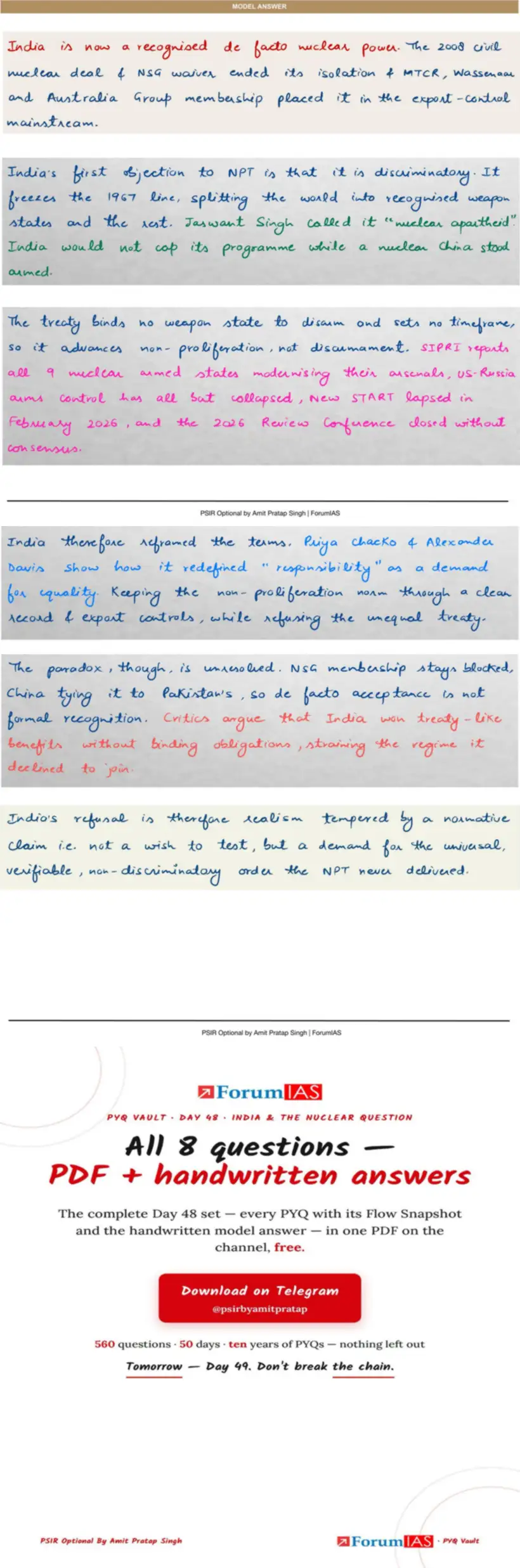
NPT discriminatory (1967 freeze → weapon-states vs the rest) → Jaswant Singh “nuclear apartheid” → realist ground (won’t cap while China armed → survival first) → structural flaw (no disarmament obligation, no timeframe → non-proliferation, not disarmament) → charge borne out: SIPRI modernisation + US–Russia collapse + New START lapse (Feb 2026) + 2026 RevCon third failure → India reframes “responsibility” as equality (Chacko & Davis) → norm kept, treaty refused
integration incomplete: NSG blocked (China links to Pakistan) → de facto ≠ formal recognition → critics: treaty-like benefits without binding obligations → strain on the regime
Route 1 realism tempered by a normative claim → demand for a universal, verifiable, non-discriminatory order
Route 2 not freedom to test but a fairer bargain → the time-bound disarmament the NPT never delivered
Model answer
Handwritten, in the form it would be written in the examination hall.
Also asked on this head
India and the Nuclear Question — 8 questions in the Vault.
- “India’s Nuclear policy is deeply influenced by its cultural beliefs and the pragmatic approach of its foreign policy.’ Discuss.
- Discuss the reasons behind India’s refusal to sign the nuclear non-proliferation treaty (NPT).
- Examine the evolution of India’s role in the global nuclear order.
How this is taught
The same flow snapshot, built for every head of the syllabus, with the answer written in class.
The first session of Foundation 2027 is published in full.
Six programmes across three levels.