
Examine the evolution of India’s role in the global nuclear order.
How the answer moves
The flow snapshot — the routes in, the body, the counter-view and the routes out.
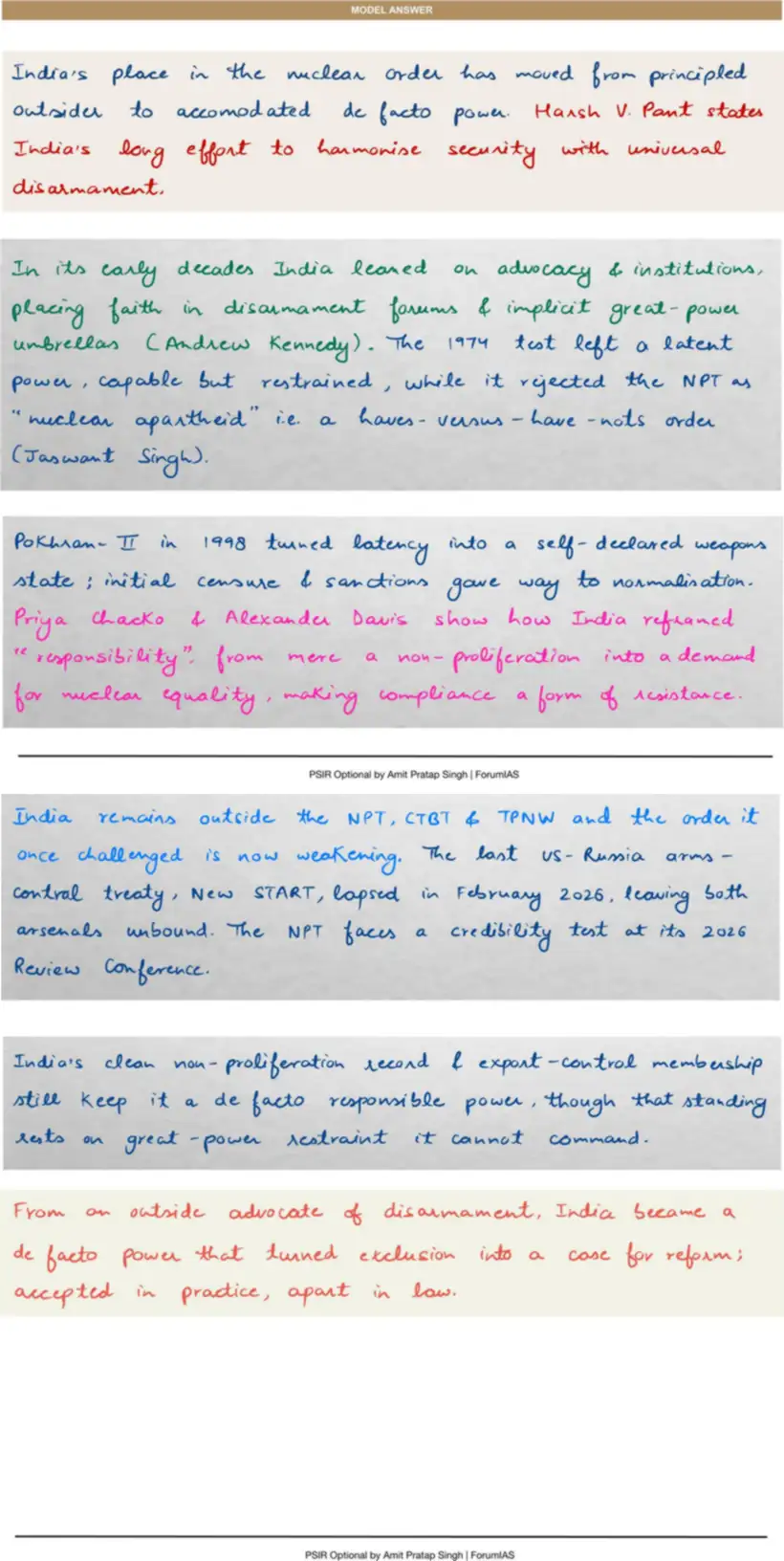
Route 1 principled outsider → accommodated de facto power → never joined the central treaty
Route 2 Pant: security ↔ universal disarmament tension → India as first critic, then claimant
early advocacy + institutions + implicit umbrellas (Kennedy) → 1974 PNE = latency → NPT rejected as “nuclear apartheid” (Jaswant Singh) → 1998 Pokhran-II = self-declared NWS → sanctions → normalisation → 2005–08 deal + 2008 NSG waiver → MTCR / Wassenaar / Australia Group → Chacko & Davis: “responsibility” reframed as equality → compliance as resistance
still outside NPT, CTBT, TPNW → order now unravelling → New START lapse (Feb 2026) + NPT credibility test (2026 RevCon) → clean record + regimes still sustain de facto power → but standing rests on great-power restraint India cannot command
Route 1 outside advocate → de facto power that turned exclusion into a case for reform → accepted in practice, apart in law
Route 2 reframed responsibility as India’s lever → next test: holding its standing as the order decays
Model answer
Handwritten, in the form it would be written in the examination hall.
Also asked on this head
India and the Nuclear Question — 8 questions in the Vault.
- Critically examine India’s persistent refusal to sign the nuclear non-proliferation treaty (NPT) despite being recognized as a de facto nuclear power.
- “India’s Nuclear policy is deeply influenced by its cultural beliefs and the pragmatic approach of its foreign policy.’ Discuss.
- Discuss the reasons behind India’s refusal to sign the nuclear non-proliferation treaty (NPT).
How this is taught
The same flow snapshot, built for every head of the syllabus, with the answer written in class.
The first session of Foundation 2027 is published in full.
Six programmes across three levels.