
Discuss the reasons behind India’s refusal to sign the nuclear non-proliferation treaty (NPT).
How the answer moves
The flow snapshot — the routes in, the body, the counter-view and the routes out.
Route 1 refusal of the treaty, not of disarmament → Nehru-era NWFW vision meets the 1968 “haves/have-nots” divide → “nuclear apartheid”
Route 2 India reads the NPT as unequal → three grounds staked → discrimination · insecurity · autonomy
discrimination: 1967 cut-off + P-5 monopoly → IAEA binds only NNWS, no Article VI timeframe → “eyewash” → Trivedi’s “disarm the unarmed” → 2026 RevCon collapse (3rd cycle, NWS resist deadline) → insecurity: China 1964 (Pant) + refused guarantees → self-help vs armed China & Pakistan → autonomy: external caps vs self-reliance
India upholds the non-proliferation norm (clean record, India-specific safeguards, MTCR/Wassenaar) → opposes the discriminatory treaty, not the norm → official line: no NNWS accession, “pending non-discriminatory… disarmament,” time-bound framework
Route 1 refusal both principled and realist → resistance to an unequal order, not to the goal
Route 2 compliance reframed as a demand for a fairer order → NWFW pursued through a non-discriminatory, verifiable, time-bound route
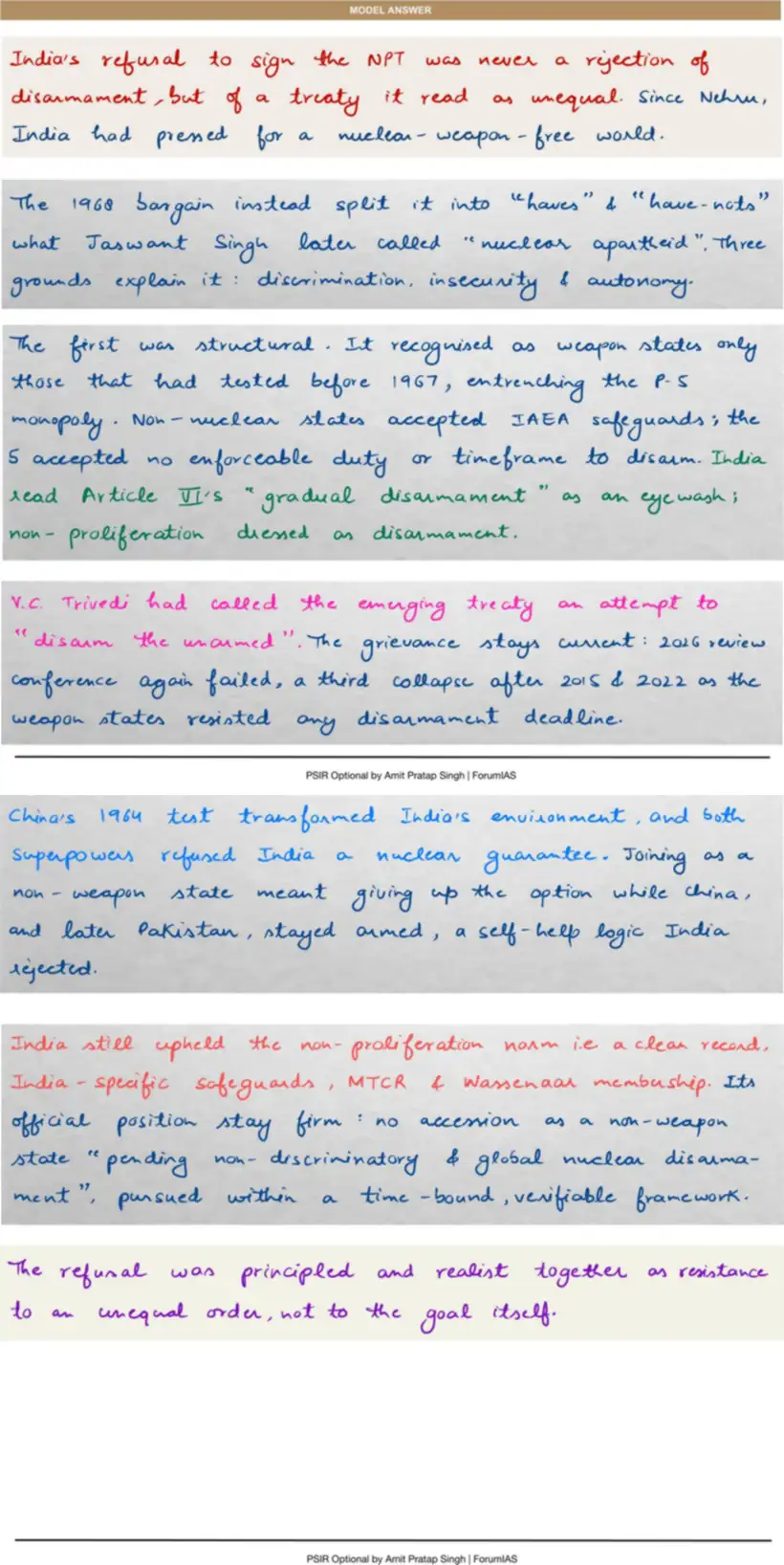
Model answer
Handwritten, in the form it would be written in the examination hall.
Also asked on this head
India and the Nuclear Question — 8 questions in the Vault.
- Critically examine India’s persistent refusal to sign the nuclear non-proliferation treaty (NPT) despite being recognized as a de facto nuclear power.
- “India’s Nuclear policy is deeply influenced by its cultural beliefs and the pragmatic approach of its foreign policy.’ Discuss.
- Examine the evolution of India’s role in the global nuclear order.
How this is taught
The same flow snapshot, built for every head of the syllabus, with the answer written in class.
The first session of Foundation 2027 is published in full.
Six programmes across three levels.