
Critically analyze India’s nuclear policy.
How the answer moves
The flow snapshot — the routes in, the body, the counter-view and the routes out.
Route 1 two goals held at once: security + universal disarmament → strategic ambiguity (Pant)
Route 2 2003 doctrine institutionalises the restraint–deterrence balance → NFU + credible minimum deterrence
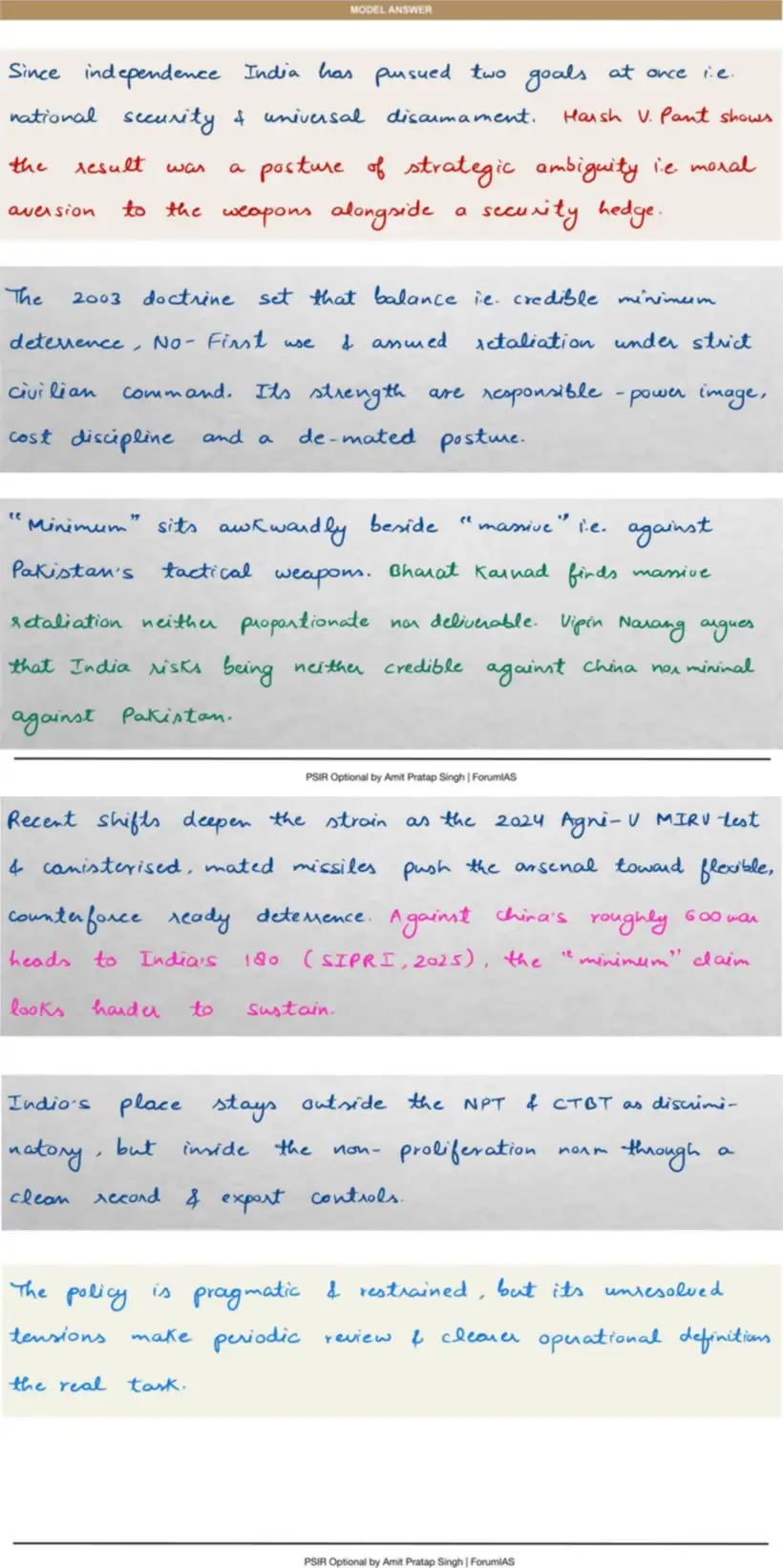
strategic ambiguity (Pant) → 2003 doctrine (CMD + NFU/CBW caveat + assured retaliation + civilian NCA) → strengths (responsible image, cost discipline, de-mated posture) → internal fault-line: “minimum” vs “massive” → Karnad (retaliation neither proportionate nor deliverable) → Narang (neither credible vs China nor minimal vs Pakistan) → recent shifts: Agni-V MIRV 2024 + canisterised/mated missiles → flexible, counterforce-ready deterrence → China ~600 vs India ~180 (SIPRI 2025) → “minimum” strained
restraint case (responsible image, cost discipline, de-mated posture, no arms race) vs credibility critique (minimum–massive incompatibility, modernising China + Pakistan’s tactical weapons, drift toward counterforce)
Route 1 distinctive place: outside NPT/CTBT (discriminatory) yet inside the non-proliferation norm
Route 2 pragmatic and restrained, tensions unresolved → periodic review + clearer operational definitions
Model answer
Handwritten, in the form it would be written in the examination hall.
Also asked on this head
India and the Nuclear Question — 8 questions in the Vault.
- Critically examine India’s persistent refusal to sign the nuclear non-proliferation treaty (NPT) despite being recognized as a de facto nuclear power.
- “India’s Nuclear policy is deeply influenced by its cultural beliefs and the pragmatic approach of its foreign policy.’ Discuss.
- Discuss the reasons behind India’s refusal to sign the nuclear non-proliferation treaty (NPT).
How this is taught
The same flow snapshot, built for every head of the syllabus, with the answer written in class.
The first session of Foundation 2027 is published in full.
Six programmes across three levels.