
The philosophy and administration of the distribution of powers between Centre and State is required to be re- assessed.
How the answer moves
The flow snapshot — the routes in, the body, the counter-view and the routes out.
Route 1 distribution of powers = hallmark of Indian federalism → reconciles national unity with local autonomy
Route 2 Centre-tilt justified by Partition / princely integration / fissiparous fears → those conditions no longer hold
Austin: design as a blend of centralisation + decentralisation → tilt rooted in 1947 context → conditions changed since 1950 → education / environment / health / migration / digital need joint action → over-centralisation weakens State initiative → administrative friction: Governor, central agencies, GST → Kothari: centralisation under single-party dominance
reassessment ≠ weakening the Union → corrective is consultation, not dilution of central authority
Route 1 Sarkaria / Punchhi / NCRWC + Bommai converge → States gain flexibility in non-national matters, Union intact
Route 2 recalibration, not rupture → balance restored within a cooperative federal spirit
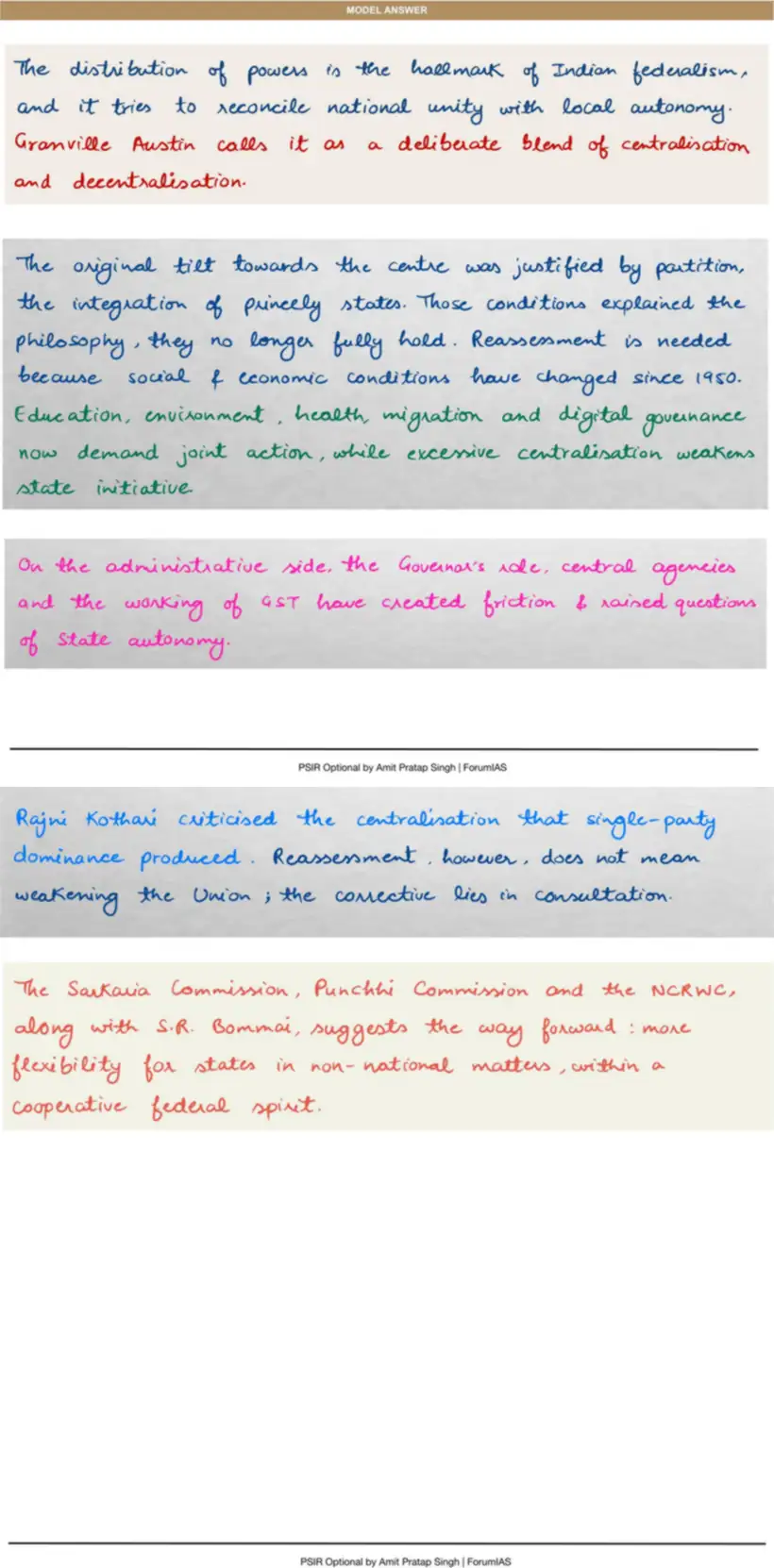
Model answer
Handwritten, in the form it would be written in the examination hall.
Also asked on this head
Federalism — 13 questions in the Vault.
- Discuss the causes and consequences of inter-State water disputes in India.
- Evaluate the Centre-State relation with reference to Article 293 and analyze its implications for the Indian federal structure.
- The recent developments in Indian Politics has not eroded the true spirit of federalism in India. Critically examine this statement with the help of appropriate examples.
How this is taught
The same flow snapshot, built for every head of the syllabus, with the answer written in class.
The first session of Foundation 2027 is published in full.
Six programmes across three levels.