
Do you agree that the growing assertiveness of China is leading to multilayered Indo-Japan relations? Comment.
How the answer moves
The flow snapshot — the routes in, the body, the counter-view and the routes out.
Route 1 ties predate China’s rise → 1952 treaty, yen loans 1958, CEPA, high-speed rail → assertiveness changed pace and range, not origin
Route 2 “multilayered” must be shown, not asserted → layers exist → but unequal in strength
same pressure on both: Senkakus + LAC + nine-dash line rejected 2016 → Panda: Asia uneasy, Beijing reads friendship as ganging up → layered response: 2+2, Malabar, Quad, Act East Forum–FOIP → 2025 security declaration replaces 2008 → UNICORN co-development 2026 → coercion adds newest layer: Takaichi in Diet, Nov 2025 → travel advisory + seafood ban → July 2026 economic-security declaration: semiconductors, critical minerals, clean energy → no dependence on one country
depth lags breadth → Jain: economic ties the weak link, 10 trillion yen slow → Menon: strategic autonomy caps Tokyo’s balancing hopes → India still engages Beijing while Japan’s China ties worsen
Route 1 assertiveness explains breadth better than depth
Route 2 the layers are real but uneven → agreement with the question, not endorsement of its implied depth
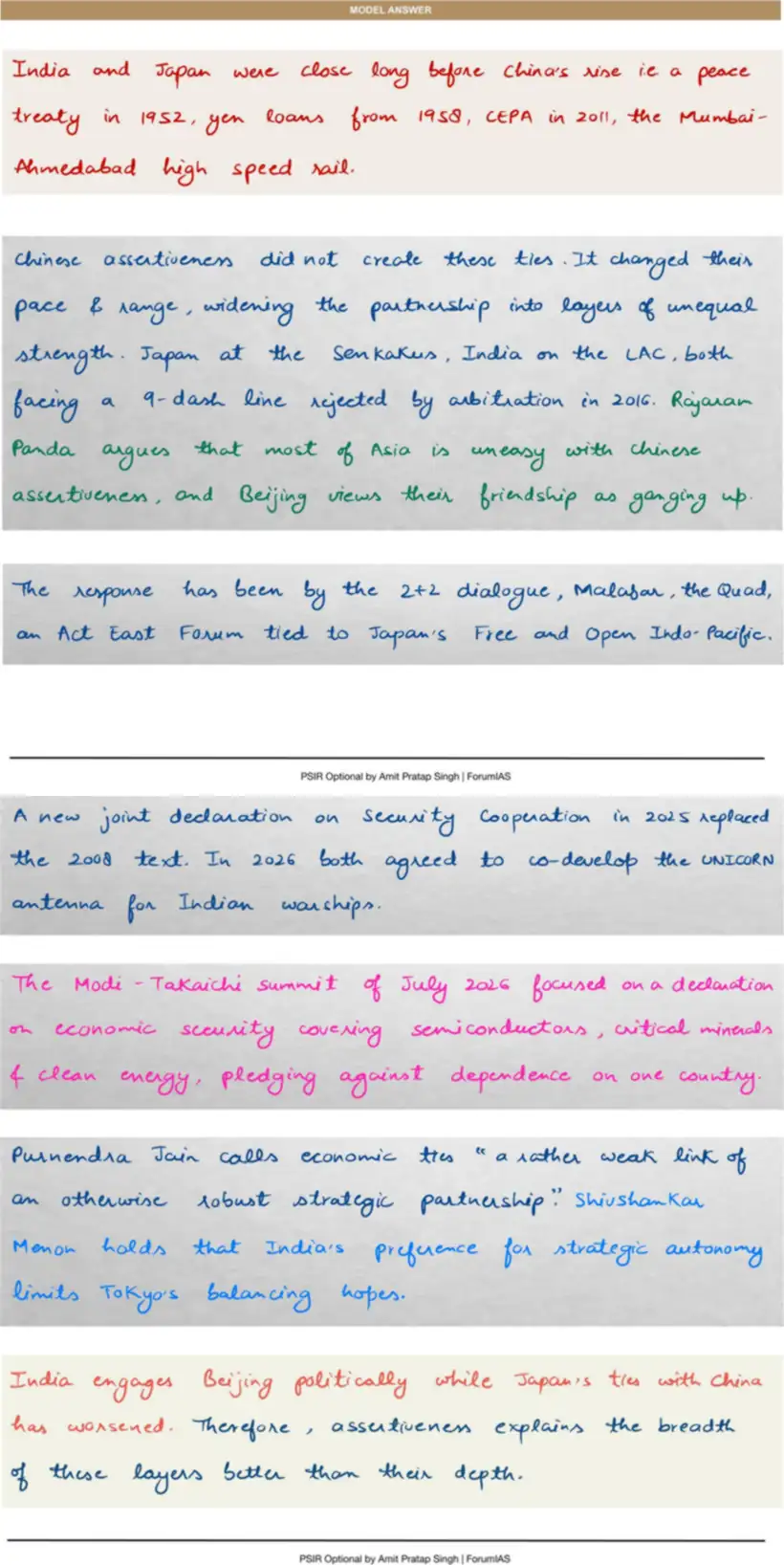
Model answer
Handwritten, in the form it would be written in the examination hall.
Also asked on this head
India and the Global Centres of Power — 27 questions in the Vault.
- Critically evaluate India-Russia relations in the 21st century. How have both the countries responded to America meddling in their relations in the recent times.
- “The mother of all deals” is a transformative milestone in Indo-EU trade relations. Elaborate on the new Security and Defence partnership.
- Does the idea of the 21st century as ‘Asian century’ continue to remain feasible given the growing friction between India and China?
How this is taught
The same flow snapshot, built for every head of the syllabus, with the answer written in class.
The first session of Foundation 2027 is published in full.
Six programmes across three levels.