
Do you agree with the view that the Indian Foreign Policy is increasingly being shaped by the Neoliberal outlook? Elaborate
How the answer moves
The flow snapshot — the routes in, the body, the counter-view and the routes out.
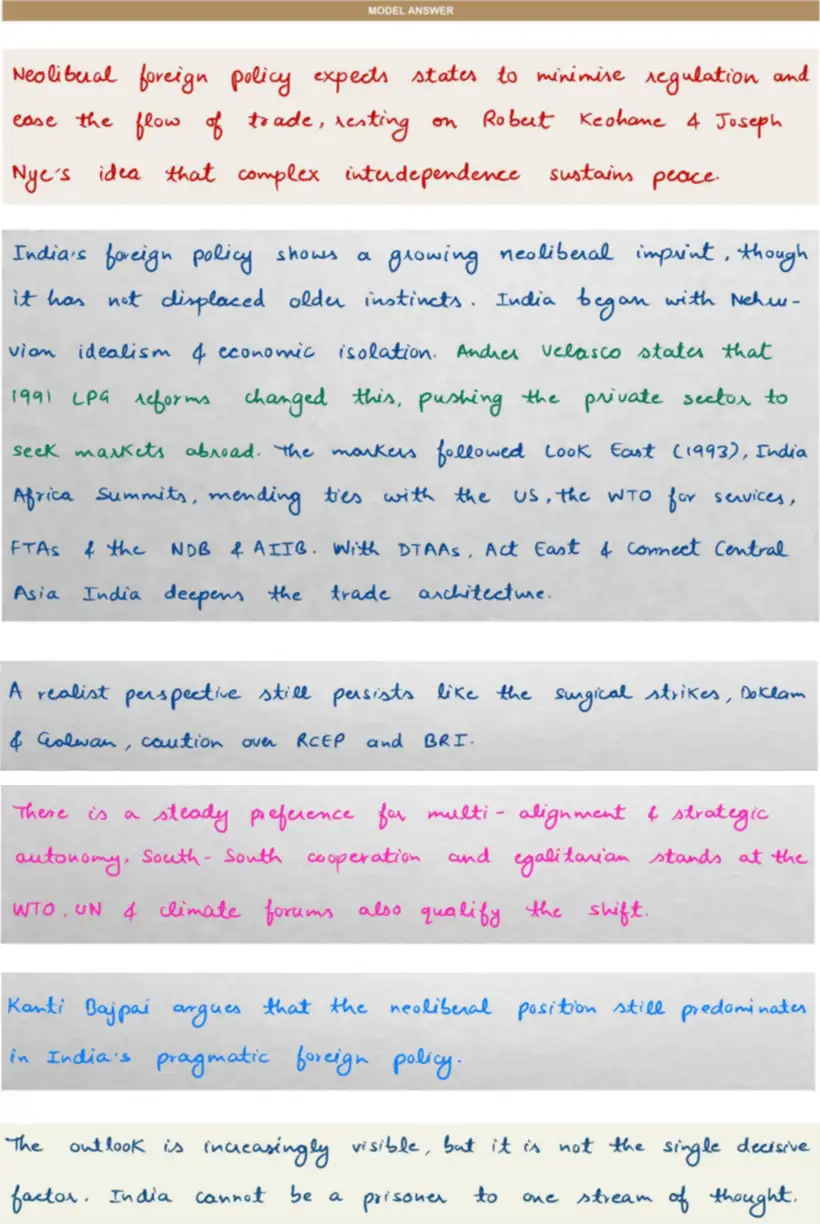
Route 1 neoliberal FP = minimal regulation + free trade → Keohane & Nye: complex interdependence sustains peace → India shows a growing imprint
Route 2 from Nehruvian idealism + economic isolation → 1991 LPG reforms as the pivot → neoliberal outlook increasingly visible
Nehruvian isolation → 1991 LPG pushes private sector abroad (Velasco) → markers: Look East ‘93 · India–Africa Summits · US ties · WTO services · FTAs · NDB/AIIB → deeper architecture: DTAAs · Act East · Connect Central Asia
realism persists: surgical strikes, Doklam, Galwan → caution on RCEP/BRI → multi-alignment + strategic autonomy → South–South + egalitarian WTO/UN/climate stands qualify the shift
Route 1 Bajpai: neoliberal position predominates in pragmatic FP → agree, with qualification
Route 2 increasingly visible, but not the single decisive factor → India no prisoner to one stream
Model answer
Handwritten, in the form it would be written in the examination hall.
Also asked on this head
Indian Foreign Policy — 17 questions in the Vault.
- India has adopted multi-alignment to fulfill its core values and interests in International relations. Discuss.
- What are the external determinants of the Foreign Policy of a State?
- How do the constituent states influence the foreign policy making process in India?
How this is taught
The same flow snapshot, built for every head of the syllabus, with the answer written in class.
The first session of Foundation 2027 is published in full.
Six programmes across three levels.