
How the answer moves
The flow snapshot — the routes in, the body, the counter-view and the routes out.
Route 1 contractual in method + distributive in result → the two bound together
Route 2 the hypothetical contract is the source → it generates and justifies the distribution
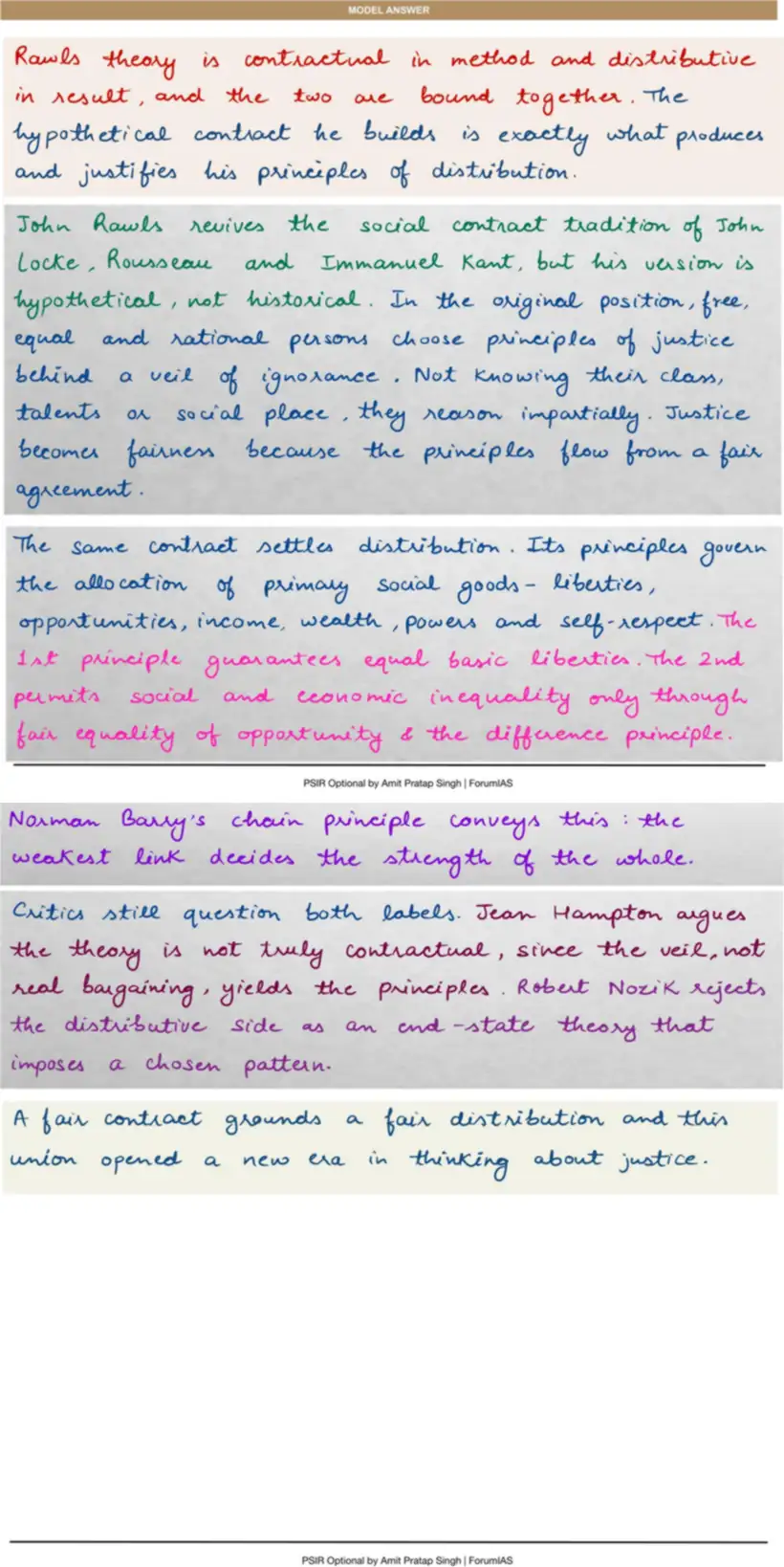
revives contract tradition (Locke / Rousseau / Kant), hypothetical not historical → original position + veil of ignorance → impartial choice + maximin → fairness from a fair agreement → same contract fixes distribution → primary social goods → first principle (equal liberties) → second principle (fair equality of opportunity + Difference Principle) → least advantaged / Barry’s chain principle → Macpherson: defence of the liberal democratic welfare state
Hampton: not truly contractual (veil, not bargaining, yields the principles) → Nozick: distributive side is an end-state theory imposing a pattern
Route 1 a fair contract grounds a fair distribution → the two characters reinforce each other
Route 2 despite the critics, Rawls opened a new era in justice theory
Model answer
Handwritten, in the form it would be written in the examination hall.
Also asked on this head
Justice — 11 questions in the Vault.
- Explain how Rawls used the liberal and egalitarian perspective to develop his concept of distributive justice.
- Rawls’ idea of the ‘liberal self’ is too individualistic. Explain, in this context, the communitarian critique of Rawls’ theory of justice.
- Dr. Ambedkar’s idea of social justice leads to ‘egalitarian justice’ as compared to Rawls’ ‘justice as fairness’ which aims at the notion of ‘pure procedural justice’....
How this is taught
The same flow snapshot, built for every head of the syllabus, with the answer written in class.
The first session of Foundation 2027 is published in full.
Six programmes across three levels.