
Comment on Women’s role in anti-arrack movement.
How the answer moves
The flow snapshot — the routes in, the body, the counter-view and the routes out.
Route 1 Locate: AP, early 1990s, a rural women’s uprising → born in Dubagunta, Nellore from the National Literacy Campaign → women name arrack → women as central actors, private grievance → public struggle.
Route 2 Open on agency: unlettered rural women, no political experience → move household suffering into political action → force the state to act → the “comment” weighs the significance of that leadership.
Literacy-campaign origin → women link alcohol to domestic violence / financial ruin / social breakdown → forms of action (marches, picketing, night patrols, sit-ins, processions, brewing material destroyed, fines) → opponents: liquor contractors + the state’s Varun Vahini → feminist reading: Tharu & Lalitha (patriarchy at home + in public) → Mazumdar (rural women changing policy = a turning point) → ‘the personal is the political’.
Weigh the mismatch: inexperienced, unlettered rural women vs powerful liquor contractors + the state’s own Varun Vahini patronage → that ordinary women overturned this nexus is what makes their role significant.
Route 1 Outcome: CM Kotla Vijaya Bhaskara Reddy bans arrack, 1 Oct 1993 → women without formal power reshaped state policy.
Route 2 Close on scale: one of the largest women-led agitations against the state → women as agents of grassroots democracy.
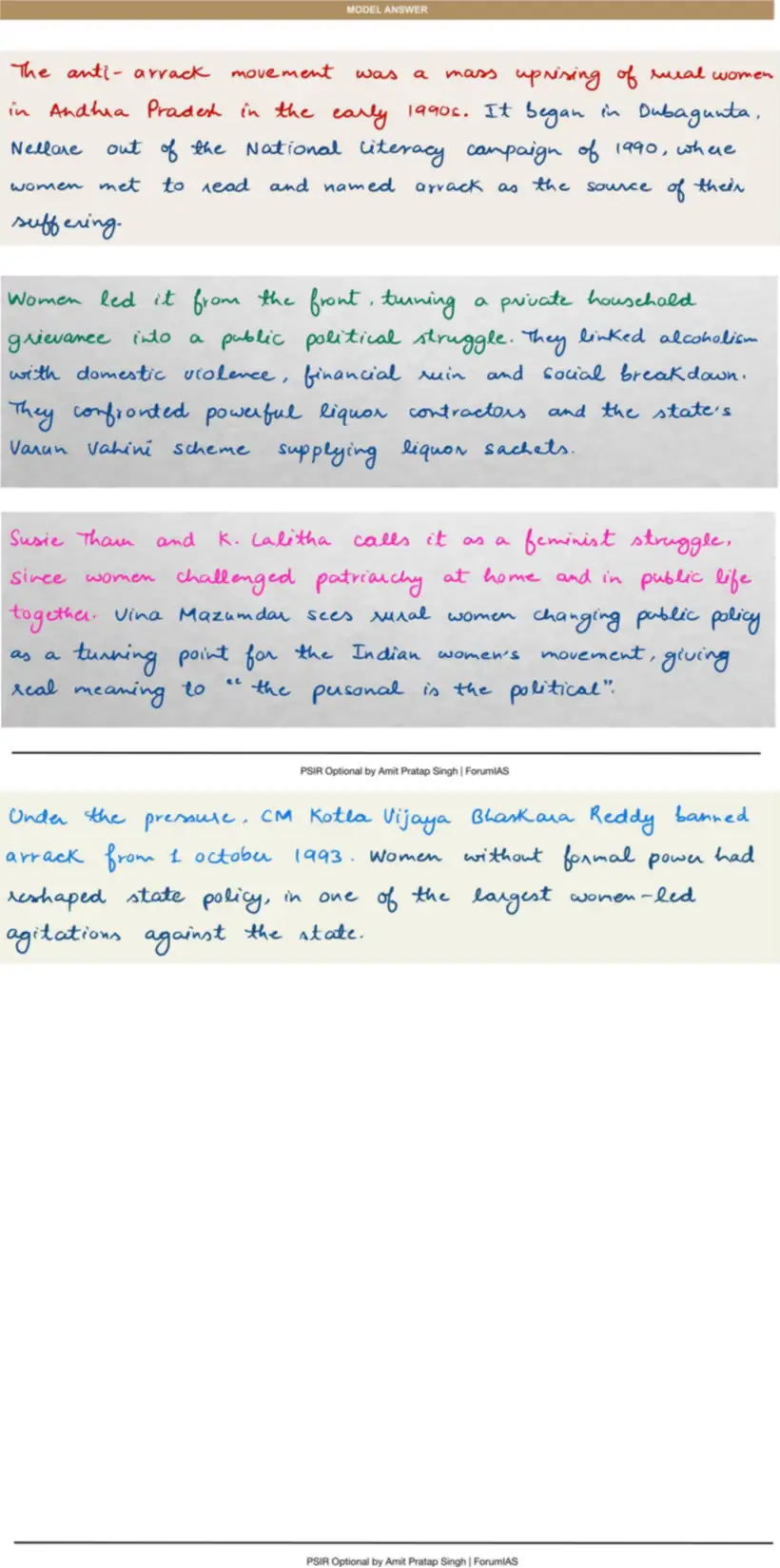
Model answer
Handwritten, in the form it would be written in the examination hall.
Also asked on this head
Social Movements — 9 questions in the Vault.
- “The lack of political will in preventing environmental degradation is one of the major challenges that India is experiencing.” Comment.
- Discuss the role of environmental movements in shaping the environmental governance in India.
- Dr. Ambedkar’s clarion call, “Educate, Agitate and Organize’, strategizes the Dalit movement towards achieving civil liberty. Discuss.
How this is taught
The same flow snapshot, built for every head of the syllabus, with the answer written in class.
The first session of Foundation 2027 is published in full.
Six programmes across three levels.