
Critically examine the provisions made in the Constitution for the protection of Environment.
How the answer moves
The flow snapshot — the routes in, the body, the counter-view and the routes out.
Route 1 Constitution offers no single environmental provision → protects through an enabling spread of duties, directives and rights → deepened by the courts.
Route 2 Environmental protection sits in the Constitution as an enabling framework → Directive Principles + Fundamental Duty + judicially expanded Article 21 → both strength and limits flow from this.
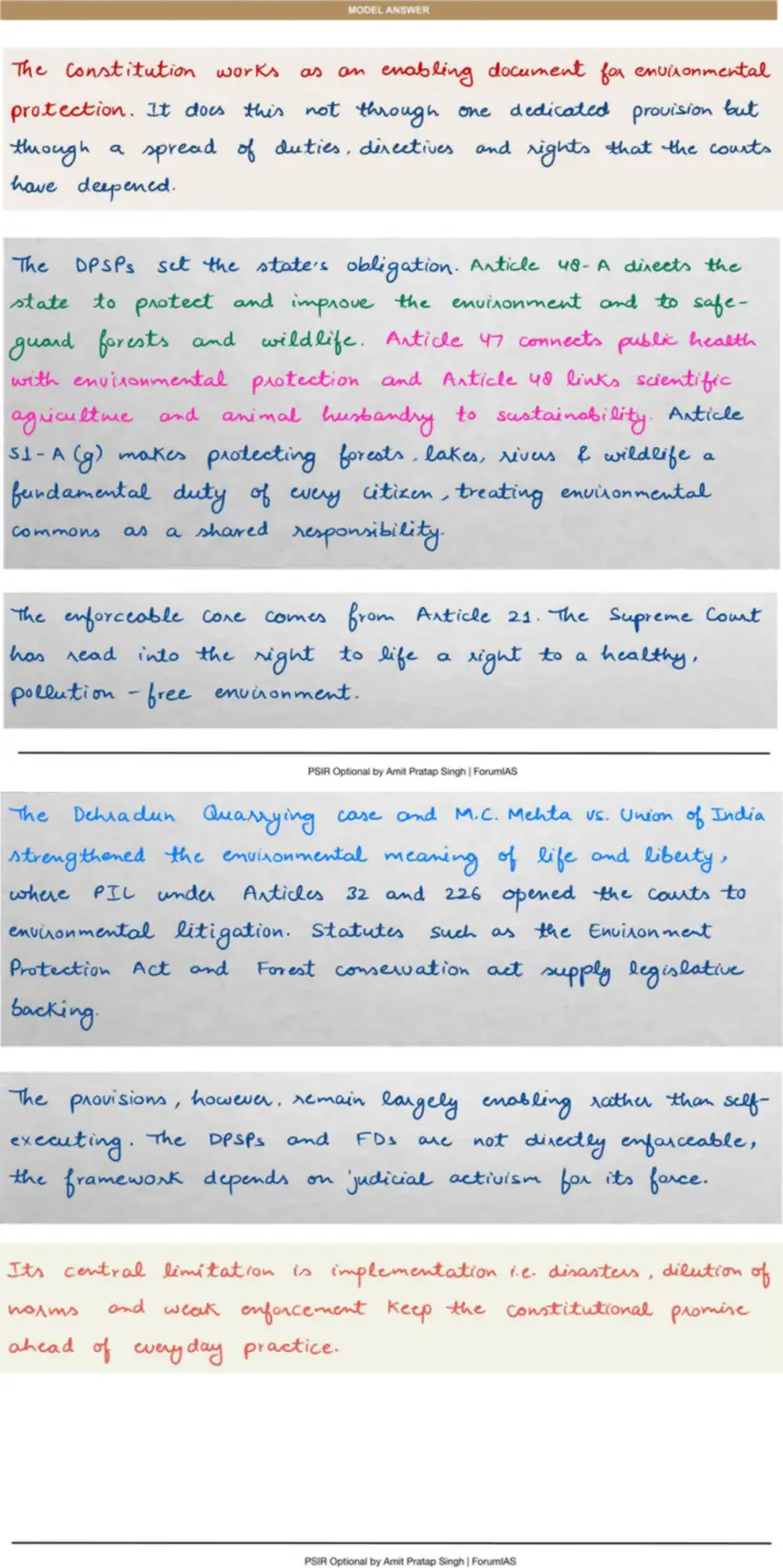
Directive Principles set the state’s duty (Art 48-A environment/forests/wildlife; Art 47 public health; Art 48 agriculture–sustainability) → Fundamental Duty Art 51-A(g) makes the citizen responsible → enforceable core Article 21 → Supreme Court reads in a right to a healthy, pollution-free environment → Dehradun Quarrying + M. C. Mehta strengthen the environmental meaning of life and liberty → PIL via Articles 32 & 226 → statutory backing (Environment Protection Act, Forest Conservation Act).
Provisions enabling, not self-executing → Directive Principles + citizen duty non-justiciable → force depends on judicial activism → central limitation is implementation (disasters, dilution of norms, weak enforcement) → promise stays ahead of practice.
Route 1 Framework enabling by design → limited by non-enforceable directives and the enforcement gap → promise runs ahead of practice.
Route 2 Article 21 jurisprudence gives the framework real teeth → but constitutional protection is only as strong as its enforcement.
Model answer
Handwritten, in the form it would be written in the examination hall.
Also asked on this head
Social Movements — 9 questions in the Vault.
- “The lack of political will in preventing environmental degradation is one of the major challenges that India is experiencing.” Comment.
- Discuss the role of environmental movements in shaping the environmental governance in India.
- Comment on Women’s role in anti-arrack movement.
How this is taught
The same flow snapshot, built for every head of the syllabus, with the answer written in class.
The first session of Foundation 2027 is published in full.
Six programmes across three levels.