
Write short note on the significance of Chipko Movement.
How the answer moves
The flow snapshot — the routes in, the body, the counter-view and the routes out.
Route 1 1973 Garhwal, tree-hugging against commercial felling → significance = ecology tied to livelihood (“Ecology is economy”).
Route 2 Open on its layered character → not a single-issue protest → environmental + peasant + women’s + regional at once.
Layered character → women at the core → early ecofeminism (forest loss raises women’s fuel/fodder/water burden) → the poor suffer most from degradation → Guha’s “environmentalism of the poor” (survival, not leisure) → Shiva & Bandyopadhyay: a revival of “forest satyagraha” → concrete impact: 15-year felling ban + National Forest Policy, 1988 + inspired Appiko and Narmada Bachao Andolan.
Guha’s later assessment → forests, rivers and water tables kept declining after Chipko → structural change limited, dominant development model largely intact.
Route 1 Lasting worth = binding ecology to survival + a Gandhian, non-violent template.
Route 2 Impact lies more in awareness and precedent than in transforming the development model.
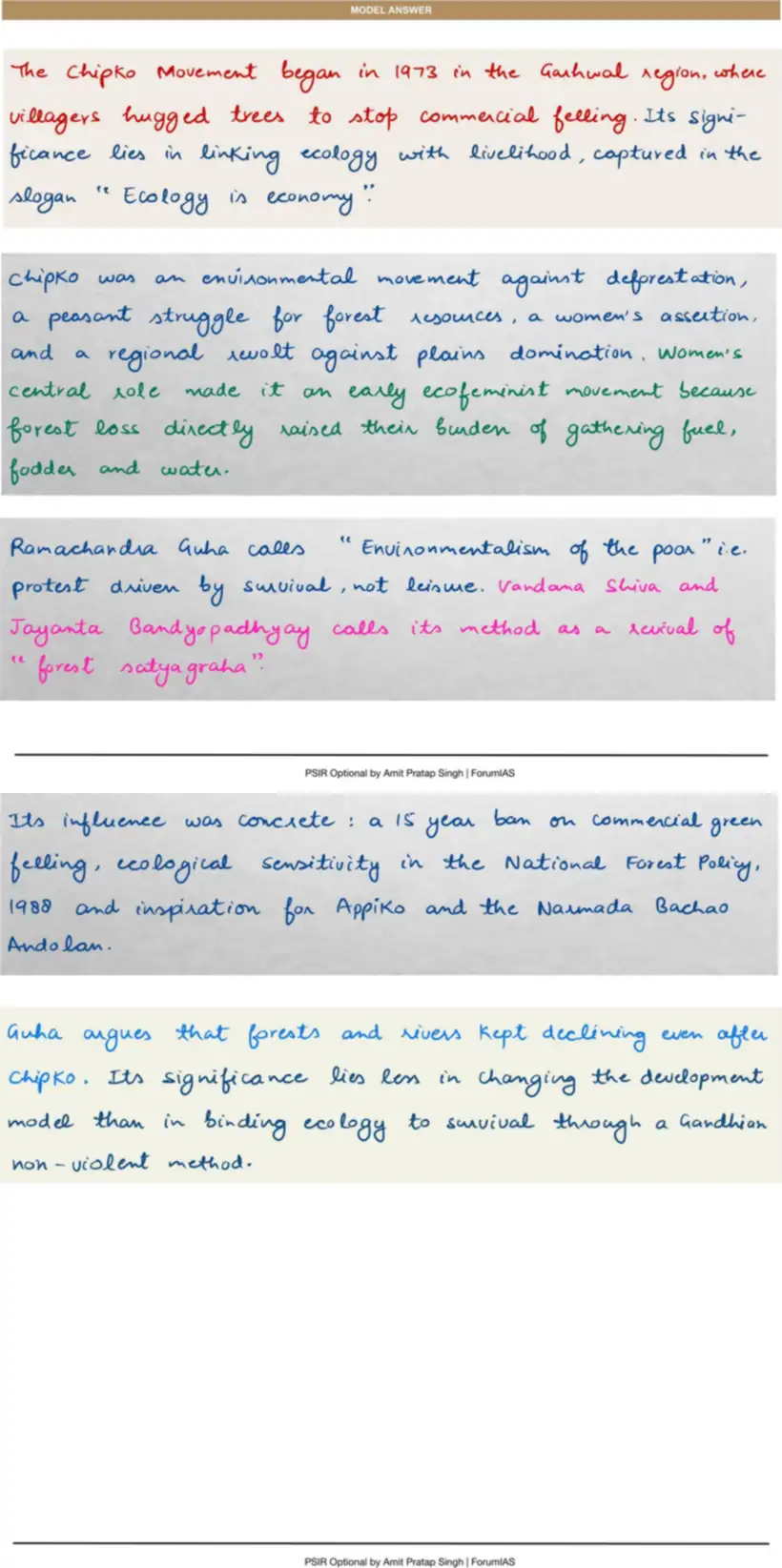
Model answer
Handwritten, in the form it would be written in the examination hall.
Also asked on this head
Social Movements — 9 questions in the Vault.
- “The lack of political will in preventing environmental degradation is one of the major challenges that India is experiencing.” Comment.
- Discuss the role of environmental movements in shaping the environmental governance in India.
- Comment on Women’s role in anti-arrack movement.
How this is taught
The same flow snapshot, built for every head of the syllabus, with the answer written in class.
The first session of Foundation 2027 is published in full.
Six programmes across three levels.