
Examine the nature of the civil liberty movement in India.
How the answer moves
The flow snapshot — the routes in, the body, the counter-view and the routes out.
Route 1 Civil liberty movement defends individual freedom, equality before law and rule of law against an arbitrary state → read its nature through origin, method and limits.
Route 2 Open from colonial roots → demands born of press curbs, racial discrimination, detention → a state-facing struggle from the start.
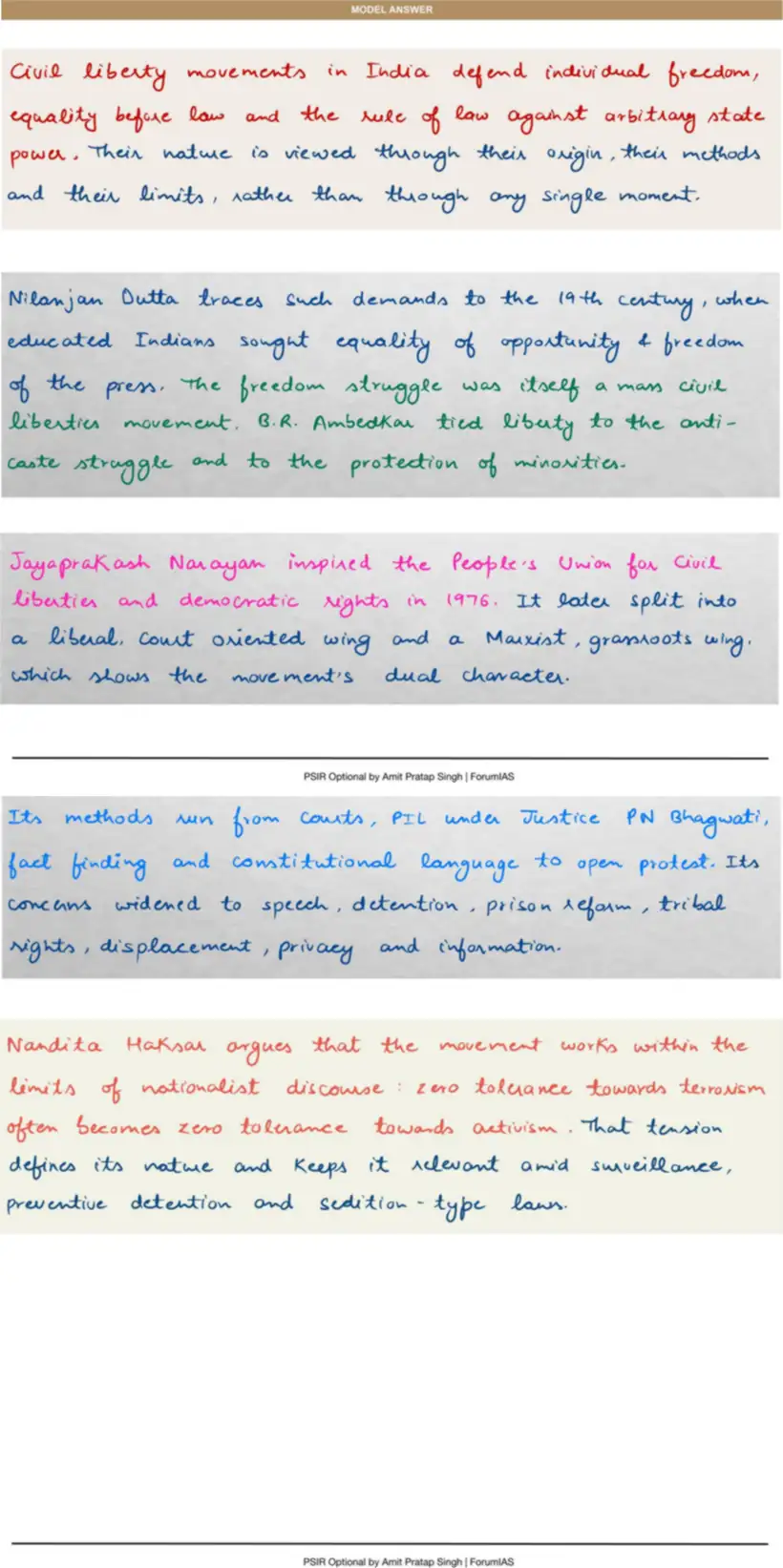
Colonial resistance (press restrictions, racial discrimination in courts, Rowlatt Act, detention without trial) → Nilanjan Dutta, 19th-century demands → freedom struggle as a mass civil liberties movement → Ambedkar links liberty to anti-caste struggle + minority protection → post-independence lull → Naxalite repression + Emergency 1975 revive it → Jayaprakash Narayan → PUCL & DR, 1976 → split: liberal court-oriented wing / Marxist grassroots wing → dual character → methods (courts, PIL under Bhagwati, fact-finding, constitutional language, protest) → widening concerns (speech, detention, prison reform, tribal rights, displacement, privacy, information).
Nandita Haksar → movement bounded by nationalist discourse → zero tolerance towards terrorism becomes zero tolerance towards activism.
Route 1 That tension defines its nature → remains relevant amid surveillance, preventive detention and sedition-type laws.
Route 2 Not one moment but a continuing struggle → plural in method and concern, state-facing throughout.
Model answer
Handwritten, in the form it would be written in the examination hall.
Also asked on this head
Social Movements — 9 questions in the Vault.
- “The lack of political will in preventing environmental degradation is one of the major challenges that India is experiencing.” Comment.
- Discuss the role of environmental movements in shaping the environmental governance in India.
- Comment on Women’s role in anti-arrack movement.
How this is taught
The same flow snapshot, built for every head of the syllabus, with the answer written in class.
The first session of Foundation 2027 is published in full.
Six programmes across three levels.