
Critically analyse the environmentalist movement in Tuticorin, Tamil Nadu.
How the answer moves
The flow snapshot — the routes in, the body, the counter-view and the routes out.
Route 1 Locate the movement → grassroots environmental-justice struggle against Sterlite Copper (Vedanta), Thoothukudi → resistance since the 1990s, peaked 2018 → demand = closure over pollution and health.
Route 2 Frame as a poor-community struggle defending livelihood and health against a polluting plant the state had cleared where others refused.
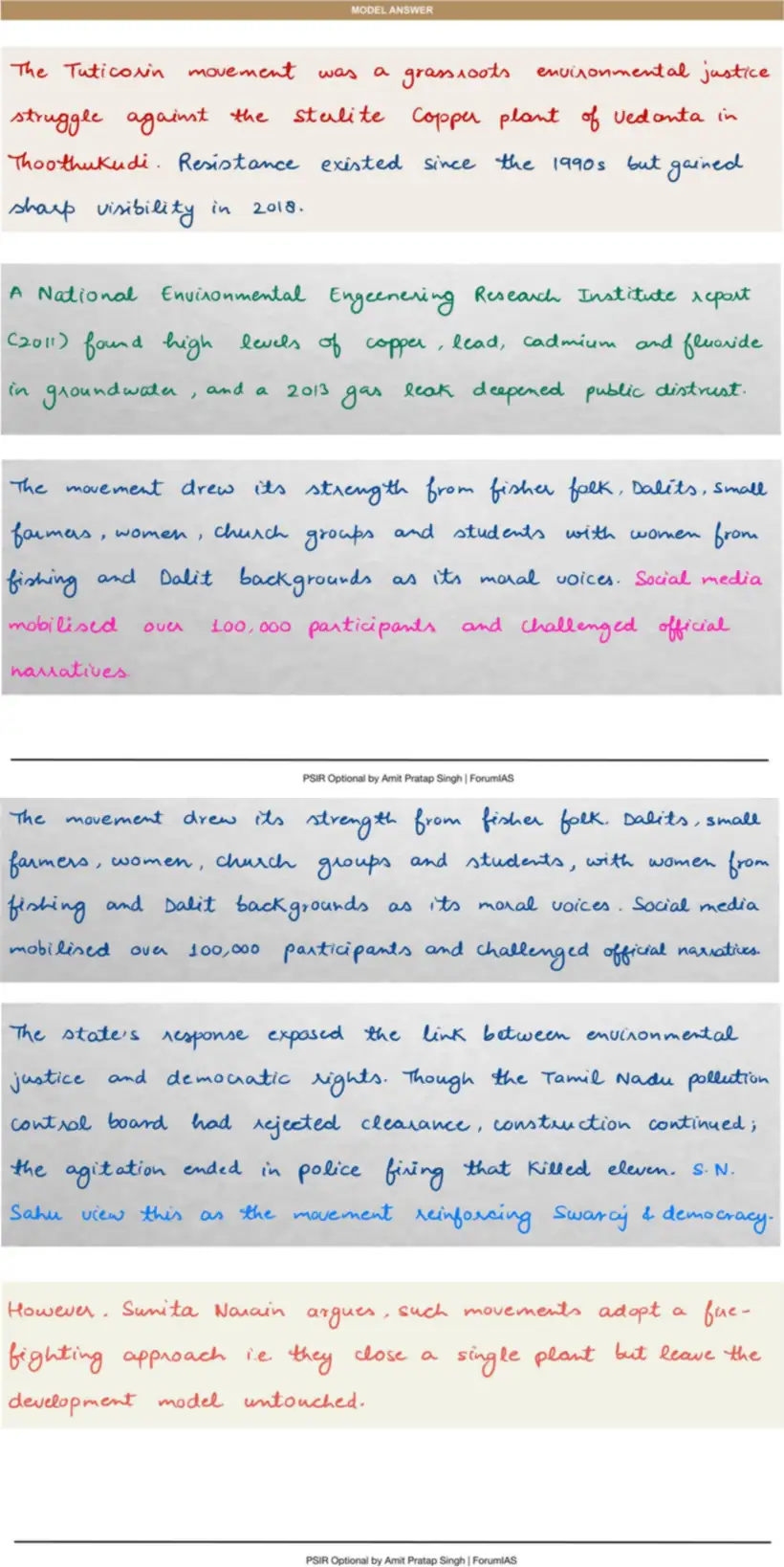
Grievance documented — NEERI report 2011 (copper, lead, cadmium, fluoride in groundwater) + 2013 gas leak → CSE: three states rejected the plant first + faulty EIA → state cleared what others refused (governance failure) → popular base: fisher folk, Dalits, small farmers, women, church groups, students; women as moral voices → social media mobilised 100,000+, challenged official narratives → TNPCB clearance rejected but construction continued → police firing, eleven dead → environmental justice tied to democratic rights → Sahu: reinforcing Swaraj and democracy.
Narain’s fire-fighting critique → closure achieved, development model left untouched → weak environmental governance persists.
Route 1 A real victory for environmental justice and an exposure of governance failure, but bounded by an unchanged development model.
Route 2 Success and limit are the same fact → one plant closed, the paradigm that breeds such conflicts intact.
Model answer
Handwritten, in the form it would be written in the examination hall.
Also asked on this head
Social Movements — 9 questions in the Vault.
- “The lack of political will in preventing environmental degradation is one of the major challenges that India is experiencing.” Comment.
- Discuss the role of environmental movements in shaping the environmental governance in India.
- Comment on Women’s role in anti-arrack movement.
How this is taught
The same flow snapshot, built for every head of the syllabus, with the answer written in class.
The first session of Foundation 2027 is published in full.
Six programmes across three levels.