
Comment on Environmentalism of the poor.
How the answer moves
The flow snapshot — the routes in, the body, the counter-view and the routes out.
Route 1 Concept = ecological struggle of poor and marginal communities → livelihood, health, culture, autonomy at stake → survival, not leisure.
Route 2 Not a post-material luxury → for the poor, protecting forests/land/water is a survival struggle → ties human and ecological survival together.
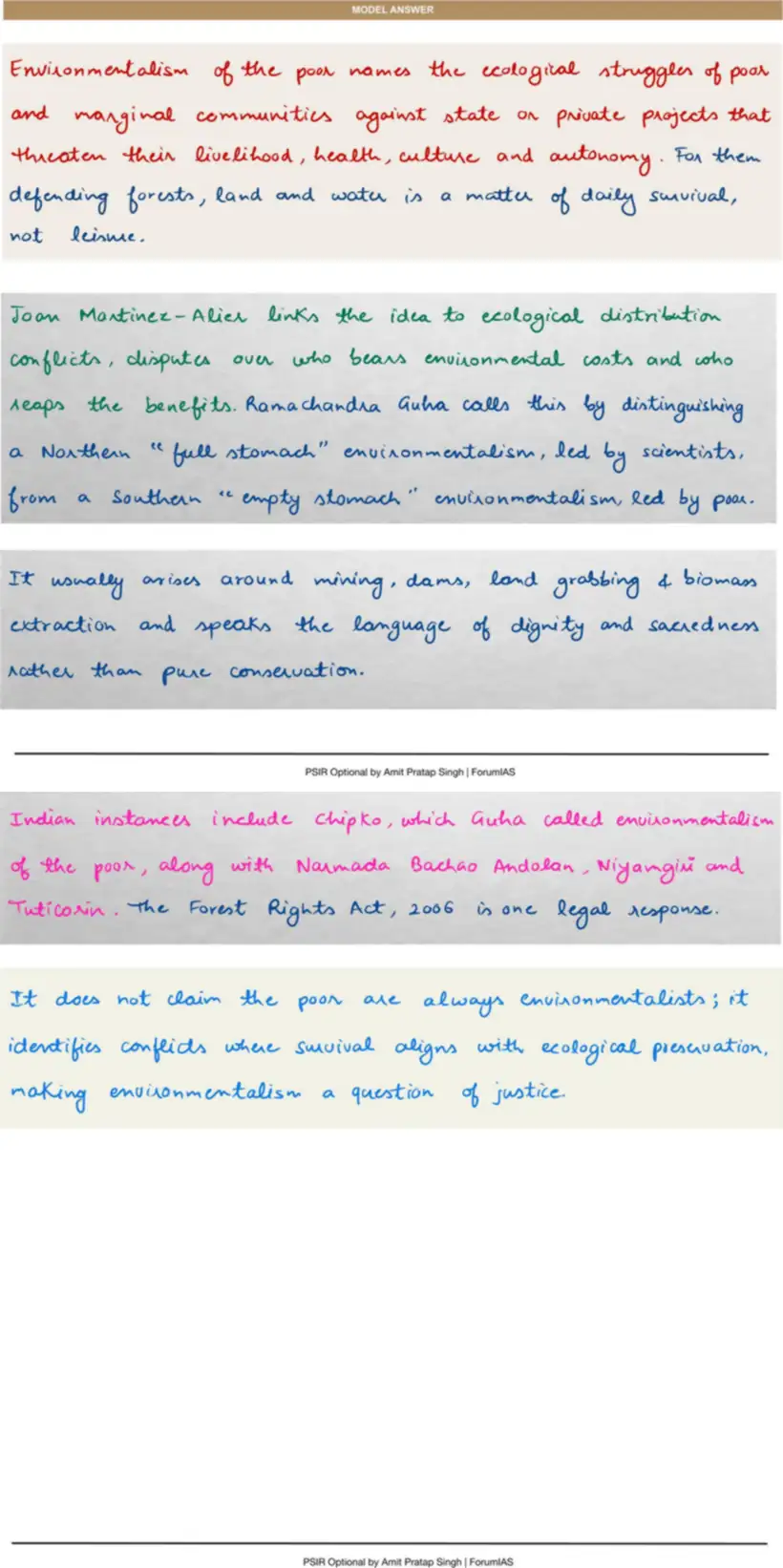
Martinez-Alier: ecological distribution conflicts (who bears costs / who gains) → Guha: Northern “full stomach” (scientists) vs Southern “empty stomach” (the poor) → joins distribution + recognition + participation; human rights = environmental rights → arises around mining, dams, land grabbing, biomass; idiom of dignity and sacredness → Indian cases: Chipko (Guha’s label), Narmada, Niyamgiri, Tuticorin → Forest Rights Act, 2006 as a legal response.
The poor are not always environmentalists → the concept names only conflicts where survival aligns with ecological preservation.
Route 1 Reframes environmentalism as justice — the distribution of ecological benefits and burdens.
Route 2 Ecological protection and human survival are inseparable → environment as equity, not leisure.
Model answer
Handwritten, in the form it would be written in the examination hall.
Also asked on this head
Social Movements — 9 questions in the Vault.
- “The lack of political will in preventing environmental degradation is one of the major challenges that India is experiencing.” Comment.
- Discuss the role of environmental movements in shaping the environmental governance in India.
- Comment on Women’s role in anti-arrack movement.
How this is taught
The same flow snapshot, built for every head of the syllabus, with the answer written in class.
The first session of Foundation 2027 is published in full.
Six programmes across three levels.