
Discuss the role of environmental movements in shaping the environmental governance in India.
How the answer moves
The flow snapshot — the routes in, the body, the counter-view and the routes out.
Route 1 Governance not state-handed → Kohli: societal forces and movements shaped it → local conflicts become national policy questions.
Route 2 Chipko / Silent Valley / Narmada → carry sustainability, justice and equity into a debate that once called ecology a rich-nation luxury.
Activism gives force to Art 48-A + 51-A(g) → new statutes and bodies (EP Act, Forest Conservation Act, FRA, EIA, NGT) → PIL → judiciary as a governance actor → M. C. Mehta cases (Ganga, vehicular emissions, deforestation) → Gadgil: the participatory turn → People’s Biodiversity Registers + Western Ghats report.
Movements are not the sole driver → Sinha: resource-intensive development, not activism alone → Narain: fire-fighting, development model intact → weak implementation / localised / state-corporate / low priority.
Route 1 Rewrote how the environment is governed, not the direction of development.
Route 2 Law + courts + participation reshaped; the structural development model only slowed.
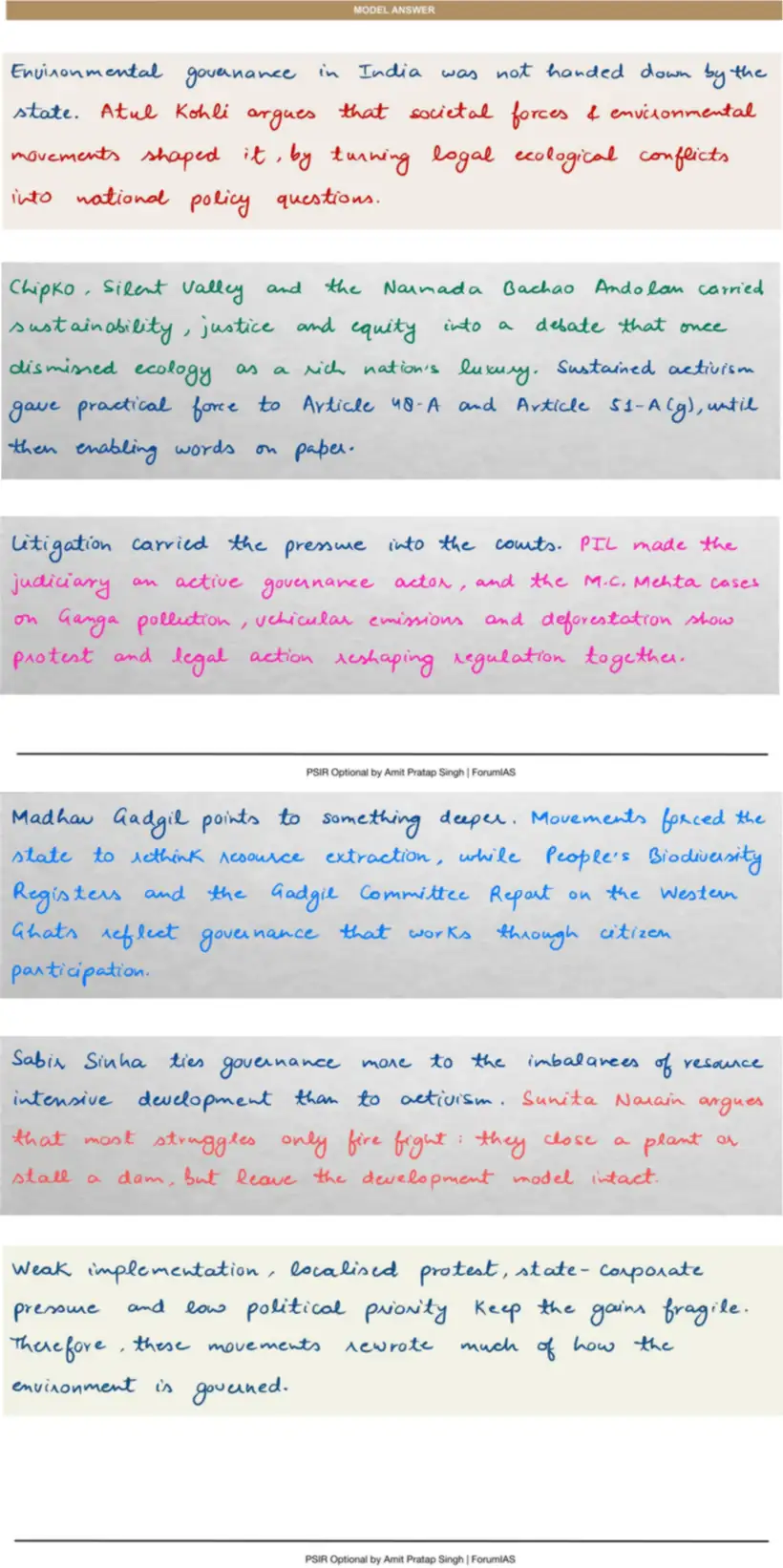
Model answer
Handwritten, in the form it would be written in the examination hall.
Also asked on this head
Social Movements — 9 questions in the Vault.
- “The lack of political will in preventing environmental degradation is one of the major challenges that India is experiencing.” Comment.
- Comment on Women’s role in anti-arrack movement.
- Dr. Ambedkar’s clarion call, “Educate, Agitate and Organize’, strategizes the Dalit movement towards achieving civil liberty. Discuss.
How this is taught
The same flow snapshot, built for every head of the syllabus, with the answer written in class.
The first session of Foundation 2027 is published in full.
Six programmes across three levels.