
Explain the Political-Sociological Approach in the field of comparative politics and discuss its limitations.
How the answer moves
The flow snapshot — the routes in, the body, the counter-view and the routes out.
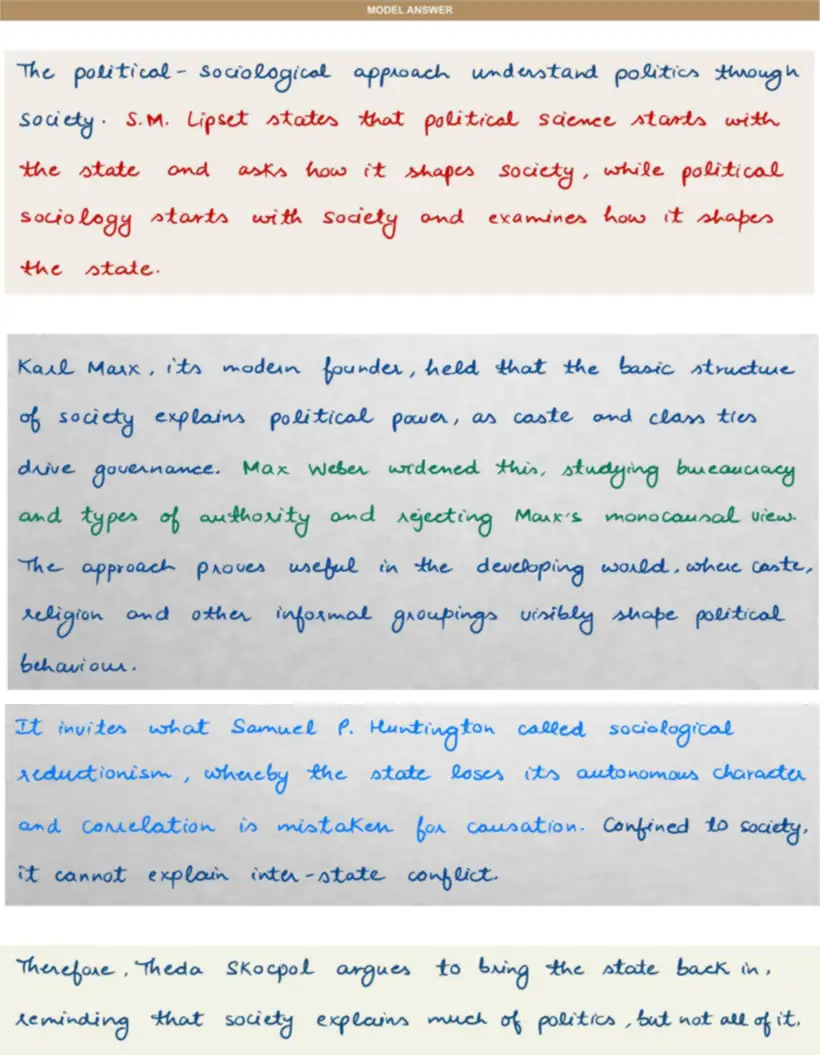
Route 1 politics read through society → Lipset’s inversion: society as the starting point, its effect on the state → this inversion = the founding claim
Route 2 approach maps state–society relations → begins from society, not the state → frames its comparative-politics use
Marx (modern founder): society’s basic structure explains political power → caste–class ties drive governance → Weber widens it: bureaucracy + types of authority, Marx’s view too monocausal → strength in the developing world → caste, religion, informal groupings shape political behaviour
the tilt toward society becomes its weakness → Huntington: sociological reductionism → state loses autonomy + correlation mistaken for causation → confined to society, blind to inter-state conflict
Route 1 Skocpol: bring the state back in → society explains much of politics, not all
Route 2 strength and limitation are one coin → the state must be restored for a complete account
Model answer
Handwritten, in the form it would be written in the examination hall.
Also asked on this head
Comparative Politics — 15 questions in the Vault.
- Extractive capitalism (150 words)
- Criticism of the institutional approach in comparative political analysis has come up in successive waves. Comment. (150 words)
- The modernization thesis asserts that affluence breeds stable democracy. How do you explain the success of India being the world’s largest democracy as an exceptional case?
How this is taught
The same flow snapshot, built for every head of the syllabus, with the answer written in class.
The first session of Foundation 2027 is published in full.
Six programmes across three levels.