
What are the crucial functions of empirical political theory in Comparative Politics?
How the answer moves
The flow snapshot — the routes in, the body, the counter-view and the routes out.
Route 1 EPT = abstract facts → generalisations + hypotheses → tested against evidence → gives CP its scientific character
Route 2 Popper: deductive side → proposition first → empirical research verifies against facts → functions flow from this
empirical testing of assumptions (median voter theorem) → systematic comparative analysis across countries → prediction of trends → policy evaluation → democratic processes (electoral systems/parties/voter behaviour) → institutional analysis → advanced statistical methods → Lijphart & Dahl: essential to understanding systems → replication (King, Keohane, Verba: shared goal = logical inference) → refine/build new theories
purely empirical focus can neglect the state → concept of political system left elusive
Route 1 EPT makes comparative knowledge cumulative + testable, not merely descriptive
Route 2 strength lies in replication → scientific, theory-building character is EPT’s core contribution to CP
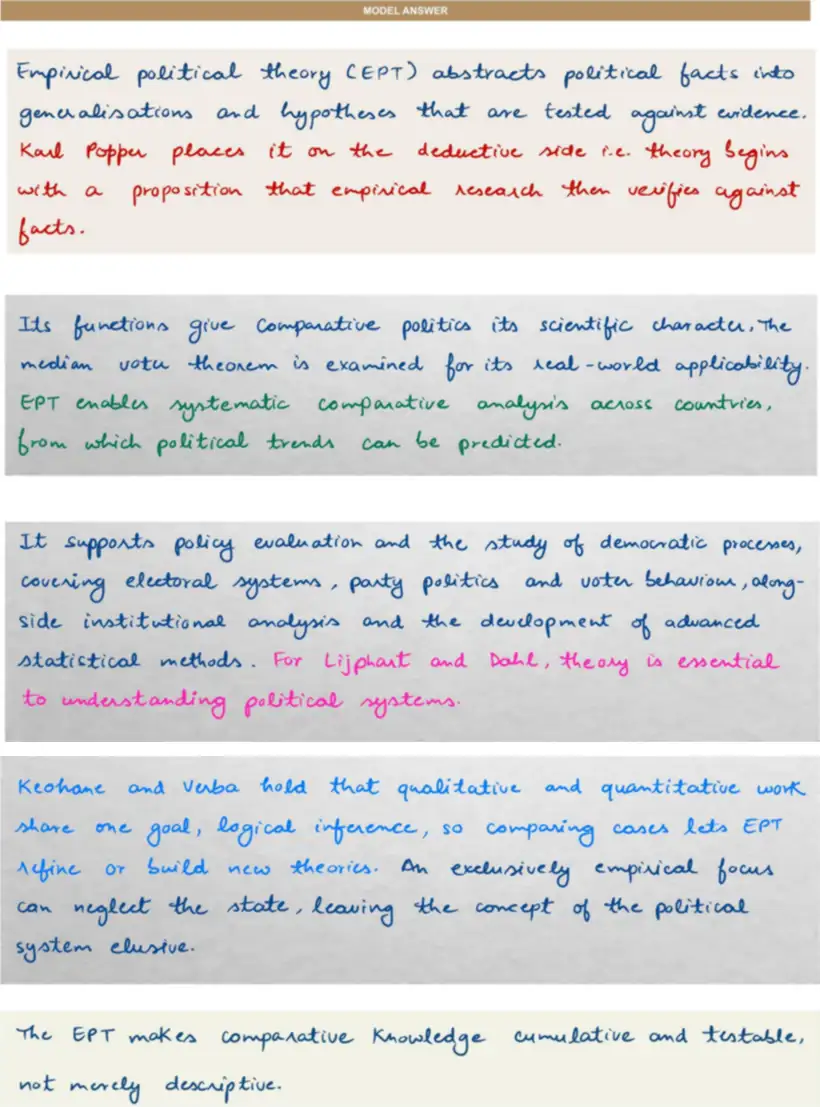
Model answer
Handwritten, in the form it would be written in the examination hall.
Also asked on this head
Comparative Politics — 15 questions in the Vault.
- Extractive capitalism (150 words)
- Criticism of the institutional approach in comparative political analysis has come up in successive waves. Comment. (150 words)
- The modernization thesis asserts that affluence breeds stable democracy. How do you explain the success of India being the world’s largest democracy as an exceptional case?
How this is taught
The same flow snapshot, built for every head of the syllabus, with the answer written in class.
The first session of Foundation 2027 is published in full.
Six programmes across three levels.