
Discuss the interpretive approach to the study of comparative politics.
How the answer moves
The flow snapshot — the routes in, the body, the counter-view and the routes out.
Route 1 approach recovers meanings actors attach to actions → culture/ideas/interpretation over empirical–structural factors
Route 2 politics read through meaning, not measurement → positivist empirical lens set aside
Geertz + Taylor: culture/ideas shape action → Geertz’s thick description: behaviour read through cultural context, not outward acts → constructivism: actors shaped by social constructions of reality → defined against rational choice: self-interest vs beliefs/emotions/norms → Snyder’s contextualized comparisons: events within own cultural–historical–ideological frame → fits non-Western societies
weak generalisation → risk of cultural relativism → difficulty of cross-cultural interpretation
Route 1 trades predictive breadth for depth of meaning
Route 2 restores meaning to a discipline long drawn to measurement
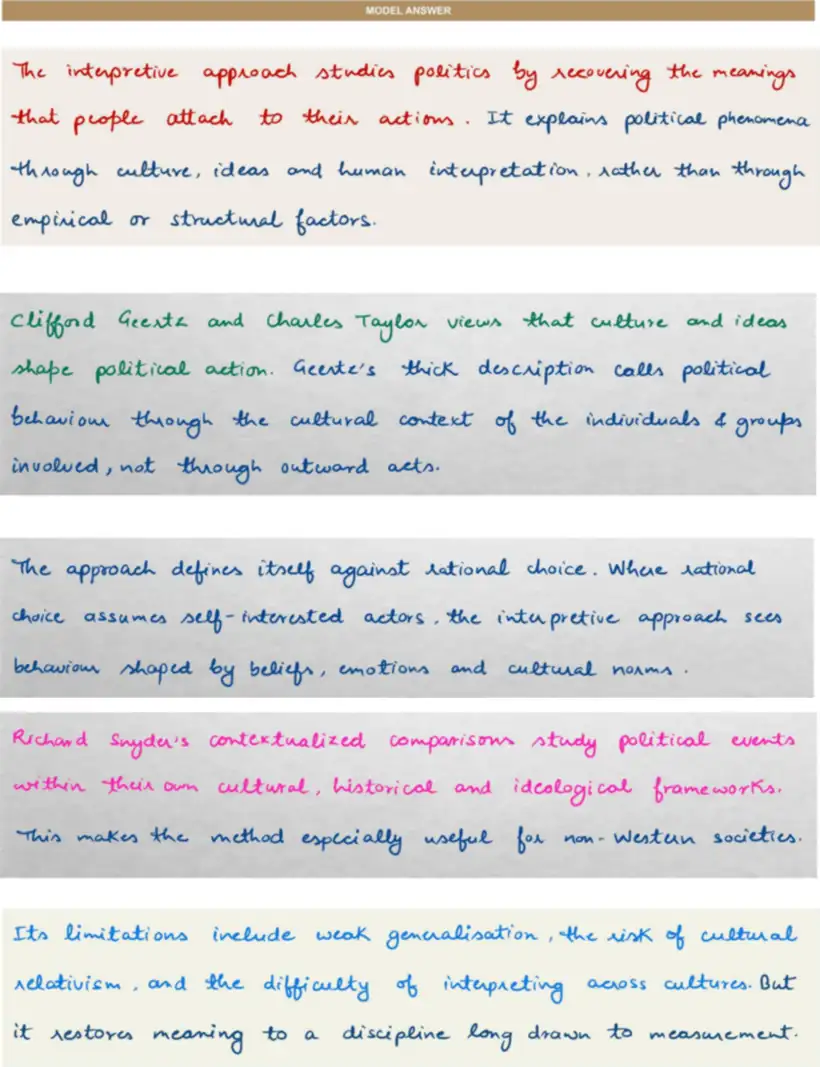
Model answer
Handwritten, in the form it would be written in the examination hall.
Also asked on this head
Comparative Politics — 15 questions in the Vault.
- Extractive capitalism (150 words)
- Criticism of the institutional approach in comparative political analysis has come up in successive waves. Comment. (150 words)
- The modernization thesis asserts that affluence breeds stable democracy. How do you explain the success of India being the world’s largest democracy as an exceptional case?
How this is taught
The same flow snapshot, built for every head of the syllabus, with the answer written in class.
The first session of Foundation 2027 is published in full.
Six programmes across three levels.