
Describe the changing nature of Comparative Politics. Briefly explain the Political Economy approach to the study of Comparative Politics.
How the answer moves
The flow snapshot — the routes in, the body, the counter-view and the routes out.
Route 1 CP defined by method, not subject matter → the method itself keeps being redefined
Route 2 formal-legal description → scientific, process-based analysis → contemporary interdisciplinary phase
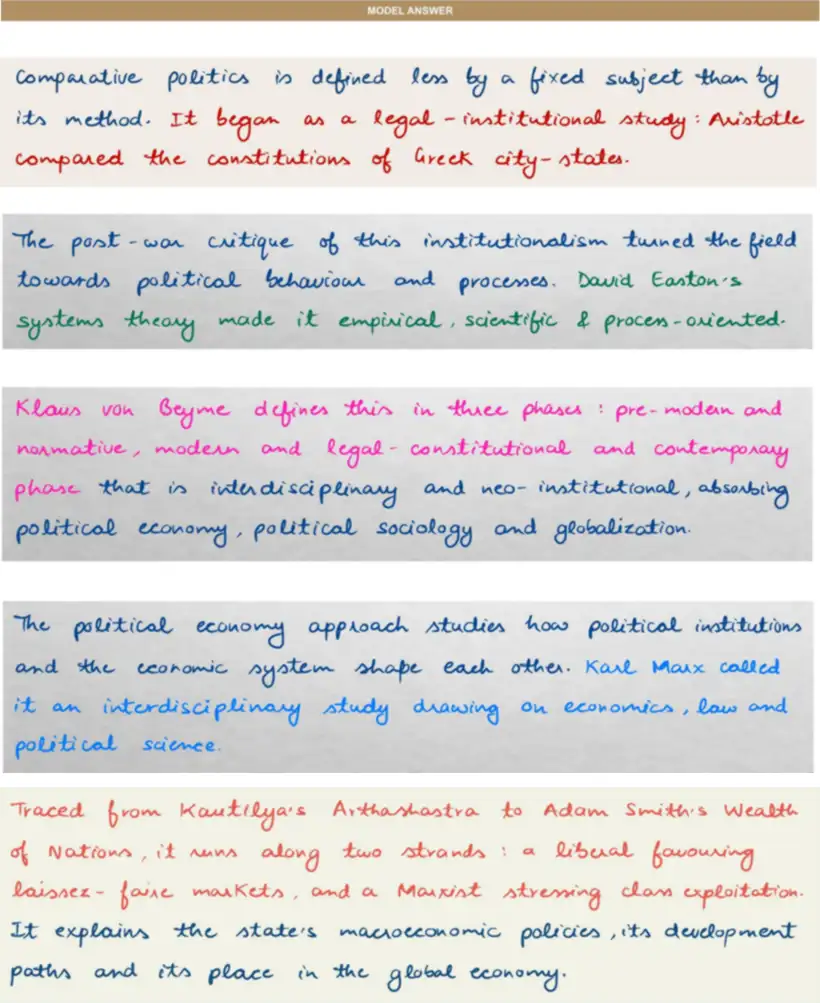
legal-institutional origin (Aristotle; description over analysis) → post-war critique of institutionalism → behavioural/process turn → Easton’s systems theory (empirical, scientific) → von Beyme’s three phases: pre-modern → modern → contemporary/interdisciplinary → contemporary phase absorbs political economy → PE: politics and economy shape each other (Marx — interdisciplinary) → roots: Kautilya’s Arthashastra → Smith’s Wealth of Nations → PE explains state’s macroeconomic policy, development, global economy
the two strands inside PE pull opposite ways: liberal laissez-faire markets vs Marxist class exploitation
Route 1 PE as one product of CP’s contemporary, interdisciplinary turn
Route 2 PE ties domestic institutions and state policy to the global economy
Model answer
Handwritten, in the form it would be written in the examination hall.
Also asked on this head
Comparative Politics — 15 questions in the Vault.
- Extractive capitalism (150 words)
- Criticism of the institutional approach in comparative political analysis has come up in successive waves. Comment. (150 words)
- The modernization thesis asserts that affluence breeds stable democracy. How do you explain the success of India being the world’s largest democracy as an exceptional case?
How this is taught
The same flow snapshot, built for every head of the syllabus, with the answer written in class.
The first session of Foundation 2027 is published in full.
Six programmes across three levels.