
Discuss the political socialization of open and closed societies.
How the answer moves
The flow snapshot — the routes in, the body, the counter-view and the routes out.
Route 1 define via Easton & Dennis → acquiring political orientations → character set by the system it serves
Route 2 socialization as a universal function (Almond & Verba: sustains the system) → but its content is regime-dependent
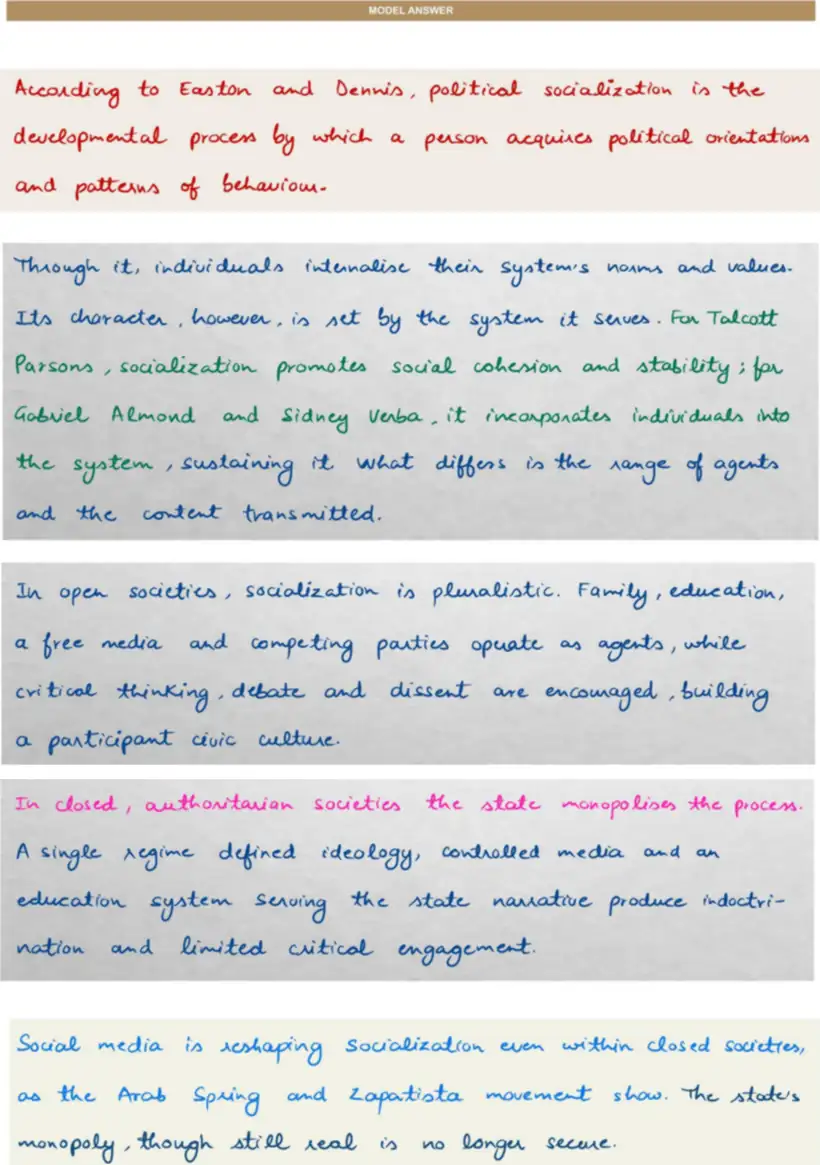
common function (Parsons: cohesion + stability; Almond & Verba: incorporate, sustain) → what differs = agents + content → open societies: plural agents, critical thinking, debate, dissent, participant civic culture → closed societies: state monopoly, single regime ideology, controlled media, schooling serves state narrative, indoctrination
binary under strain → social media reshaping socialization even in closed societies → Arab Spring, Zapatista
Route 1 open–closed distinction holds, but the state monopoly is no longer secure in the digital age
Route 2 same universal function turned to opposite ends → citizens in open societies, subjects in closed ones
Model answer
Handwritten, in the form it would be written in the examination hall.
Also asked on this head
Comparative Politics — 15 questions in the Vault.
- Extractive capitalism (150 words)
- Criticism of the institutional approach in comparative political analysis has come up in successive waves. Comment. (150 words)
- The modernization thesis asserts that affluence breeds stable democracy. How do you explain the success of India being the world’s largest democracy as an exceptional case?
How this is taught
The same flow snapshot, built for every head of the syllabus, with the answer written in class.
The first session of Foundation 2027 is published in full.
Six programmes across three levels.