
Discuss the main limitations of the comparative method to the study of Political Science.
How the answer moves
The flow snapshot — the routes in, the body, the counter-view and the routes out.
Route 1 comparison is the sub-discipline’s defining method (Lijphart: method, not substance) → but the method itself is limited
Route 2 comparison stands in for the laboratory control social science lacks (Sartori) → yet that scientific promise is only partly met
subject resists science (behaviour not purely rational → no uniform scientific method → individuals & institutions follow no fixed rules → scarce data on systems and non-state actors) → comparison distorts (generalisation from few cases → systems too different or too alike resist it: India vs Bahrain → concepts travel badly, Sartori’s conceptual stretching) → bias intrudes (cases picked to fit a prior view → Macridis: non-comparative, descriptive, parochial, Eurocentric → Marxist charge: systems approach status-quoist, Western as ideal)
flaws temper the method, not discredit it → careful operationalisation + Landman’s moderate universalism keep comparison workable
Route 1 read comparative findings as provisional generalisations, not scientific laws
Route 2 despite its limits, comparison still widens political science beyond the West
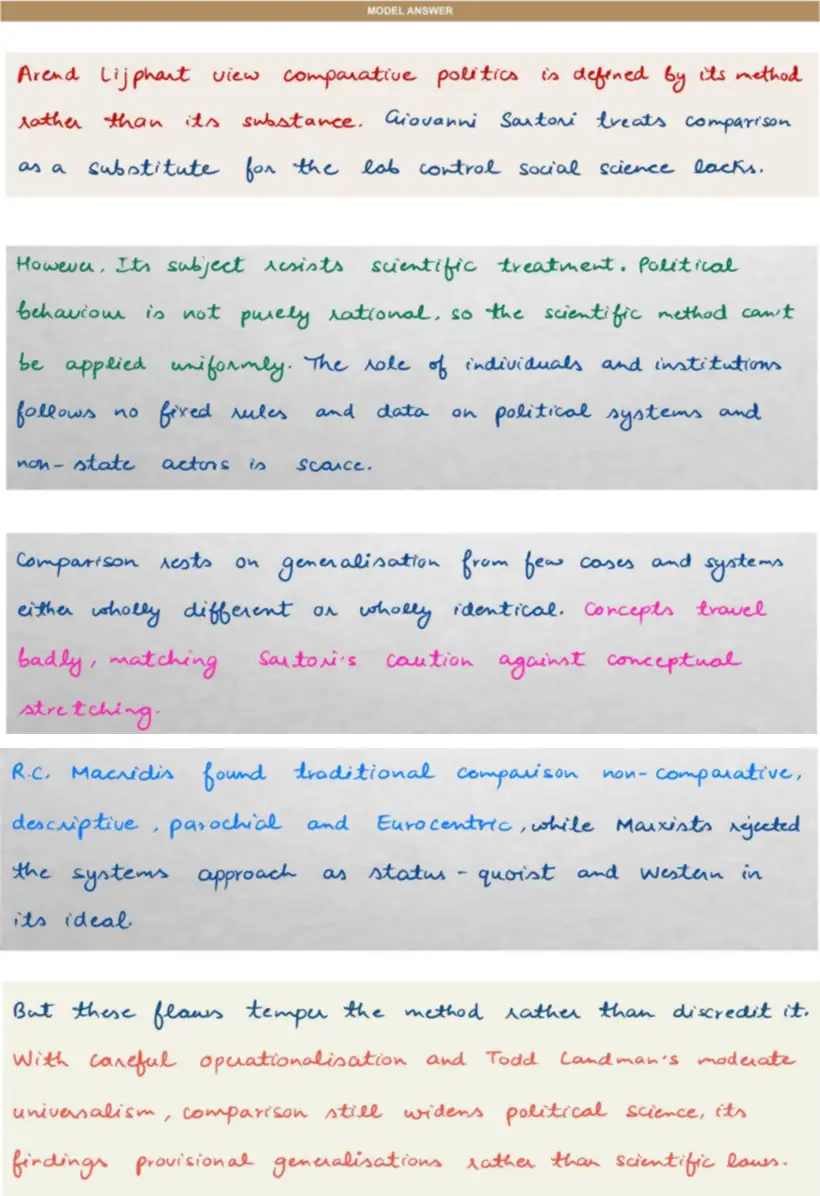
Model answer
Handwritten, in the form it would be written in the examination hall.
Also asked on this head
Comparative Politics — 15 questions in the Vault.
- Extractive capitalism (150 words)
- Criticism of the institutional approach in comparative political analysis has come up in successive waves. Comment. (150 words)
- The modernization thesis asserts that affluence breeds stable democracy. How do you explain the success of India being the world’s largest democracy as an exceptional case?
How this is taught
The same flow snapshot, built for every head of the syllabus, with the answer written in class.
The first session of Foundation 2027 is published in full.
Six programmes across three levels.