
Examine the significance of the comparative method in political analysis. Discuss its limitations.
How the answer moves
The flow snapshot — the routes in, the body, the counter-view and the routes out.
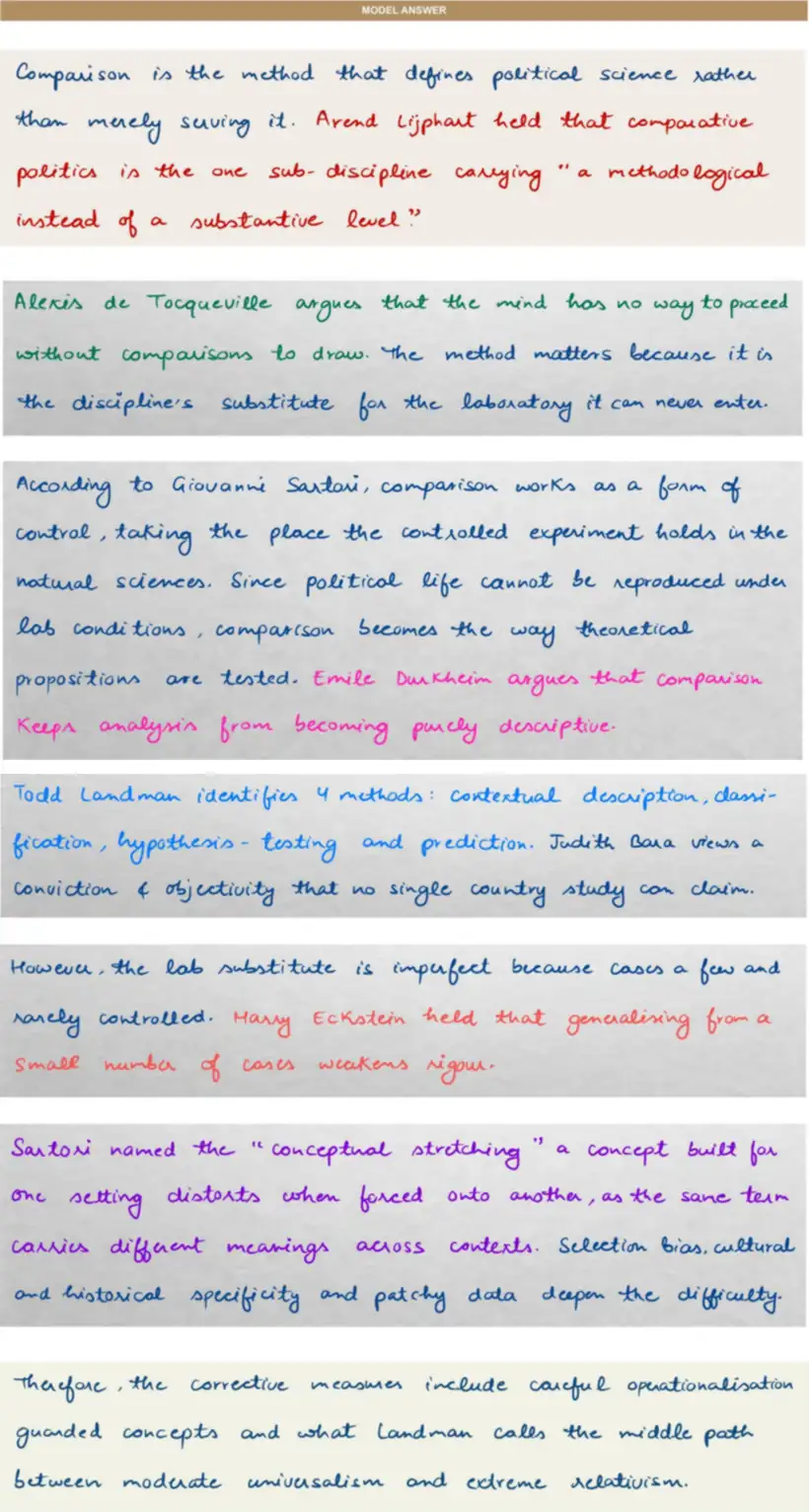
Route 1 method defines the sub-discipline, not its subject (Lijphart) → comparison = political science’s laboratory-substitute
Route 2 the mind cannot proceed without comparison (Tocqueville) → comparison-as-control is the discipline’s core method
Sartori: comparison works as control, the surrogate for the experiment social science cannot run → it tests theoretical propositions → Durkheim: keeps analysis from staying purely descriptive → Landman: four functions (description → classification → hypothesis-testing → prediction) → Bara: a conviction and objectivity single-country study cannot claim
the surrogate is imperfect because political life resists laboratory control → Eckstein: small N weakens rigour → Sartori: conceptual stretching + non-equivalence of concepts across contexts → selection bias, cultural/historical specificity, patchy data
Route 1 the flaws limit the method, they do not discredit it → corrective is care: operationalisation + guarded concepts → comparison stays indispensable
Route 2 Landman’s middle path — moderate universalism vs extreme relativism → used with awareness of its limits, comparison remains political analysis’s central tool
Model answer
Handwritten, in the form it would be written in the examination hall.
Also asked on this head
Comparative Politics — 15 questions in the Vault.
- Extractive capitalism (150 words)
- Criticism of the institutional approach in comparative political analysis has come up in successive waves. Comment. (150 words)
- The modernization thesis asserts that affluence breeds stable democracy. How do you explain the success of India being the world’s largest democracy as an exceptional case?
How this is taught
The same flow snapshot, built for every head of the syllabus, with the answer written in class.
The first session of Foundation 2027 is published in full.
Six programmes across three levels.