
Discuss the subject matter of comparative politics. Outline the limitations of comparative political analysis.
How the answer moves
The flow snapshot — the routes in, the body, the counter-view and the routes out.
Route 1 CP defined by method, not substance (Lijphart) → subject matter is fluid, widening as the discipline grows
Route 2 comparison as the analytical core → what it compares expands from institutions to the whole political process
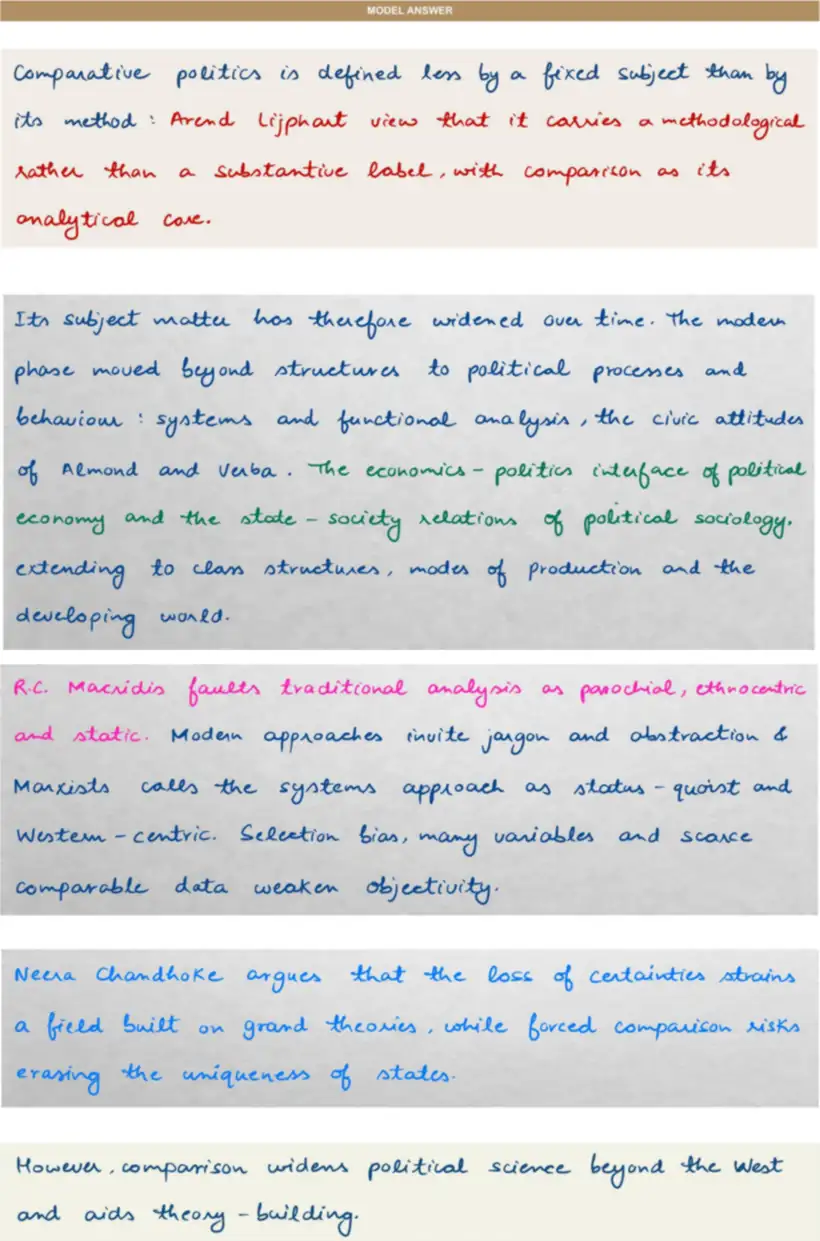
traditional subject matter: formal institutions/constitutions/forms of government, mostly Western → modern shift to political processes + behaviour → systems & functional analysis → political culture, civic attitudes (Almond & Verba) → political economy (economics–politics) → political sociology (state–society) → class structures + modes of production + developing world
Macridis: parochial/ethnocentric/static → modern approaches: jargon + abstraction; Marxists: status-quoist + Western-centric → selection bias/many variables/scarce data weaken objectivity → Chandhoke: loss of certainties strains a grand-theory field → over-comparison erases the uniqueness of states
Route 1 limitations real but not disabling → CP still widens political science beyond the West, aids theory-building
Route 2 the same breadth that limits also enriches → value lies in comparison handled with care, against conceptual stretching
Model answer
Handwritten, in the form it would be written in the examination hall.
Also asked on this head
Comparative Politics — 15 questions in the Vault.
- Extractive capitalism (150 words)
- Criticism of the institutional approach in comparative political analysis has come up in successive waves. Comment. (150 words)
- The modernization thesis asserts that affluence breeds stable democracy. How do you explain the success of India being the world’s largest democracy as an exceptional case?
How this is taught
The same flow snapshot, built for every head of the syllabus, with the answer written in class.
The first session of Foundation 2027 is published in full.
Six programmes across three levels.