
Discuss the political economy approach to the comparative analysis of politics.
How the answer moves
The flow snapshot — the routes in, the body, the counter-view and the routes out.
Route 1 polity and economy shape each other → Marx: interdisciplinary study (economics, law, politics)
Route 2 Oxford Handbook definition — state’s economic policies + processes → Kautilya’s Arthashastra → Smith: modern political economy born
two strands → liberal ( → Hayek, Friedman): free markets, minimal state → Marxist (Frank dependency, Wallerstein world-systems): core–periphery exploitation → comparative payoff → regularities & causal mechanisms across systems → corporation–government links & autocracy-vs-democracy policy differences → global integration alters state decisions
economic determinism → Kenworthy: ignores historical, political, cultural contexts
Route 1 PE compares systems through the economy–polity interface → shows why policy and regime behaviour differ, as institutions alone cannot
Route 2 hold its comparative value but read with cultural and institutional context (Kenworthy), not economic reductionism
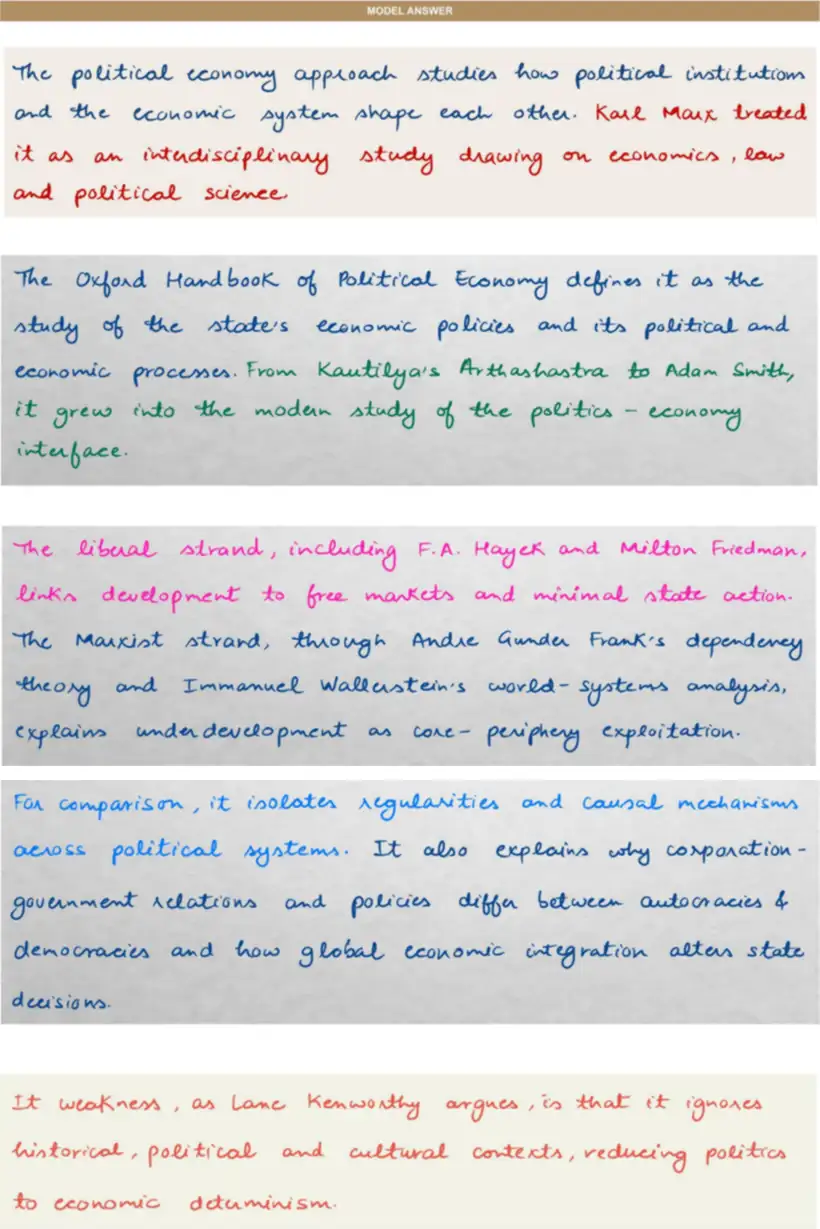
Model answer
Handwritten, in the form it would be written in the examination hall.
Also asked on this head
Comparative Politics — 15 questions in the Vault.
- Extractive capitalism (150 words)
- Criticism of the institutional approach in comparative political analysis has come up in successive waves. Comment. (150 words)
- The modernization thesis asserts that affluence breeds stable democracy. How do you explain the success of India being the world’s largest democracy as an exceptional case?
How this is taught
The same flow snapshot, built for every head of the syllabus, with the answer written in class.
The first session of Foundation 2027 is published in full.
Six programmes across three levels.