
Discuss the psychological approach to the study of comparative politics.
How the answer moves
The flow snapshot — the routes in, the body, the counter-view and the routes out.
Route 1 inner human dimension (motivation, belief, perception, personality) over institutions → challenges rational-actor model
Route 2 politics as human behaviour → emotion + cognition drive voting, participation, leadership across systems
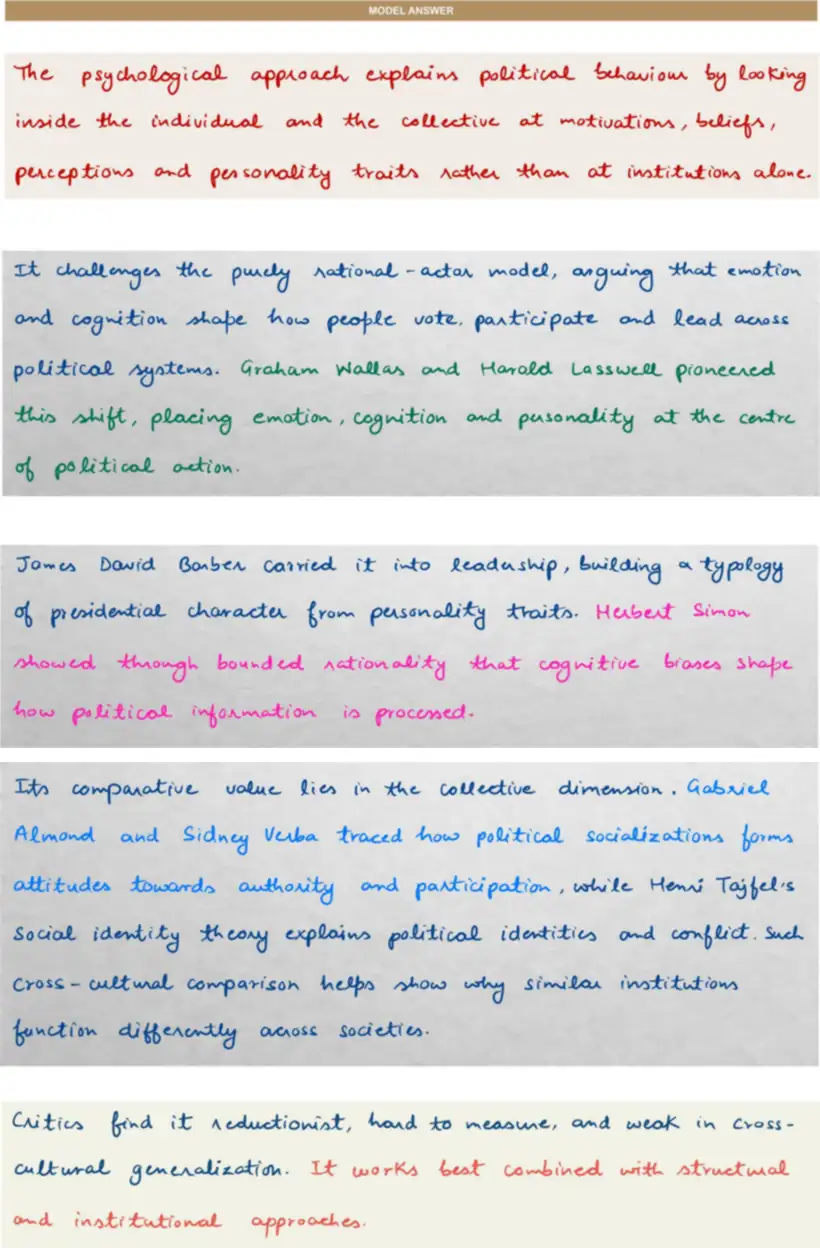
Wallas/Lasswell pioneer emotion–cognition–personality → Barber: personality typology of leadership → Simon: bounded rationality, cognitive bias in processing → collective turn: Almond & Verba (socialization → attitudes to authority/participation) → Tajfel (social identity → political identities/conflict) → cross-cultural comparison explains why similar institutions function differently
reductionism vs multi-causal politics → difficulty measuring psychological variables → weak cross-cultural generalization
Route 1 not a standalone key → strongest when fused with structural/institutional approaches
Route 2 inner dimension completes, does not replace, institutional analysis
Model answer
Handwritten, in the form it would be written in the examination hall.
Also asked on this head
Comparative Politics — 15 questions in the Vault.
- Extractive capitalism (150 words)
- Criticism of the institutional approach in comparative political analysis has come up in successive waves. Comment. (150 words)
- The modernization thesis asserts that affluence breeds stable democracy. How do you explain the success of India being the world’s largest democracy as an exceptional case?
How this is taught
The same flow snapshot, built for every head of the syllabus, with the answer written in class.
The first session of Foundation 2027 is published in full.
Six programmes across three levels.