
Transnational actors have qualitatively transformed the world by the way of their fresh insights and actions. Illustrate your answer with suitable examples.
How the answer moves
The flow snapshot — the routes in, the body, the counter-view and the routes out.
Route 1 Thiel: cross-border agents pursuing goals independently of governments → impact is qualitative, not additional → interstate cooperation gives way to multi-actor governance
Route 2 open with the shift itself: rules once written only by states → today ideas, delivery and legitimacy come from outside them → place Thiel’s definition inside that shift
fresh insights = ideas → advocacy networks + epistemic communities + World Bank / UNESCO → knowledge, agenda-setting, norm diffusion → persuasion, not command → winning coalitions built with domestic actors → Risse → then actions → MSF + Amnesty in Syria, Myanmar, Ukraine → Simmons: agenda, negotiation, legitimacy → MNCs (Google, Amazon, Apple) on tax and labour → Nye: direct and indirect pressure → Taliban and Hamas win recognition → state response → Scholte: post-sovereign governance (Basel, OECD, FATF) → formal inclusion: Cardoso Report, Global Compact
realists: these actors run on state sponsorship, no independent role → feminists: MNC policies harm women → Buzan: state remains the principal security provider
Route 1 the transformation is qualitative → rule-making, implementation and legitimacy are now shared tasks
Route 2 states remain central but are no longer the sole authors of world order → governance is multi-actor, not post-state
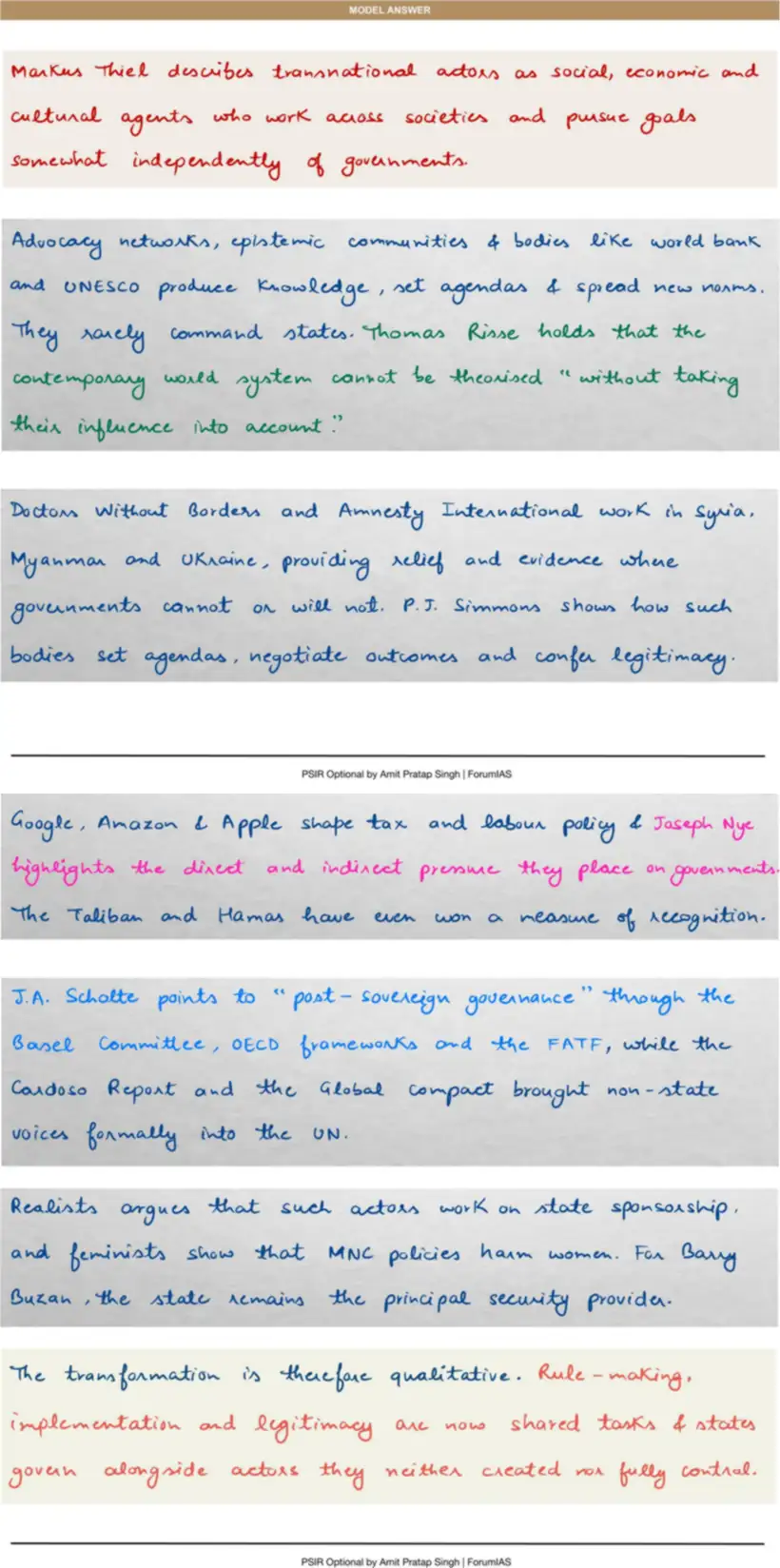
Model answer
Handwritten, in the form it would be written in the examination hall.
Also asked on this head
Key Concepts in International Relations — 16 questions in the Vault.
- Diplomacy has always rested on two pillars: Institutional memory and individual craft. Elaborate.
- Discuss various methods of Balance of Power. (150 words)
- Collective security and responsibility to protect (R2P) are similar but different in scope, goals and methods. Explain.
How this is taught
The same flow snapshot, built for every head of the syllabus, with the answer written in class.
The first session of Foundation 2027 is published in full.
Six programmes across three levels.