
Discuss the evolution of non-proliferation of nuclear weapons in the post-Cold War period.
How the answer moves
The flow snapshot — the routes in, the body, the counter-view and the routes out.
Route 1 regime built for two-power management → after 1991 agenda widens, authority does not → that gap = the evolution
Route 2 post-1991 record = new treaties, new summits, a prohibition → none of them binds the states holding the weapons
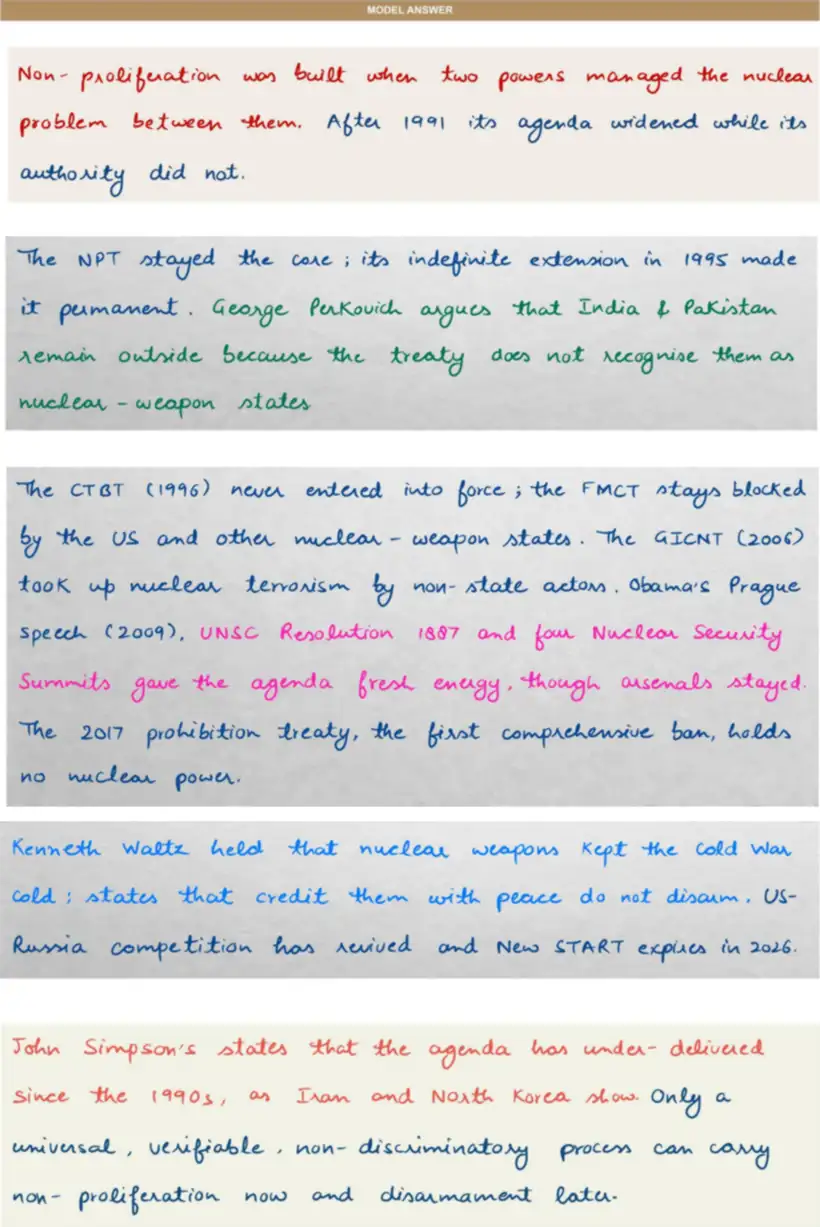
NPT stays the core → 1995 indefinite extension = permanence → Perkovich: India, Pakistan outside, non-recognition → 1995 freezes the exclusion → deepening stalls: CTBT (1996) not in force, FMCT blocked by US + other weapon states → growth turns sideways → GICNT (2006): non-state actors, nuclear terrorism → Obama push: Prague (2009), UNSC 1887, four Nuclear Security Summits → energy renewed, arsenals stay → 2017 prohibition treaty: first comprehensive ban, no nuclear power inside
Waltz: weapons kept the Cold War cold → holders will not disarm what they credit with peace → US–Russia competition revived, New START expiring 2026
Route 1 Simpson: under-delivery since the 1990s (Iran, North Korea) → universal, verifiable, non-discriminatory process → non-proliferation now, disarmament later
Route 2 the period added instruments, not authority → the regime grew in law while consent stayed where 1991 left it
Model answer
Handwritten, in the form it would be written in the examination hall.
Also asked on this head
Changing International Political Order — 21 questions in the Vault.
- Does power transition theory reflect the dynamics of US-China relations?
- NATO, the oldest surviving collective security system, is facing challenge of transactional coercion from its own biggest member. What future does NATO have amidst such developments?
- The expansionist tendencies of the current Russian regime indicate its intentions for the realisation of a Greater Russia on the lines of the Soviet era. Comment....
How this is taught
The same flow snapshot, built for every head of the syllabus, with the answer written in class.
The first session of Foundation 2027 is published in full.
Six programmes across three levels.