
‘Uniting for Consensus’ also known as ‘Coffee Club’
How the answer moves
The flow snapshot — the routes in, the body, the counter-view and the routes out.
Route 1 locate group: mid-1990s, Italy-led “Coffee Club”, ~50 states → line: objections blend principle (no new permanent privilege) + regional rivalry
Route 2 1945 Council frozen → G4 seeks permanent seats → UfC forms as the counter-coalition → its objections now define the reform deadlock
Objection 1: new permanent seats “freeze privilege” → widen small-elite-vs-membership divide → expand an existing oligarchy → Objection 2: veto untouched → deepens democratic deficit, no cure for paralysis → UfC alternative (March 2024): enlarge only elected tier, longer/re-electable seats → rotation + accountability + geographic balance → Objection 3: Article 108 → two-thirds GA + all five ratify → reform must rest on widest consensus → underlying motive: regional rivalry (Pakistan v India, Italy v Germany) → think-tank reading
India rejects the model → Kamboj (2024): ignores Africa / Global South, “just vetoes the process” → calls for “UN 2.0” → yet UfC numbers block the two-thirds majority → reform stuck without an agreed text
Route 1 objections coherent in principle yet selective in effect → democratic language + regional rivalry + Charter rigidity → entrenches the order it claims to reform
Route 2 objections are real constraints, not mere obstruction → but deadlock persists → any breakthrough needs the consensus UfC’s veto-on-privilege denies
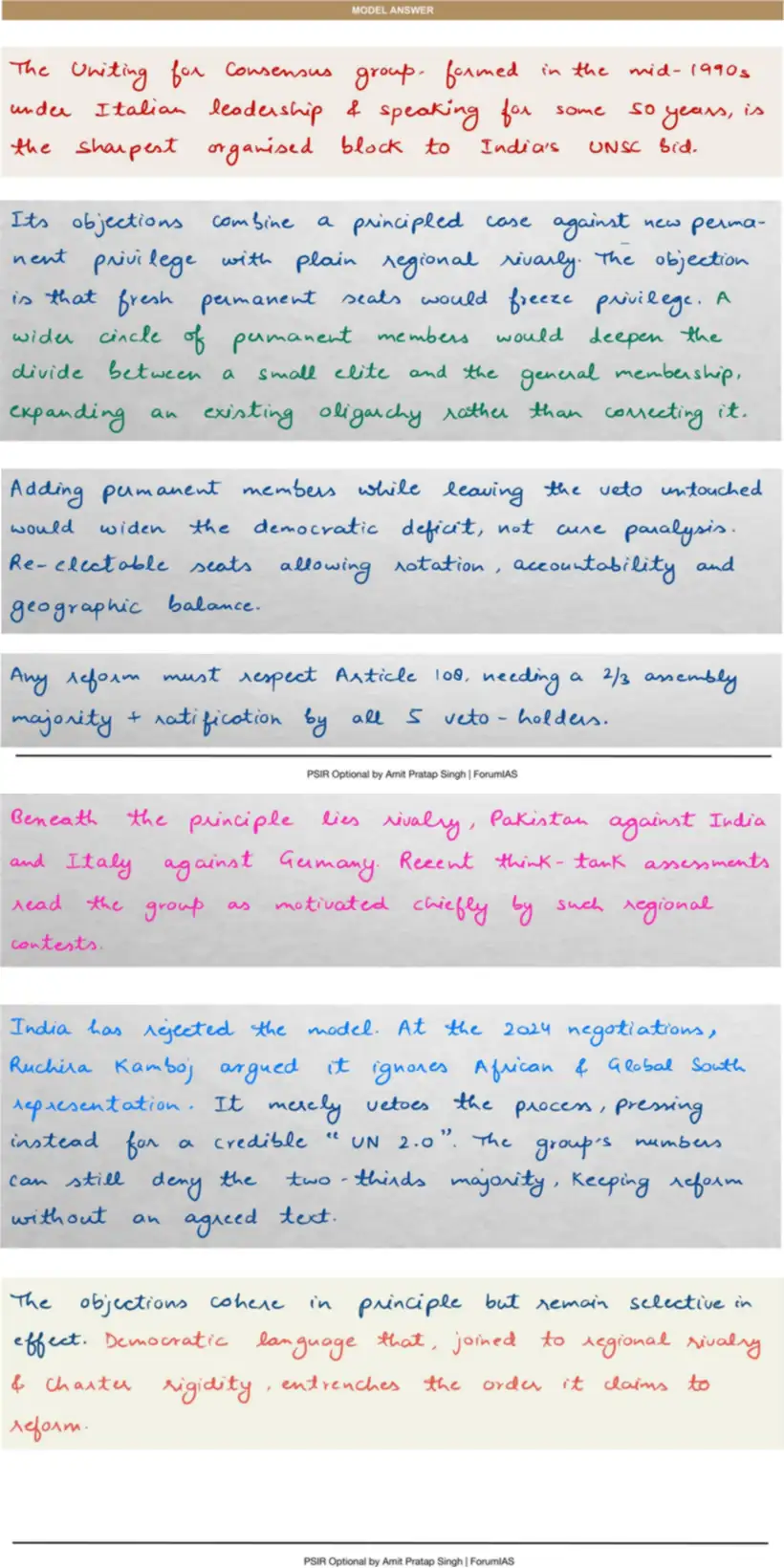
Model answer
Handwritten, in the form it would be written in the examination hall.
Also asked on this head
India and the UN System — 9 questions in the Vault.
- “India must strive to become a semi-permanent member of the UNSC, rather than a permanent member without the right to veto.” Comment. (2024/10 marks)
- Discuss the importance of India’s role in UN
- Explain the factors which justify India’s claim for a permanent seat at the UN security council. (2022/15 marks)
How this is taught
The same flow snapshot, built for every head of the syllabus, with the answer written in class.
The first session of Foundation 2027 is published in full.
Six programmes across three levels.