
“India must strive to become a semi-permanent member of the UNSC, rather than a permanent member without the right to veto.” Comment. (2024/10 marks)
How the answer moves
The flow snapshot — the routes in, the body, the counter-view and the routes out.
Route 1 two diminished statuses on offer → both fall short of the equal-rights permanent seat India demands
Route 2 semi-permanent = Uniting for Consensus route; permanent-without-veto = US / 2005 Annan model → neither meets the real demand: parity
seat’s worth substantive, not symbolic → Uday Bhaskar: refuse a veto-less seat, it entrenches the P5 / two-tier Council → Tellis: veto withheld over India’s independent foreign policy → semi-permanent no escape → it is the UfC device (Pakistan, Italy) to block the bid → pragmatic turn → Desai: veto-restraint norms = “pragmatic way out” + Gharekhan: realism + G4’s fifteen-year moratorium
principle: parity, veto as substantive power vs pragmatism: realism, presence, persistent deadlock
Route 1 keep the principle (equal rights), bend only on timing → semi-permanent = stepping stone, never settlement
Route 2 flexibility on timing, not surrender of category → press the parity claim through the deadlock (Pact for the Future 2024 → 17th postponement 2025)
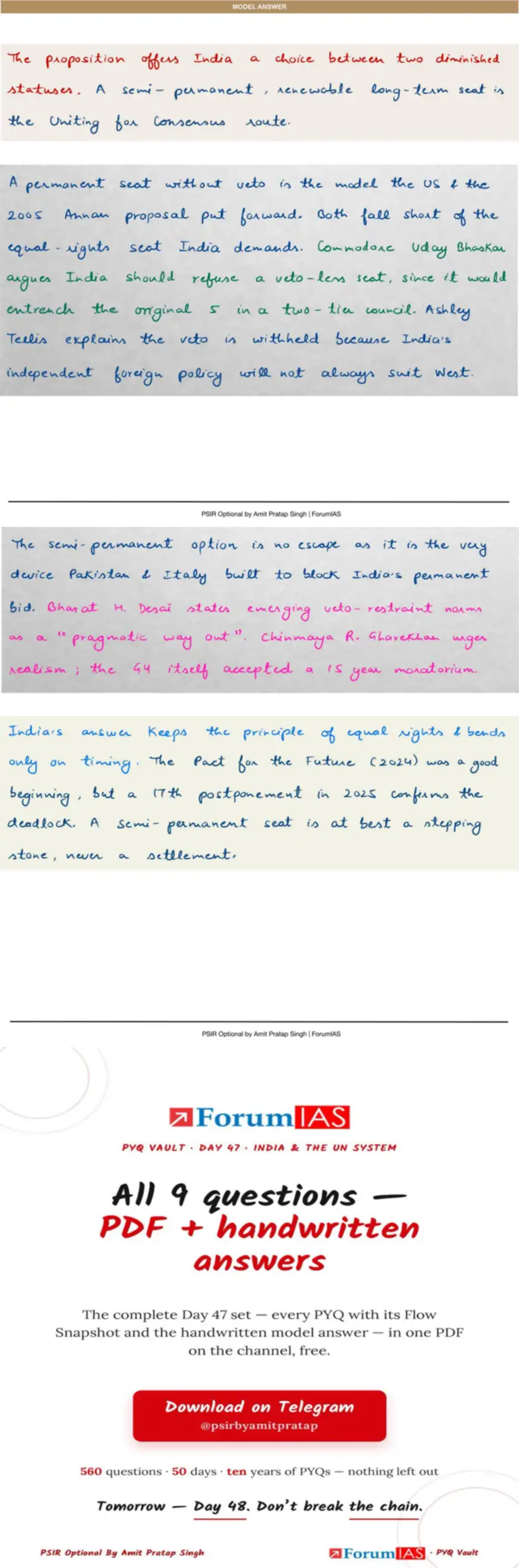
Model answer
Handwritten, in the form it would be written in the examination hall.
Also asked on this head
India and the UN System — 9 questions in the Vault.
- Discuss the importance of India’s role in UN
- Explain the factors which justify India’s claim for a permanent seat at the UN security council. (2022/15 marks)
- Explain the importance of India’s claim for a permanent seat in the United Security Council. (2020/15 marks)
How this is taught
The same flow snapshot, built for every head of the syllabus, with the answer written in class.
The first session of Foundation 2027 is published in full.
Six programmes across three levels.