
Analyze the recent trends in India’s role in the UN peacekeeping operations. (2019/15 marks)
How the answer moves
The flow snapshot — the routes in, the body, the counter-view and the routes out.
Route 1 largest all-time contributor → recent story is quality, not quantity → specialised + tech + gender service
Route 2 “recent trends” = how India contributes has changed → bulk infantry gives way to niche capability, technology, women-led roles
specialisation (engineers, medics, aviation, trainers — Nambiar; high-risk African missions, South Sudan / DR Congo — Kanwal) → technology (UNITE AWARE + UN DPO; Jaishankar “protecting the protectors”; MP-IDSA → technology-contributing country; 2025 Berlin pledges — QRF, counter-IED, K-9) → gender leadership (first all-women FPU Liberia 2007 → 150+ women in Congo / South Sudan / Lebanon / Golan; 2025 Global South women’s conference, Delhi) → normative push (Resolution 2589 — accountability for crimes against peacekeepers)
Gowan & Singh: habit not strategy → goodwill ≠ influence → active-deployment rank now behind Nepal & Bangladesh
Route 1 C. Raja Mohan: beyond troops to training, logistics, mediation, tech → convert specialised service into a decisive voice in mandate-making
Route 2 recent trends mark India as reformer, not just responder → field credibility must become agenda-setting influence
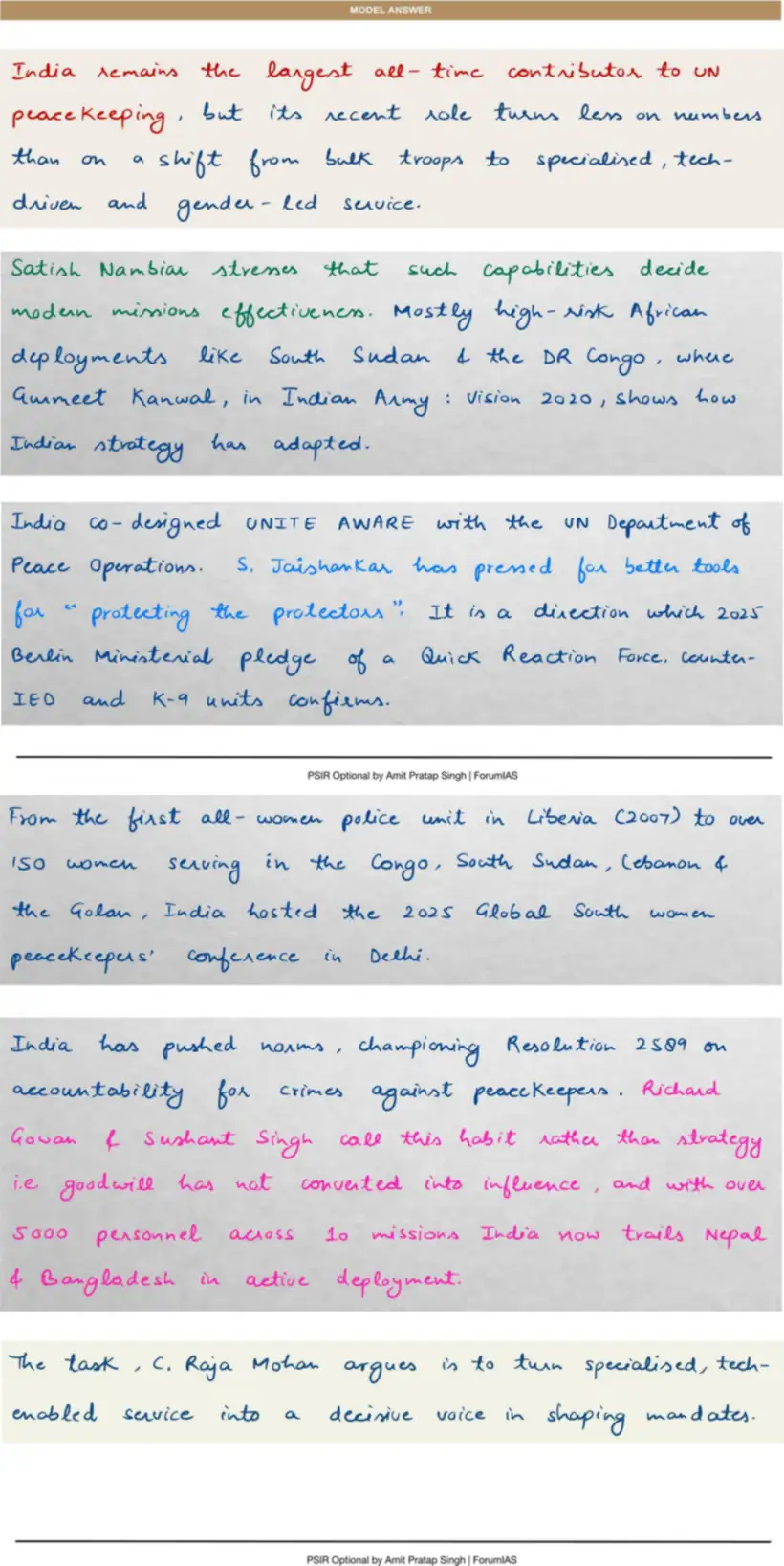
Model answer
Handwritten, in the form it would be written in the examination hall.
Also asked on this head
India and the UN System — 9 questions in the Vault.
- “India must strive to become a semi-permanent member of the UNSC, rather than a permanent member without the right to veto.” Comment. (2024/10 marks)
- Discuss the importance of India’s role in UN
- Explain the factors which justify India’s claim for a permanent seat at the UN security council. (2022/15 marks)
How this is taught
The same flow snapshot, built for every head of the syllabus, with the answer written in class.
The first session of Foundation 2027 is published in full.
Six programmes across three levels.